The Evolution of a Story (See Part I and Part II)
In Part I I discussed Joseph Smith’s reinterpretation of Isaiah 29 and the insertion of this reinterpretation into the prophetic narrative of 2 Nephi 27 and in Part II I identified Smith as the ultimate author and creator of the various transcripts of Book of Mormon Reformed Egyptian. A final element that has powerfully shaped the traditional understanding of the Anthon story is Smith’s official 1838 account itself. According to this narrative, which claims to be a secondhand report from Martin Harris,
“I went to the city of New York, and presented the characters which had been translated, with the translation thereof, to Professor Charles Anthony, a gentleman celebrated for his literary attainments. Professor Anthony stated that the translation was correct, more so than any he had before seen translated from the Egyptian. I then showed him those which were not yet translated, and he said that they were Egyptian, Chaldaic, Assyriac, and Arabic; and he said they were true characters. He gave me a certificate, certifying to the people of Palmyra that they were true characters, and that the translation of such of them as had been translated was also correct. I took the certificate and put it into my pocket, and was just leaving the house, when Mr. Anthony called me back, and asked me how the young man found out that there were gold plates in the place where he found them. I answered that an angel of God had revealed it unto him. He then said to me, ‘Let me see that certificate.’ I accordingly took it out of my pocket and gave it to him, when he took it and tore it to pieces, saying that there was no such thing now as ministering of angels, and that if I would bring the plates to him he would translate them. I informed him that part of the plates were sealed, and that I was forbidden to bring them. He replied, ‘I cannot read a sealed book.’ I left him and went to Dr. Mitchell, who sanctioned what Professor Anthony had said respecting both the characters and the translation.”
The account is short and compact, with very little detail provided about the individuals Harris interviewed or the circumstances of their meetings. The emphasis is rather on how some scholars of eminent worldly status had once affirmed the translation and ancient origin of the characters brought to them by Harris and that one of them had even written a certificate to this effect but at the last second withdrew his support upon hearing the story about the divine origin of the plates. Also, the statement, “I cannot read a sealed book” is clearly an allusion to the fulfillment of Isaiah’s prophecy.
Yet as is well known this report of Harris’s meeting with scholars in New York materially contradicts Anthon’s own version of the events, as found in two letters published in 1834 and 1841. First, according to Anthon, Harris met with Samuel L. Mitchell first, who was the one who directed him to Anthon. Second, Anthon reports that Harris showed him only a sheet containing characters and symbols and specifically states that “no translation had been furnished at the time by the young man with the spectacles”. Lastly and most importantly, Anthon denies having ever affirmed the authenticity of the characters for Harris, whether in a certificate or otherwise, and suggests that the same was the case for Mitchell.
So how do we explain and reconcile the dramatic divergences between these accounts of Harris’ interviews with Anthon and Mitchell? Are one of them lying or substantially misrepresenting the facts? Or are both correct in some respects and simply bending the truth to advance their particular interests? Is Anthon trying to avoid the impression of having been associated with or lent any legitimacy to the Mormonite delusion? Or has Harris or Smith embellished upon Anthon’s first blush assessment of the symbols?
In the following I will attempt to reconstruct a basic outline of what happened during Harris’s interviews with Anthon and Mitchell by examining a variety of sources both earlier and later than the 1838 official history. Through synthesizing the information contained in these sources, I will then argue that while Anthon’s report of the meeting with Harris is not without its issues, the 1838 account is not only factually inaccurate to a greater degree, but the story has been consciously adapted and embellished by Joseph Smith from the historical reality of the event that was known to him, or in other words, that he purposefully misrepresented the facts of the case for his own ends.
1. Harris visited Samuel L. Mitchell first, who referred him to Charles Anthon.
As was already mentioned, the 1838 account implies that after arriving in New York Martin Harris made his way directly to Charles Anthon, who is portrayed as a famous literary scholar and the natural candidate for an inquiry into the subject of ancient languages. Later, Harris reports that he visited with Samuel Mitchell, with no indication that the two meetings were connected or that one had led to the other. Rather, the impression is simply that Harris had visited with two eminent scholars in succession and that the second had independently confirmed the judgement of the first.
However, there are a number of problems with this description of the relationship between the two interviews. First, Anthon specifically states in both his 1834 and 1841 accounts that Harris had visited Mitchell first and then came to him “with a note from Dr. Mitchell of our city, now deceased, requesting me to decypher, if possible, a paper, which the farmer would hand me, and which Dr. M. confessed he had been unable to understand.” In other words, according to Anthon, the two meetings were inextricably linked: Mitchell had more or less been a stopover who because of his inability to interpret the symbols on the transcript had directed Harris to someone else.
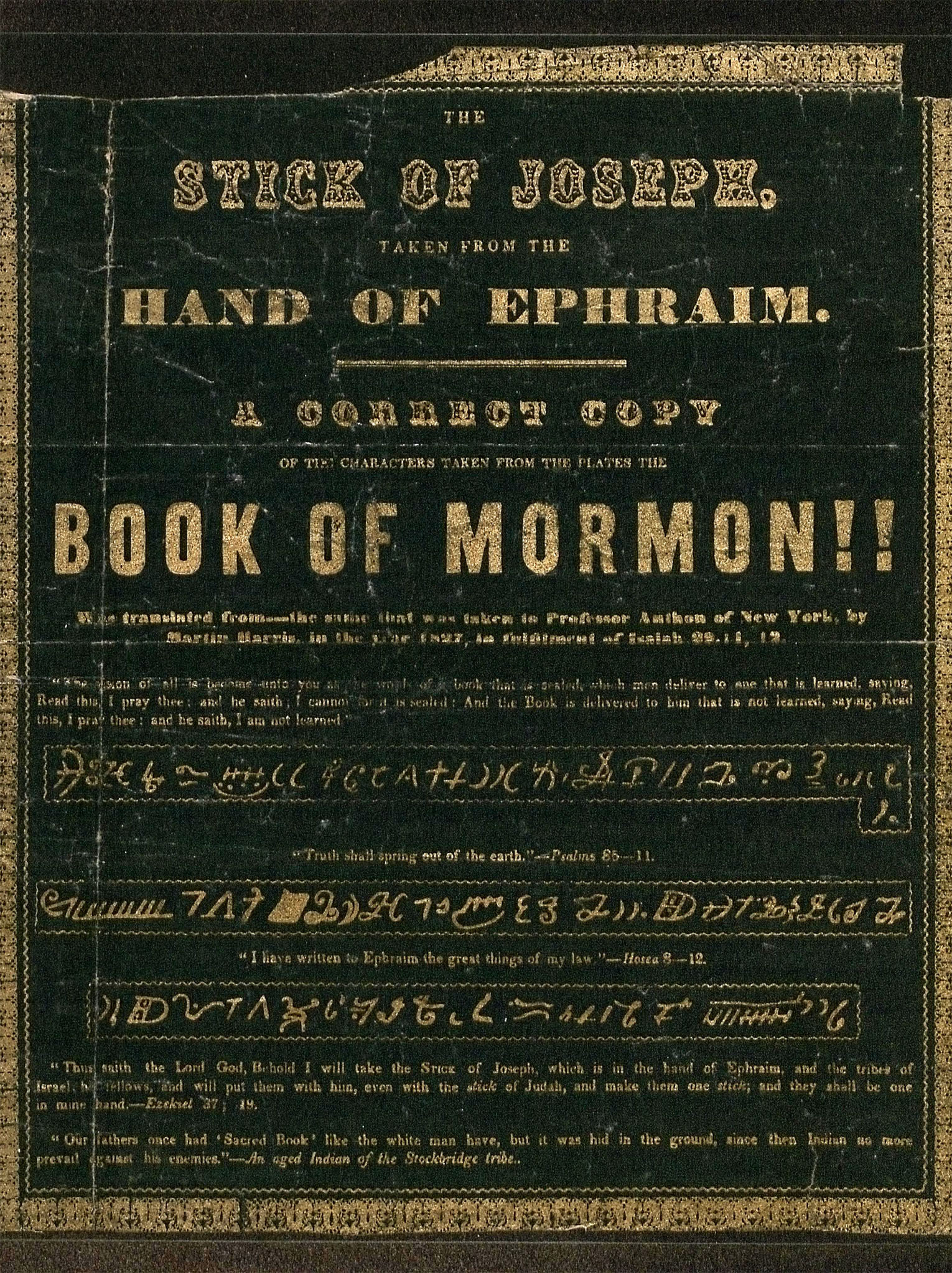
Second, there are several reports by early Mormons that support Anthon’s claim that the meetings were interconnected and that Harris had visited with Mitchell first. In his January 15, 1831 letter to E. D. Howe, W. W. Phelps stated, “”When the plates were said to be found, a copy of one or two lines of the characters, were taken by Mr. Harris to Utica, Albany and New York; at New York, they were shown to Dr. Mitchell, and he referred to professor Anthon who translated and declared them to be ancient shorthand Egyptian” (Mormonism Unvailed, 1834). Phelp’s inclusion of the relatively minor detail that Mitchell had referred Harris to Anthon is highly significant, first, because the letter was written before Anthon’s 1834 account and therefore could only have been based on an independent source of information, and second, the broader context of the letter, which speaks of Harris declaring his testimony of the Book of Mormon, suggests that the source may have been Harris himself. Joseph Knight’s recollection of the event similarly seems to assume that Mitchell was visited first. He mentions the cities that Harris visited in sequence and then names Mitchell before Anthon, “[Harris] went to Albeny and to Philadelpha and to new york and he found men that Could Translate some of the Carictors in all those places. Mitchel [Samuel L, Mitchill] and Anthony [Charles Anthony of New York ware the most Larded [learned]” (Reminiscences, 1833-1847). Another document that possibly reflects knowledge that Harris first met with Mitchell includes the ‘Stick of Joseph’ broadside published in 1844: “The following is a correct copy of the characters taken from the plates which the Book of Mormon was translated from: the same that was taken to Professor Mitchell, and afterwards to Professor Anthon of New York, by Martin Harris in the year 1827 [sic] in fulfillment of Isaiah 29: 11-12.”
Third, a sequence in which Harris first met with Mitchell before Anthon is by far historically more plausible. At the time Samuel L. Mitchell, vice president of Rutgers Medical College, was at the end of a long career and popularly viewed as one of the most knowledgeable experts living on all things scientific, literary, and historical. He was the go-to man on difficult questions and linguistic curiosities and only five years previously had been sent a copy of similarly unknown and ancient looking characters found buried in the foundation of an old house in Detroit for examination. Perhaps not coincidentally the man who found what is now known as the Detroit Manuscript was a business partner of Stephan Mack, the uncle of Joseph Smith, who also lived in Detroit. [1] On the other hand, Charles Anthon was a young instructor of classical languages at Columbia College just at the beginning of his career. According to Richard E. Bennett, “in 1828 [Anthon] was but an ‘adjunct professor’ of Greek and Latin, more an accomplished grammarian than a prestigious scholar. It was not until 1830, two years after Harris’s visit, that he became ‘Head Master’ or rector of Columbia College Grammar School (its students would have been high school age today) and was promoted to professor in the Greek and Latin Languages Department.” [2] While circumstantial evidence suggests he was familiar with Champollion’s efforts to decipher Egyptian hieroglyphics and was as knowledgeable of the language as anyone in America, he was nevertheless an obscure figure compared to Mitchell. Thus considering the respective backgrounds and notoriety of Mitchell, it is likely that Anthon’s understanding of how Harris came to visit him is essentially correct, “As Dr. Mitchell was our ‘Magnus Appollo’ in those days, the man called first upon him.” But after being unable to make sense of the characters, Mitchell then referred Harris to a talented young linguist he knew to be acquainted with the Oriental and Egyptian realm.
Fourth, the prominence of the figure of Anthon in virtually all early and later preserved accounts of Harris’ meeting with scholars in New York and the relative absence of Mitchell from them accords with the general notion that Mitchell had simply made a referral, as per Anthon’s account. Aside from one exceptional second hand report (see below), Anthon is the special focus of these narratives and tends to be the only one who engages in dialogue with Harris about the Book of Mormon characters (W. W. Phelps, Joseph Knight, Henry Harris, Martin Harris via David B. Dille, John A. Clark, Joseph Smith Sr. via Fayette Lapham, David Whitmer). For example, Anthon is clearly the “learned” individual alluded to by Joseph Smith in his 1832 history requesting that Harris bring to him the plates. If Mitchell had pronounced upon the authenticity of the characters as alleged in the 1838 account, then we would expect for this to have left more traces in the available reports about Harris’ meeting with Mitchell and Anthon.
There is one final account that differs from all others in asserting that Harris visited with Anthon first and then Mitchell and that it was Mitchell who had pronounced on the linguistic origin of the characters. James Gordon Bennett, from the Morning Courier and New York Inquirer, wrote a feature story on the Mormons from interviews he had previously conducted in upstate New York. Published in August 1831, the article contains one of the earliest accounts of Harris’ trip to New York to authenticate Book of Mormon characters, based on an interview with Charles Butler, a lawyer-philanthropist from whom Harris had earlier requested money to pay for the printing of the Book of Mormon. According to the information obtained from Butler,
“Harris with several manuscripts in his pocket, went to the city of New York and called upon one of the Professors of Columbia College for the purpose of shewing them to him. Harris says that the Professor thought them very curious, but admitted that he could not decypher them. Said he to Harris, “Mr. Harris you had better go to the celebrated Doct. Mitchell and shew them to him. He is very learned in these ancient languages, and I have no doubt will be able to give you some satisfaction. “Where does he live,” asked Harris. He was told and off he posted with the engravings from the Golden Plates to submit to Doc. Mitchell—Harris says that the Doctor received him very “purlitely,” looked at his engravings—made a learned dissertation on them—compared them with the hieroglyphics discovered by Champollion in Egypt—and set them down as the language of a people formerly in existence in the East, but now no more.”
Because of the early date of the Bennett report and the additional detail it provides about the substance of the interviews with Anthon and Mitchell, the account is of considerable historical interest. Even as a secondhand communication, it is the earliest known recital of Harris’ visit to New York that can be assumed to derive from the mouth of Harris himself. As a consequence, Richard E. Bennett has recently argued for the possibility that it may contain reliable information about the original sequence of the interviews with Anthon and Mitchell and that Mitchell may in fact have had a pivotal role in confirming the Book of Mormon characters and inspiring Harris to mortgage his farm. [3]
Yet on closer analysis the account’s unexpected ordering of the interviews and the highlighting of Mitchell presents no fundamental challenge to the scenario reconstructed from other accounts discussed above and was rather a product of misidentification or confusion on the part of Butler about the individuals that Harris had interviewed. If we ignore the names and other identifying information of the scholars and concentrate solely on their statements and actions, then it becomes obvious that they correspond closely to how Mitchell and Anthon are known to have responded to Harris’ request for them to translate the characters. The first scholar interviewed says that he is a) unable to decipher the characters and as a consequence b) sends Harris to another scholar who he thought would be better equipped to ascertain their meaning. The second scholar then c) has an apparently long discussion with Harris about the engravings and d) compares them to Egyptian hieroglyphics. As has already been mentioned, this sequence of events lines up to what can be reconstructed to have occurred between Harris and Mitchell and Anthon from a variety of sources. According to Anthon and Phelps, Mitchell was a) not able to read the characters and so b) directed Harris to Anthon for a second opinion. On the other hand, the mention of a “long dissertation” is reminiscent of accounts that Anthon had c) spoken at some length with Harris about the characters and d) had compared them to some ancient Oriental scripts: Egyptian (W. W. Phelps); Egyptian, Chaldaic, Assyriac, and Arabic (Martin Harris via Joseph Smith); Egyptian, Chaldaic, and Arabic (Martin Harris via Martin Harris Jr.); Egyptian (David Whitmer); Hebrew, with a mixture of Egyptian (William Smith); and Arabic (Joseph Smith Sr via Fayette Lapham).
Bennett’s account is a secondhand report via Charles Butler, so it is understandable how confusion about the individuals Harris interviewed could have arisen. Butler would have naturally been more familiar with Mitchell and his intellectual and linguistic capacities and thus easily transposed Mitchell for Anthon. Further evidence for some confusion in the account is found in the journal note made by Bennett at the time of the interview as the basis for his later article: “[Harris] showed them to Prof. Anthon who said that he did not know what language they were—told him to carry them to Dr. Mitchill. Dr. Mitchill examined them and compared them with other hieroglyphics— thought them very curious—and [said] they were the characters of a nation now extinct which he named. Harris returned to Anthon who put some questions to him and got angry with Harris.” [4] According to this summary, Harris first visited with Anthon, then Mitchell, and finally returned to Anthon again. But we know from Anthon’s own accounts that he was visited by Harris only once, and then later a second time after the publication of the Book of Mormon. Thus either Butler is telescoping events from the second visit so that they occurred soon after the first, or better he has correctly recalled that Anthon became angry with Harris during the first interview and so had to imagine a second meeting on top of the one where he referred Harris to Mitchell. In any case, it seems dubious that Harris would have visited either Mitchell or Anthon so soon again after the initial interview.
2. Harris did not present any translation to Mitchell or Anthon.
The 1838 account conspicuously highlights the role of a document containing a translation of some of the Book of Mormon characters in its depiction of Harris’ interviews with Mitchell and Anthon. According to this narrative, the first thing that Harris presented to Anthon was “the characters which had been translated, with the translation thereof,” immediately after which Anthon affirmed that “the translation was correct, more so than any he had before seen translated from the Egyptian.” Then Anthon wrote a certificate saying among other things that “the translation of such of [the characters] as had been translated was also correct.” Finally, Harris showed the translation to Mitchell who verified Anthon’s opinion with regard to its accuracy.
But the claim that Harris presented to Anthon and Mitchell a sample of translated Book of Mormon characters in addition to a sample of untranslated characters is problematic and inconsistent with various earlier and later sources. First, as was already mentioned, Anthon specifically states that when Harris came to him he was asked to interpret a single paper with curious symbols but that “no translation had been furnished at the time by the young man with the spectacles.” In other words, according to Anthon, the only document he saw was a transcript of Reformed Egyptian. There was no division of the interview into an analysis of translated and untranslated characters, because such a translation was simply not available. If Anthon had been given a translation for examination, it is difficult to understand why he would have failed to mention it. From reading his letters Anthon appears to have been scrupulous and methodical in describing the content of the transcript delivered to him and its background, so we have little reason to think that such an important detail would have been carelessly omitted or forgotten. This is especially because as a scholar of languages a sample of characters accompanied by their translation would have substantially impacted the way he went about interpreting their origin and meaning.
Second, a number of early reports or accounts left by knowledgeable informants fail to mention anything about a translation and indeed suggest that Harris presented only a copy of plain characters to the scholars he visited and that the primary purpose of the trip was to find out whether they could translate what appeared on the document. For example, Joseph Smith’s 1832 history states,
“the Lord had shown him [Martin Harris] that he must go to New York City with some of the characters so we proceeded to coppy some of them and he took his Journy to the Eastern Cittys and to the Learned read this I pray thee and the learned said I cannot but if he would bring the blates [plates] they would read it but the Lord forbid it and he returned to me and gave them to me to translate and I said I said [ I ] cannot for I am not learned but the Lord had prepared spetticke spectacles for to read the Book therefore I commenced translating the characters and thus the Prop[h]icy of Isiaah was fulfilled which is written in the 29 chapter concerning the book” (1832 History).
Similarly, Lucy Mack Smith,
“he was instructed to take off a facsimile of the alphabet Egyptian charecters <composing the alphabet> <which were called reformed egyptian> Alphabetically and send them to all the learned men that he could find and ask them for the translation of the same… it was agreed that Martin Harris… should take the characters to the East, and on his way, he was to call on all the professed linguists, in order to give them an opportunity to display their talents in giving a translation of the characters” (History, 1844-45).
Joseph Knight Sr. recalled, “He therefore with his wife Drew of[f] the Caricters exactley like the ancient and sent Martin Harris to see if he Could git them Translated” (Reminiscences, 1833-1847).
Within these accounts and others (W. W. Phelps, John A. Clark, James Gordon Bennett; Joseph Smith Sr. via Fayette Lapham), there is little room for the possibility that Smith had already produced a formal translation accompanying some characters and that Harris had brought this translation with him to submit for scholarly analysis and verification. The sense is rather that Smith was at a fairly preliminary stage of interpreting the characters, that he wanted the Book of Mormon translated but he himself had not engaged in full scale translation. At this point he therefore had little interest in having his translational abilities analyzed or confirmed to the world. In addition, sending a translation document on top of the simple characters document implies a rather high degree of confidence in the scholars’ ability to read and translate the characters and is inextricably connected to the 1838 account’s claim that Anthon and Mitchell both affirmed the correctness of the translation, whereas we will see below that there are compelling reasons to doubt that any such validation ever occurred.
3. Neither Mitchell nor Anthon were able to translate the Book of Mormon characters. At the most, Anthon seems to have identified some of the characters as resembling certain ancient Near Eastern languages, including Egyptian.
The most controversial claim made in the 1838 retelling of Harris’ visit with scholars in New York is that both Anthon and Mitchell affirmed the translation and the antiquity of the characters and that Anthon had even written a certificate to this effect. This element is stressed throughout the narrative and can even be seen to be its unifying theme: “Professor Anthony stated that the translation was correct, more so than any he had before seen translated from the Egyptian.” … “he said that they were Egyptian, Chaldaic, Assyriac, and Arabic” … “he said they were true characters” … “He gave me a certificate, certifying to the people of Palmyra that they were true characters, and that the translation of such of them as had been translated was also correct.” … “I took the certificate and put it into my pocket” … “I accordingly took it out of my pocket and gave it to him” … “I left him and went to Dr. Mitchell, who sanctioned what Professor Anthony had said respecting both the characters and the translation.”
The difficulties with these statements about scholars authenticating the Book of Mormon are well known. First, as was mentioned above, Anthon in his accounts claims that neither Mitchell nor he was able to make any sense of the characters. He reports in 1834 that when Harris visited his office he came with a note from Mitchell who had already examined the transcript and “confessed that he had been unable to understand.” He then states, “Upon examining the paper in question, I soon came to the conclusion that it was all a trick, perhaps a hoax.” After describing the shapes and forms of the characters in some detail, he concludes, “I am thus particular as to the contents of the paper… and well remember that the paper contained any thing else but ‘Egyptian Hieroglyphics.’” Second, we have already noted various considerations that support Anthon’s claim that Harris was in fact directed to him through a referral from Mitchell, which tallies with the idea that Mitchell had not himself been able to decipher the characters and so sent Harris to Anthon for another opinion. At the very least, this evidence undermines the claim that Mitchell had ever affirmed the authenticity of the characters or a purported translation per the 1838 account.
Third, as knowledgeable as Mitchell and Anthon were for their time, neither had anywhere near the ability to verify a translation from Egyptian. The Rosetta Stone had only been deciphered by Champollion in 1822 and knowledge of Egyptian in America was still very primitive. We have little evidence that Mitchell in all his scholarly pursuits was even interested in Egyptian hieroglyphs, and while the evidence for Anthon is substantially better, as Richard E. Bennett has explained, “While it is reasonable to conclude that [Anthon] may have been interested in ancient Near Eastern languages, he was by no means a scholar of these languages.” [5] Thus the assertion that Anthon had pronounced the translation of Book of Mormon characters to be correct, “more so than any he had before seen translated from the Egyptian” is dubious on the face. Anthon simply did not have the knowledge or training to make such a judgement. At the most, he could have speculated at an informed level about similarities shared between the characters and other ancient scripts of which he was aware. Because of this technical inability to read Egyptian, the possibility has been suggested that perhaps Anthon “pretended knowledge that [he] did not have” and was simply acting as though he could translate. [6] But this theory seems hardly credible. What interest would Anthon have in putting on airs for a country farmer like Harris, especially to the extent that he would completely lie and act as though he could translate from Egyptian? How would he benefit, considering that the meeting was private and he would likely never meet Harris again? As far as can be known from the historical record, Charles Anthon appears to have been very much a scholar’s scholar, a pure academic who placed a higher value on books and study more than social interaction. As one who was rigorous and strict in his teaching and scholarship, he was not the type to dissemble about the languages he knew for the sake of impressing others.
Fourth, virtually all accounts of the Anthon story that come earlier than the 1838 History and even those that come after emphasize that the scholars interviewed by Harris were unable to translate or decipher the characters:
1) “So blindly enthusiastic was Harris, that he took some of the characters interpreted by Smith, and went in search of some one, besides the interpreter, who was learned enough to English them; but all to whom he applied (among the number was Professor Mitchell, of New York,) happened not to be possessed of sufficient knowledge to give satisfaction!” (Jonathan Hadley, Palmyra Freeman, Aug 11, 1829). Cf. “Facsimiles of these pretended hieroglyphics were shown to some of the most learned in this section of the country, but they proved quite too ignorant to render them into English. Some lines of them were even sent to the late Dr. Mitchell, of New-York, but notwithstanding his profound literary researches, he was equally unsuccessful” (Jonathan Hadley, Wayne County Whig, Sept 14, 1842).
2) “Harris with several manuscripts in his pocket, went to the city of New York, and called upon one of the Professors of Columbia College for the purpose of shewing them to him. Harris says that the Professor thought them very curious, but admitted that he could not decypher them. Said he to Harris, “Mr. Harris you had better go to the celebrated Doct. Mitchell and shew them to him. He is very learned in these ancient languages, and I have no doubt will be able to give you some satisfaction.” “Where does he live,” asked Harris. He was told, and off he posted with the engravings from the Golden Plates to submit to Doc. Mitchell—Harris says that the Doctor received him very “purlitely,” looked at his engravings—made a learned dissertation on them—compared them with the hieroglyphics discovered by Champollion in Egypt—and set them down as the language of a people formerly in existence in the East, but now no more” (James Gordon Bennett, Morning Courier and New York Inquirer, Aug 31, 1831).
3) “… the Lord had shown him [Martin Harris] that he must go to New York City with some of the characters so we proceeded to coppy some of them and he took his Journy to the Eastern Cittys and to the Learned read this I pray thee and the learned said I cannot but if he would bring the blates [plates] they would read it” (Joseph Smith, 1832 History).
4) “After his return [Harris] came to see me again, and told me that, among others, he had consulted Professor Anthon, who thought the characters in which the book was written very remarkable but he could not decide exactly what language they belonged to” (John A. Clark, Gleanings by the Way, 1842).
5) “I took a transcript of the characters of the plates to Dr. Anthon, of New York. When I arrived at the house of Professor Anthon, I found him in his office and alone, and presented the transcript to him, and asked him to read it. He said if I would bring the plates, he would assist in the translation. I told him I could not, for they were sealed. Professor Anthon then gave me a certificate certifying that the characters were Arabic, Chaldaic, and Egyptian. I then left Dr. Anthon and was near the door, when he said, “How did the young man know the plates were there?” I said an angel had shown them to him. Professor Anthon then said, “Let me see the certificate!” – upon which I took it from my waistcoat pocket and unsuspectingly gave it to him. He then tore it up in anger, saying there was no such thing as angels now – it was all a hoax. I then went to Dr. Mitchell with the transcript, and he confirmed what Professor Anthon had said” (Martin Harris, 1853, as reported by David B. Dille, Millennial Star, 1859).
6) “but not until after the most learned men had exhausted their knowledge of letters in the vain effort to decipher the characters…. after, all human means had failed to secure a translation, Smith was commissioned to undertake the task” (Martin Harris, as reported in the Iowa State Register, 1870).
7) “He went by the request of the Prophet Joseph Smith to the city of New York, and presented a transcript of the records of the Book of Mormon to Professor Anthon and Dr. Mitchell and asked them to translate it. He also presented the same transcript to many other learned men at the different schools of learning in Geneva, Ithica, and Albany with the same request but was unsuccessful in obtaining the translation of the transcript from any of them” (Martin Harris, as reported by Martin Harris Jr., 1875).
8) “He therefore with his wife Drew of[f] the Caricters exactley like the ancient and sent Martin Harris to see if he Could git them Translated. He went to Albeny and to Philadelpha and to new york and he found men that Could Translate some of the Carictors in all those places. Mitchel [Samuel L, Mitchill] and Anthony [Charles Anthony of New York ware the most Larded [learned] But there were some Caricters they could not well understand” (Joseph Knight Sr., Reminiscences, 1833-1847).
9) “He examined them; but was unable to decipher them correctly; but he presumed, that if the original records could be brought, he could assist in translating them” (Orson Pratt, An Interesting Account of Several Remarkable Visions and of the Late Discovery of Ancient American Records, 1840).
10) “The professor pronounced the characters to be ancient Hebrew corrupted, and the language to be degenerate Hebrew, with a mixture of Egyptian. He could decypher only one entire word” (William Smith, as reported in the Peoria Register, Sept 3, 1841).
11) “But Joseph was not willing to give up the matter, without further trial; and from Franklin county he went to New York city, where the most learned man then in the city told him that, with few exceptions, the characters were Arabic, but not enough to make any thing out” (Joseph Smith Sr., as reported by Fayette Lapham, Historical Magazine, May 1870).
12) “Smith made facsimilies of some of the plates, and sent them by Martin Harris to Profs. Anson and Mitchell, of New York city, for examination. They pronounced the characters reformed Egyptian, but were unable to read them” (David Whitmer, as reported in Kansas City Journal, June 5, 1881).
The exceptions to this overwhelming trend to understand the importance of Harris’ interviews in terms of the scholars’ inability to read the characters are few and generally admit of other interpretations. For example, in his 1831 account W. W. Phelps claims that Anthon “translated [the characters] and declared them to be ancient shorthand Egyptian.” But this usage of “translate” seems to be rather loose, with the emphasis falling more on the identification of the language of the transcript than that Anthon had actually recovered its underlying structure and meaning. Similarly, at a fairly late period of his life Martin Harris began to insert the language of “translation” from the official 1838 History into his testimonies about the significance of his meeting with Anthon, perhaps in response to some people inquiring for clarification on what Anthon had said with regard to the translation. In 1870 Harris wrote to H. B. Emerson in Ohio about the origin of the Book of Mormon, “Further, the translation that I carried to Professor Anthon was copied from these same plates; also, that the professor did testify to it being a correct translation.” But here again the word “translation” seems to reflect an idiosyncratic usage; the context of the statement suggests that what Harris is referring to by “translation” is actually the transcript of Book of Mormon characters described by Anthon and not a rendering of the characters in English.
The implications of these reports for understanding the development of the “Presentation of the Characters to the Learned” story among first generation Mormons are rather clear. For the earliest Mormons the story was commonly received and understood that when Harris visited with Mitchell and Anthon neither was able to read or effectively translate the characters presented to them. At the most some accounts state that Anthon was able to identify the script of the language or a possible ancient origin (James Gordon Bennett, W. W. Phelps, William Smith, Martin Harris via David B. Dille, Joseph Smith Sr. via Fayette Lapham, David Whitmer), while others are more limited in their claims and indicate that he and Mitchell simply did not understand the characters (Jonathan Hadley, Joseph Smith Jr., Joseph Knight Sr., Orson Pratt) or even what language they represented (John A. Clark).
Taking all this information, we are now in a position to reconstruct a basic outline of what can be assumed to have occurred between Harris and Anthon during their meeting. On the one hand, Anthon is probably correct in his assertion that he never directly authenticated the Reformed Egyptian of the Book of Mormon characters and that at some point during the interview he came to realize that the symbols were fictitious and counterfeit. This assumption is substantiated by the following: 1) The earliest accounts about Harris’ experience agree that Anthon was ultimately unable to make sense of the characters. Although some accounts state that Anthon made a more positive identification of the language represented by the characters (“the language of a people formerly in existence in the East”; “shorthand Egyptian”; Egyptian, Chaldaic, Assyriac, and Arabic; “ancient Hebrew corrupted… with a mixture of Egyptian”; Arabic, Chaldaic, and Egyptian; Arabic), the substantial variation and vagueness characterizing this element across accounts suggests that not too much weight should be put on it. This rather seems to have been a part of the story that grew and changed with time and was capable of significant distortion, depending on the situation and who was doing the telling. A more plausible scenario is that reflected in the John A. Clark account, that according to Harris “[Anthon] could not decide exactly what language they belonged to”. 2) Various accounts support the idea that at some point during the interview Anthon became upset and ill tempered at Harris (James Gordon Bennett, Joseph Knight Sr., Martin Harris via David B. Dille). This detail is most easily explained if we assume that indeed Anthon had eventually come to the conclusion that the transcript was fraudulent and that Harris and by extension himself were being duped. 3) Anthon’s memory of the transcript and interpretation of various elements shows that he had correctly ascertained the derivative and artificial nature of the characters: “Greek and Hebrew letters, crosses and flourishes, Roman letters inverted or placed sideways” (1834); “Greek, Hebrew and all sorts of letters, more or less distorted, either through unskilfulness or from actual design” (1841). As was already argued earlier, distorted alphabetic characters accurately describes the origin of many of the symbols contained in surviving Book of Mormon character transcripts.
On the other hand, Anthon in his recollection does not seem to have been fully honest about how quickly he came to the realization that the Book of Mormon characters were of modern origin. According to Anthon, almost immediately upon “examining the paper in question, I soon came to the conclusion that it was all a trick, perhaps a hoax” (1834); “A very brief examination of the paper convinced me that it was a mere hoax, a very clumsy one too…. The conclusion was irresistible, that some cunning fellow had prepared the paper in question for the purpose of imposing upon the countryman, who brought it, and I told the man so without any hesitation.” (1841). However, we have a number of clues and indications that this portrayal is inaccurate and misleading. First, various reports suggest that after having the document presented to him Anthon initially devoted considerable attention to examining the characters and comparing them to some ancient Near Eastern languages, particularly Egyptian (W. W. Phelps; James Gordon Bennett; John A. Clark; Orson Pratt; William Smith; Martin Harris via David B. Dille; Joseph Smith Sr. via Fayette Lapham; David Whitmer). In his 1841 letter Anthon himself cryptically admits to having compared the characters to “alphabetical characters” of various languages. Whether this investigation of a possible resemblance to ancient Egyptian was stimulated by comments by Harris himself is unclear. In any case, the above reports lend support to the idea that at least at first Anthon did not identify the Book of Mormon transcript as an obvious hoax.
Second, in his 1834 letter Anthon states that after hearing the story about the origin of the transcript and the Book of Mormon he changed his mind about the document, “and, instead of viewing it any longer as a hoax upon the learned, I began to regard it as part of a scheme to cheat the farmer of his money.” This admission points to the likelihood that Anthon’s opinion about the transcript developed over the course of the interview and the reference to it as a “hoax upon the learned” implies that even he was initially taken off guard and had treated the examination of the characters with greater interest and seriousness than he later realized was warranted.
Third, in his 1834 account Anthon denies having written any opinion about the characters for Harris, whereas his 1841 account acknowledges that he had and his explanation for why he did so is effusive with self-legitimation, “I did so without hesitation, partly for the man’s sake, and partly to let the individual ‘behind the curtain’ see that his trick was discovered.” Yet the very fact that Harris requested an opinion from Anthon in writing about the characters’ similarities to other scripts suggests that at least up to that point Anthon had not explicitly identified them as fraudulent and spurious. He may not have been able to make any sense of the characters and was cautiously suspicious of them, but more than anything he was curious. As the John A. Clark account states, “[Anthon] thought the characters in which the book was written very remarkable.” Further confirmation for the idea that Anthon at this stage was merely suspicious and somewhat undecided about the authenticity of the characters is provided by the Joseph Knight account, which uniquely connects the writing of an opinion for Harris with a request to send the original plates of Reformed Egyptian: “But there were some Caricters they could not well understand therefore Anthony told him that he thot if he had the original he culd translate it and he rote a very good piece to Joseph and said if he would send the original he would translate it.” It is difficult if not impossible to know whether any of the elements of this description are based in reality rather than the stories that were subsequently circulated about the interview. But the idea that one of Anthon’s purposes in writing the letter to Joseph Smith was to request for him to send the plates for further examination and study is very plausible and indirectly supported by the appearance of the request motif in the 1838 History. It is also plausible that in the same letter Anthon had described the various scripts to which he had compared the characters and explained that he had been unable to interpret their meaning. This earlier openness to the possibility of trying to interpret the plates would then explain Anthon’s tendency to obfuscate and spin around the existence of the letter and the nature of its content. He did not want to damage his reputation by admitting the degree to which he had taken an interest in attempting to decipher the characters.
Finally, the various accounts about Anthon becoming angry suggest that it was only after hearing more about the origin and discovery of the Book of Mormon, the strictures on who could see the plates, and the monetary purpose for which Smith had sent Harris to verify the characters that it fully dawned on him that the transcript was fraudulent and an artificial creation of its author (James Gordon Bennett, Joseph Knight Sr., Martin Harris via David B. Dille). Anthon was angry because in his mind not only was Harris being used and hoodwinked, but by extension he himself had been initially taken in and pressed to seriously consider what he now recognized to be a fraud.
In sum, according to this reconstruction Anthon never affirmed the authenticity or ancient origin of the characters for Harris, but merely noted some similarities to some other ancient scripts, a point that was probably included in his letter to Joseph Smith as well. This detail was then developed and expanded upon by others in later retellings of the story.
Of course, if this reconstruction is for the most part correct, then it raises the question of why Harris returned to Pennsylvania to throw his support behind the translation and production of the Book of Mormon. If Anthon had not been able to read the characters and forthrightly declared the transcript of Reformed Egyptian to be a fraud, contrary to the 1838 History, then why didn’t this discourage Harris from going forward with the project of translation? For apologists the fact Harris went on to function as a scribe of the Book of Mormon and eventually to mortgage his farm in support of publication has long seemed to represent strong confirmatory evidence that something along the lines of the traditional 1838 interview between Harris and Anthon had occurred and that Harris had been given some sort of scholarly validation of the Book of Mormon.
To answer this question, we will have to reevaluate why Martin Harris went to present Reformed Egyptian characters to learned scholars in the first place. According to the 1832 history, “the Lord appeared unto him in a vision and shewed unto him his marvilous work which he was about to do and he imediately came to Su[s]quehanna and said the Lord had shown him [Martin Harris] that he must go to New York City with some of the characters so we proceeded to coppy some of them and he took his Journy to the Eastern Cittys,” implying that the proximate cause had been a divine revelation and that Harris had come to the idea almost independently from Smith. But the claim that a revelation from God to Harris is what led him to take a transcript to New York for scholarly analysis is problematic. As Johnny Stephenson has noted, Martin Harris himself never mentions any such revelation or makes a connection between the personal spiritual experience he had after first hearing about the golden plates and the decision to go to New York several months later. According to Harris, he had merely been spoken to by “the still small voice” that the project to bring forth the Book of Mormon was God’s work.
Furthermore, we have a number of reports that the primary instigation for Harris taking the trip came from Joseph Smith himself: 1) Lucy Mack Smith spoke to the church in Nauvoo in 1845 and recalled that after Joseph had dug up the plates, he “came to me and told me he had taken those plates out of the ground. Tell all three of them (Harris[es]) that I have got them I want Martin to assist me and take some of the characters off to send them to N.Y.” Another recording of Lucy’s speech similarly recounted that she had been “cal[l]ed upon by Joseph Smith to go & tell Mar=tin Harris & family that he had got the Plates & he wanted him to take an alphabet of the characters & carry them to the learned men to decypher.…” [7].
2) Lucy’s history also implies that the idea had come to Joseph through divine revelation: “he was instructed to take off a facsimile of the alphabet Egyptian charecters <composing the alphabet> <which were called reformed egyptian> Alphabetically and send them to all the learned men that he could find and ask them for the translation of the same” (History, 1844-45).
3) Oliver Cowdery’s rendering of Smith’s initial vision of Moroni indicates that the angel had told him that it would be his privilege to translate the plates and also that “the scripture must be fulfilled before it is translated, which says that the words of a book, which were sealed, were presented to the learned, for thus has God determined to leave men without excuse, and show to the meek that his arm is not shortened that it cannot save” (Messenger and Advocate, 1835). Or in other words, the idea of presenting the characters to the learned had come to Joseph long before he had ever met Harris.
4) Professor Anthon in his 1834 letter claimed that according to Harris “he had been requested [by Smith] to contribute a sum of money towards the publication of the ‘golden book,’ the contents of which would, as he had been assured, produce an entire change in the world and save it from ruin. So urgent had been these solicitations, that he intended selling his farm… As a last precautionary step, however, he had resolved to come to New York.” Later in his 1841 letter he expanded upon this point, “To convince him more clearly that there was no risk whatever in the matter, and that the work was actually what it claimed to be, he was told to take the paper, which purported to be a copy of one of the pages of the book, to the city of New York, and submit it to the learned in that quarter, who would soon dispel all his doubts, and satisfy him as to the perfect safety of the investment.” From the context, it is clear that it was Smith who had encouraged Harris to come to New York with the transcript.
Following Lucy Mack Smith’s statement that after obtaining the plates Joseph was “very solicitous about the work but as yet no means had come into his hands of accomplishing the same,” hints that full scale translation of the Book of Mormon began only after Smith’s relocation to Pennsylvania, and the possibility that the transcript taken by Harris was a kind of alphabet of Reformed Egyptian, several LDS historians have speculated that Smith was initially unable to translate and his intention in sending Harris to learned scholars was to seek out their assistance in interpreting the characters. [8] By having a large sample of characters translated, this would then enable Smith to proceed on his own in creating a formal translation of the Book of Mormon.
But this explanation for why Harris presented Book of Mormon characters to learned scholars is doubtful as well. First of all, Lucy Mack Smith’s statement that “as yet no means had come into his hands of accomplishing the same” should not be taken as evidence that Joseph was unable to translate prior to Harris’ journey to New York. The word “means” in this context does not indicate that he did not yet have the seer-like gift to interpret with the Urim and Thummim. He simply did not have the means, or rather the physical and social circumstances were inadequate to the task (cf. D&C 5:34). Several accounts show that the hounding of Joseph Smith by neighbors and other interested parties in search of the gold plates and the lack of peaceable surroundings had made the situation in Palmyra untenable and contributed to his decision to move to Pennsylvania. He did not have a place to go forward with the translation project undisturbed and neither did he have the necessary financial and material support (Martin Harris via William Pilkington, Joseph Knight Sr., Joseph Smith Sr. via Fayette Lapham).
Second, the story about the miraculous visitation of an angel revealing the golden plates indicates that Joseph Smith claimed from a fairly early date that he was the one destined to translate the Book of Mormon and that the translation would be performed mystically or magically through the Interpreters/Urim and Thummim, not through a formal translation process made possible by scholars from the secular world. According to various reports of the story, an angel had discovered the plates to Joseph and explained that despite not understanding the language of the record it would be his special calling to translate it through the Urim and Thummim when the appropriate time came. In Oliver Cowdery’s 1835 account of the vision of Moroni Joseph was told that it would be his “privilege, if obedient to the commandments of the Lord, to obtain and translate the [Book of Mormon], by the means of the Urim and Thummim, which were deposited for that purpose with the record.” Similarly, in the 1838 account Smith said he was was told by the angel that the Urim and Thummim were deposited with the plates and that “God had prepared them for the purpose of translating the plates.” Thus if the narrative that Joseph Smith promoted after obtaining the plates was that God had chosen him to translate the record through supernatural means, it hardly makes sense for him to suddenly think that he would now attempt a formal or secular word for word translation.
Third, while it is true that full scale translation can generally be correlated with the period after Harris’ return from New York, we have a number of indications that Smith had successfully employed the Urim and Thummim and interpreted some of the content of the plates prior to the meeting with Mitchell and Anthon: 1) According to John A. Clark, Martin Harris met with him in the Fall of 1827 and claimed that by means of the Spectacles Joseph was already able to read the Golden Bible and understand its meaning. 2) Joseph Knight reports that during the middle of the Winter after the move to Pennsylvania, Emma and Reuben at first served as scribes to Joseph. This would possibly have been before Harris came down from Palmyra in February. 3) Charles Anthon’s 1841 account states that Harris had told him that the spectacles had already been used by Joseph to translate before their meeting: “My informant assured me that this curious property of the spectacles had been actually tested, and found to be true. A young man, it seems, had been placed in the garret of a farm-house, with a curtain before him, and having fastened the spectacles to his head, had read several pages in the golden book, and communicated their contents in writing to certain persons stationed on the outside of the curtain.”
Fourth, several accounts imply that the main purpose in having Harris make the trip to New York was to strengthen his conviction that the plates were authentic and that the story Joseph had been telling about their origin was true, not to seek a scholarly tool by which to facilitate a systematic translation of the plates. According to Anthon’s 1834 account, Harris had told him that “he had been requested to contribute a sum of money towards the publication of the ‘golden book’…. So urgent had been these solicitations, that he intended selling his farm and handing over the amount received to those who wished to publish the plates. As a last precautionary step, however, he had resolved to come to New York, and obtain the opinion of the learned about the meaning of the paper which he brought with him, and which had been given him as a part of the contents of the book.” This rationale for the meeting is substantiated by Lucy Mack Smith’s history, which situates the decision for Harris to take the transcript to the learned in the context of efforts by Joseph to convince Martin and his wife Lucy of the truthfulness of his claims.
Finally, we have already seen earlier that a linguistic analysis of available Book of Mormon character transcripts suggests that the characters were an artificial creation of Joseph Smith, so it would hardly make sense for him to seek out scholarly assistance in translating them, or for that matter, to send Harris to verify their authenticity. As their creator, Smith would have already known that they were untranslatable and inauthentic.
So why would Smith send Harris to have the characters examined by scholars, since this would possibly lead him to find out that the Reformed Egyptian was counterfeit and expose Smith to charges of fraud, thus defeating the purpose for which Harris had been sent? A plausible explanation is that Smith sent Harris to scholars to see if they could translate as an ingenious authenticating experiment that he believed would result in his vindication. Because Smith knew that the characters corresponded with no existing language and were in fact unreadable–since he had altered an existing set of symbols at his disposal to such an extent that they were something sui generis and mixed in other symbols of his own creation–he was very confident that no one Harris met would be able to translate the transcript. In the event that this occurred and scholars failed to interpret or translate, this would then lend credence to his story that the characters were an ancient unknown tongue that could only be interpreted through his divinely bestowed facility. It would also confirm that he was the one intended to fulfill the prophecy of Isaiah 29 about the book being given first to the learned and then to the unlearned.
This hypothesis is supported by several considerations:
First, a major thematic element of the rhetoric surrounding the production of the Book of Mormon is a kind of anti-intellectual insistence that the scholars of the day were unable to translate the plates; this was a work that only Joseph Smith was chosen for: 1) The Wayne Sentinel described the Book of Mormon in 1829 as “an ancient record, of a religious and divine nature and origin, written in ancient characters, impossible to be interpreted by any to whom the special gift has not been imparted by inspiration.” 2) Henry Harris of Manchester recalled an earlier conversation he had with Smith, “I then asked him what letters were engraved on them, he said italic letters written in an unknown language, and that- he had copied some of the words and sent them to Dr. Mitchell and Professor Anthon of New York. By looking on the plates he said he could not understand the words, but it was made known to him that he was the person that must translate them, and on looking through the stone was enabled to translate.” 3) Oliver Cowdery’s 1835 history reports that the angel had told Smith that it would be his privilege to interpret the plates, but that “they cannot be interpreted by the learning of this generation.” 4) Lucy Mack Smith satirically recounted how Harris was to take the Egyptian alphabet “to the east and through the country in every direction to all who were professed linguists to give them an opertunity of showing their talents.” 5) Joseph Knight said that after Harris returned from meeting with Mitchell and Anthon Joseph Smith had power to translate, “Then ware the Larned men Confounded, for he, By the means he found with the plates, he Could translate those Caricters Better than the Larned.”
Second, Martin Harris seems to have found confirmation for the authenticity of the plates merely in the fact that the learned were unable to translate the characters. 1) The Rochester Gem reported in 1829, “Harris states that he went in search of some one to interpret the hieroglyphics, but found that no one was intended to perform that all important task but Smith himself,” implying that the fact that no one was able to interpret was meaningful in itself. 2) John A. Clark said that after examining some Book of Mormon characters presented to him by Harris and being unable make any sense of them, “My ignorance of the characters in which this pretended ancient record was written, was to Martin Harris new proof that Smith’s whole account of the divine revelation made to him was to be entirely relied upon.” Then after Harris returned from his meeting with Anthon, who had been unable to read the transcript, he informed Clark that he “had now become a perfect believer. He said he had no more doubt of Smith’s commission, than of the divine commission of the apostles. The very fact that Smith was an obscure and illiterate man, showed that he must be acting under divine impulses” (Gleanings by the Way, 1842) 3) Pomeroy Tucker wrote that even though the scholars Harris visited had realized that the Reformed Egyptian characters were a hoax, “Harris, nevertheless, stood firm in his position, regarding these untoward results merely as ‘proving the lack of wisdom’ on the part of the rejecters, and also as illustrating the truth of his favorite quotation, that ‘God hath chosen the foolish things of the world to confound the wise’” (Origin, Rise, and Progress of Mormonism, 1867). 4) John Gilbert, printer of the Book of Mormon, remembered that “Martin returned from his trip satisfied that ‘Joseph’ was a ‘little smarter than Professor Anthon’” (Memorandum, 1892).
Finally, allusions and references to Isaiah 29 have a prominent role in virtually all of Joseph Smith’s early visionary narratives and revelations. A substantial amount of Isaiah 29:11-14 is featured in Smith’s 1832 History, Cowdery’s 1835 history, and Smith’s 1838 History: “they draw near to me with their lips while their hearts are far from me…. marvilous work…. read this I pray thee and the learned said I cannot … and I said I said cannot for I am not learned” (1832 History); “Therefore, says the Lord, I will proceed to do a marvelous work among this people, even a marvelous work and a wonder; the wisdom, of their wise shall perish, and the understanding of their prudent shall be hid…. while those who draw near to God with their mouths, and honor him with their lips…. ‘Yet,’ said he, ‘the scripture must be fulfilled before it is translated, which says that the words of a book, which were sealed, were presented to the learned…. a part of the book was sealed’” (1835 history); “‘they draw near to me with their lips, but their hearts are far from me, they teach for doctrines the commandments of men’…. that God had a work for me to do… seers… part of the plates were sealed… He replied, ‘I cannot read a sealed book.’” (1838 History). In addition, the language of a “marvelous work” as a reference to the end time dispensation is a major theme of the Book of Mormon and Smith’s early revelations (1 Nephi 14:7; 22:8; 2 Nephi 25:17; 27:26; 29:1; 3 Nephi 21:9; 28:31-32; Mormon 9:34; Ether 3:22-24; D&C 4:1; 6:1; 11:1; 12:1; 14:1 etc).
From this we can conclude that Isaiah 29 had a decisive early influence in shaping Joseph Smith’s conception of himself and his prophetic work and in providing the scriptural roadmap for a new dispensation of Christian-Israelite renewal centered around the Book of Mormon. [9] The passage spoke about a special book coming forth from the dust (v. 4), the importance of prophets and seers (v. 10), a book that is sealed (v. 11), the role of the unlearned in receiving the book (v. 12), people drawing near to God with their lips but not with their hearts (v. 13), a marvelous work and a wonder and the wisdom of wise men perishing (v. 14), people rejoicing in the Lord (v. 19), and the house of Jacob coming to fear the God of Israel and learning correct doctrine (v. 24). Perhaps when Joseph first read and interpreted the passage, the reference to a “sealed book” was understood not literally as in “fastened by seals,” but rather an “indecipherable,” “hidden,” or “unreadable” book. [10]
Because Oliver Cowdery’s 1835 account claims that the angel told Smith that “the scripture must be fulfilled before it is translated, which says that the words of a book, which were sealed, were presented to the learned,” and this is in fact what we know to have occurred, Joseph Smith’s first undertaking in preparing for the translation project was to send Harris to the learned to see if they could translate the characters, it seems likely that the event was planned by Smith and that he knowingly attempted to fulfill the prophecy of Isaiah 29 so as to place himself in the position of the unlearned who received the book in contrast to the learned. Smith knew that the learned would not be able to read the sample of Reformed Egyptian characters, and because he would then demonstrate that he could read the plates through supernatural power this would allow him to identify himself to others as the person foretold in the familiar Old Testament prophetic narrative.
Returning to Joseph Smith’s 1838 official account, we are now finally in a position to consider its accuracy and origin as a historical document. As our analysis of a variety of early and later sources has shown, there are a number of problems with this version of the story about Harris’ presentation of the characters to the learned in New York.
1) It incorrectly places the meeting with Anthon before the meeting with Mitchell. As was discussed earlier, the order of the meetings was likely the reverse.
2) It incorrectly identifies Anthon as Anthony and describes him as a “gentleman celebrated for his literary attainments.” At this point Anthon was somewhat of a lesser known figure and had not yet truly distinguished himself as a scholar and teacher.
3) It incorrectly claims that Harris presented a translation of Reformed Egyptian to the scholars he met. Based on the earliest accounts and the purpose for which Harris went to visit these scholars, we have strong reason to doubt that this was the case.
4) It incorrectly states that Anthon affirmed the translation and unambiguously identified the characters with other ancient languages. Anthon did not affirm any translation or unequivocally identify the origin of the characters. At the most, he pointed to some similarities with some other ancient scripts.
5) It incorrectly claims that Anthon gave Harris a certificate asserting the same things. More likely, Anthon wrote a letter containing an opinion of the transcript along the lines as those above, asserting that he had not been able to make any sense of the characters, but that he would be willing to examine the original if it could be sent to him.
6) It incorrectly implies that Anthon’s rejection of the transcript was based merely on his non-belief in the miraculous. Rather, Anthon ultimately came to the conclusion that the transcript was an artificial creation based on a variety of factors, including his analysis of the characters themselves and Harris’ explanation for why he was involved in the affair.
7) It incorrectly asserts that Anthon promised if the plates were brought to him that he would translate them. Harris probably promised only that he would give them further study.
8) It is also unlikely that Anthon and Harris had any discussion about the sealed part of the plates or that Anthon said, “I cannot read a sealed book.” This is patently a quotation of Isaiah, and according to Joseph Knight’s account, the crux of the argument was over Anthon not being allowed to read the original plates, not about whether he could read the sealed portion of the Book of Mormon.
9) It incorrectly claims that Mitchell confirmed Anthon’s assessment. In fact, Mitchell did nothing of the sort. He was unable to make any sense of the characters and so referred Harris to Anthon at Columbia College.
The 1838 account is thus on the whole an unreliable representation of the circumstances and substance of Harris’ meetings with Mitchell and Anthon. The story has been developed and distorted considerably from what can be assumed to have been the historical reality and stands out from virtually all earlier and later accounts in claiming that both Anthon and Mitchell affirmed the translation and antiquity of the Book of Mormon characters.
So the question naturally arises, to whom should the formulation and development of this distinct and idiosyncratic version of the story be attributed? In his introduction to the narrative, Joseph Smith claims that he is borrowing from Martin Harris’ own account of what happened, “as he related [it] to me after his return,” and places the whole in quotation marks, thus giving the story the appearance of a firsthand report. As a result, the tendency of many LDS historians has been to treat the narrative as a faithful representation of Martin Harris’ views, whether from an oral or written source.
But it seems highly unlikely that Harris as the one who personally visited with Mitchell and Anthon would have been responsible for so many inaccuracies and distortions. First, in all of the reports stemming from Harris, he consistently spells Professor Anthon’s name correctly (W. W. Phelps, John A. Clark, Martin Harris via David B. Dille, Martin Harris via Martin Harris Jr.). The spelling Anthony seems to have originated from someone other than Harris and was fairly commonly employed by Mormons in the late 1830’s. [11] Second, a number of early accounts show that Harris knew and clearly communicated to others the correct sequence of the meetings with Mitchell and Anthon (W. W. Phelps, James Gordon Bennett, John A. Clark). It seems implausible that Harris would introduce such a glaring error on his own. Third, Harris consistently claims in his later reports that Mitchell and Anthon were unable to translate (Martin Harris via David B. Dille; Martin Harris, as reported in the Iowa State Register; Martin Harris via Martin Harris Jr.). They did not verify any English translation, but merely that the characters had some ancient analogues (W. W. Phelps, James Gordon Bennett, Martin Harris via David B. Dille). In fact, the account reported by David B. Dille includes the significant detail that Anthon declared “it was all a hoax.”
On the other hand, standing nestled in the broader context of a carefully constructed and narratively unified account about the origin of the Latter-day Saint church, the report about Harris’ experience authenticating the Book of Mormon makes sense as having been freely composed by Smith. First, at the time the 1838 account was written Harris had already separated himself from the saints who followed Smith and was living in Ohio. Therefore, not only did Smith have no direct access to Harris, but Harris was not available to correct or offer an alternative view on various aspects of Smith’s rendering of the events. Second, the strong emphasis placed on secular scholars affirming the translation from Egyptian and the ancient Near Eastern origin of the characters, though dramatically different from what we can assume to have actually occurred at Harris’ interviews with Mitchell and Anthon, reflects the changed circumstances of Smith’s prophetic calling and experience as a translator. When Harris first took a transcript of Book of Mormon characters to New York in 1828, Smith was at the very beginning of his career as a translator of ancient records and narratives; his gift to recover lost and mysterious languages was only starting to take shape. But by the time of 1838 Smith had already moved from the Book of Mormon to the New Translation of the Bible and then to Egyptian papyri and the Book of Abraham. His role as a translator had become cemented and now was crucial to his prophetic persona and public identity. He had spent a considerable amount of time studying Hebrew and interpreting Egyptian hieroglyphs and so wanted to be portrayed as more than a local visionary seer who could magically translate, but as someone whose translational abilities were technically precise and as good or better than what the secular world could provide.
Finally, the allusion to the fulfillment of the prophecy of Isaiah marks the narrative as reflecting the literary and ideological interests of Joseph Smith. As was discussed earlier, Isaiah 29:11-12 was prominently featured in Smith’s earlier revelatory narratives about the coming forth of the Book of Mormon and was in fact the prophetic template that originally guided him in sending Harris to New York in the first place. But whereas in these earlier narratives the Isaiah passage was recognized as fulfilled merely because the learned were unable to interpret or read the characters, as Dan Vogel has observed, the new emphasis in the 1838 account on scholars affirming Smith’s translation abilities “necessitated a change in the interpretation of Isaiah. According to the 1832 version, Harris took the characters to Anthon ‘saying read this I pray thee and the learned said I cannot but if he would bring the plates they would read it but the Lord forbid it.’ In this instance, Isaiah 29:11 was fulfilled because the learned could not read the words of the book. In the 1838 version, Anthon reads the characters and verifies Smith’s gift of translation. This shifting account of the interview drifted from the original interpretation of Isaiah so that the passage was no longer fulfilled. Therefore, the 1838 account placed the words from Isaiah ‘I cannot read a sealed book’ into Anthon’s mouth.” [12] In other words, Smith inserted discussion about the sealed plates into the dialogue so that the words of Isaiah could still be fulfilled. Now what the learned was not able to read was merely the sealed portion rather than the Book of Mormon as a whole.
Accepting the likelihood that Joseph Smith rather than Martin Harris was the original author of the 1838 account of Harris’ visit with scholars in New York, we can thus conclude that in constructing the narrative he has consciously adapted and embellished the story as it was known to him. While it is possible that some of the factual inaccuracies, such as the misspelling of the name Anthon and the placement of the meeting with Mitchell after Anthon, may have arisen accidentally through mistakes of memory or even through reliance on faulty sources, such as the James Gordon Bennett article, others could only have occurred intentionally and with knowledge. Based on 2 Nephi 27, Smith’s 1832 account, and the Oliver Cowdery 1835 account, it is clear that Smith knew that Anthon and Mitchell had originally been unable to read or interpret the characters given to them by Harris. This inability was in fact crucial to Smith’s assertion that the event fulfilled the prophecy of Isaiah 29. He would have also known that Harris took no translation with him to present to the learned for verification. So the strong emphasis that Smith placed in the narrative on secular scholars affirming his translational abilities and unequivocally identifying the characters as ancient and of Near Eastern origin can only be described as willfully deceptive, even if done for the sake of elaborating upon a religiously driven narrative of himself as an exceptional translator of ancient languages.
[1] For one particular investigation of the connection between the Detroit Manuscript, Samuel Mitchell, and the Smith family, see Richard Stout, “A Singular Discovery: The Curious Manuscript, Mitchell, and Mormonism,” The Evangel 2001-2.
[2] Richard E. Bennett, “’Read This I Pray Thee’: Martin Harris and the Three Wise Men of the East,” JMH 36 (2010): 190.
[3] Richard E. Bennett, “’Read This I Pray Thee’: Martin Harris and the Three Wise Men of the East,” JMH 36 (2010): 178-216.
[4] Leonard Arrington, “James Gordon Bennett’s 1831 Report on ‘the Mormonites,’ BYU Studies 10 (1970): 355.
[5] Richard E. Bennett, “’Read This I Pray Thee’: Martin Harris and the Three Wise Men of the East,” JMH 36 (2010): 191.
[6] Stanley Kimball, “The Anthon Transcript: People, Primary Sources, and Problems,” BYU Studies 10 (1970): 325-352.
[7] Dan Vogel, Early Mormon Documents (Signature Books: 1996), 1:223, as discussed in Johnny Stephenson’s post, “The ‘Caractors’ from the Gold Plates.”
[8] David Sloan, “The Anthon Transcripts and the Translation of the Book of Mormon: Studying It Out in the Mind of Joseph Smith,” Journal of Book of Mormon Studies (1996): 57-81.
[9] Compare Emily M. Austin’s recollection that around 1827-1828 Smith “declared an angel had appeared to him and told him of golden plates, which were hidden up to come forth on a certain day; and also that the plates were sacred, containing a history of a people who inhabited this continent in ancient days; also it was that which Isaiah the prophet had spoken of; a vision which should become as the words of a book that is sealed; which was delivered to one that was learned, saying “Read this, I pray thee;” and he said, “I cannot, for it is sealed;” and the book is delivered to one that is unlearned, saying: “Read this, I pray thee;” and he said, “I cannot, for I am unlearned; moreover, inasmuch as this people draw near me, with their mouths and with their lips do honor me, therefore I will proceed to do a marvelous work and a wonder; for the wisdom of their wise men shall perish, and the understanding of their prudent men shall be hid.” This is what was circulated throughout the country, and this is the rumor which was now afloat. Smith brought up many prophecies to show that the Lord was about to do a marvelous work in the last days. He also affirmed that he had seen the angel, and had talked with him face to face; and the angel told him at a certain time he would conduct him to the place where the plates could be obtained; also that he was a chosen vessel in the hands of God, to translate them and bring them to the world” (Mormonism; or Live Among the Mormons, 1882)
[10] Robert Hullinger, Joseph Smith’s Response to Skepticism (Signature Books, 1992), 82
[11] Compare Johnny Stephenson, “The ‘Caractors’ Go to new York.”
[12] Dan Vogel, Joseph Smith: The Making of a Prophet (Signature Books, 2004), 115-116.