KUTV 2News in Utah is featuring an interesting story tonight (Thursday) at 10pm. It seems that most of the stories we hear on this issue are built around people who left the church over same-sex issues. I haven’t seen too many stories featuring somebody who has chosen to remain with the church. (Ty Mansfield comes to mind.) Here’s the teaser for the report:
“Misty” is a woman in her mid 30’s. She married (in the temple) with kids, and is active in her ward. The story is her personal story of what it’s like to be a believing member of the LDS church and struggle with same-sex attraction.
There are thousand of members of the church like “Misty.” LDS family services estimates there a 4-5 members in each ward that are dealing with same-gender issues. They say most of those are married, with children.
An empty section is set up for the first Revelations and Translations volume as well.
Those of you who already own the Journals volume might be interested to check out the “Documents” section. It appears to have the yet-to-be-published contents covering 1825-1831 and 1832-1833. Whether this indicates that these items will not be subsequently published in a physical book remains to be seen, but the FAQ section on the website says “It is expected that approximately twenty printed volumes will be published.” This seems a slight downgrade from the original projection of thirty some-odd volumes. This doesn’t indicate to me that the release of JS’s papers themselves is being scaled back, but rather that the medium upon which the papers are released is still in flux. (I still prefer a good and heavy book!)
Each document on the site includes an Historical Introduction, Source Note, image of the original document, and transcript of its contents. A “detailed view” option allows the viewer to zoom right in for a closer look, although I still couldn’t smell the richness of paper, ink, dust, or mold. Nevertheless, keep those papers coming, thanks!
I’ve been ramping up for next year’s SS focus on the New Testament by reading John P. Meier’s A Marginal Jew series. [Note: I am not a SS instructor, I’m reading it for myself.] The series contains so much info there’s no way I’m going to remember everything he covers, but I believe it will be easier to remember the general thrust of his argument (the over-riding themes, methods he uses to evaluate the information according to the goal he explicitly set at the outset, etc.).
In an offhanded footnote Meier reminds readers that “examining our presuppositions makes us more modest in our claims.”1 As a reader I can certainly identify with his statement. Watching the author discuss his own presuppositions and examine those of other writers on the topics he is addressing really brings home how contested any single historical “fact” can be. Meier’s extensive footnotes highlight the messiness of history. As a Mormon I can certainly identify with this statement. Understanding some of the tendencies we have to Mormonize the scriptures helps keep me a little more modest in my claims.
Above all, thinking about Meier’s approach has helped me self-clarify how my “gut instinct” reaction to arguments (in books, online, in person, etc.) operates below the surface. I’m more likely to feel comfortable about assertions if they have some of these characteristics. Otherwise, I might start reaching for the BS flag: Continue reading “Gut instinct ways to evaluate arguments at first glance”
Recent discussions about the influence a vague entity called “Correlation” has on various Bloggernaclers got me thinking about the problem of responsibility in research. I admit I’m personally less likely to blog about certain sensitive LDS issues. For example, there are elements of temple ritual I feel comfortable writing about and other elements I don’t. I personally don’t feel like my reticence is due to being trapped in the Panopticon. I admit I’m less likely to be flippant or brash about topics that may be particularly challenging to the faith of other Latter-day Saints, and beyond that, to the general faith of other believers as well (except for the new atheists. I wouldn’t mind trying to burst bubbles there; perhaps I should be more careful). The question I am confronting is the responsibility I have to the effects of the research I create, participate in, or disseminate.
I’d like to hear reactions to an assertion made back in 1929 by sociologist George Lundberg:
“It is not the business of a chemist who invents a high explosive to be influenced in his[!] task by considerations as to whether his product will be used to blow up cathedrals or to build tunnels through the mountains” (quoted in John Durham Peters, “The Part Played by Gentiles in the Flow of Mass Communications: On the Ethnic Utopia of Personal Influence,” ANNALS of the American Academy of Political and Social Science, November 2006, 100).
I disagree with Lundberg’s vision of a social scientist’s business. What if we extend the scope from social scientists to historians, theologians, philosophers, political scientists, etc.? Should these people allow considerations of effects to influence what they write or the way they write it? What undergirds the attitude that “truth will always win out”? Are there potential downsides to the desire to “let the chips fall where they may”? Of course, the question is not always whether a particular sticky subject is handled, it can also involve how it is handled. But is it our business to even consider such things when researching and writing?
When the recent “and I’m a Mormon” ad campaign got some national media attention it reminded me of a phenomenal promotional campaign the Church produced in the mid-eighties. 1985 was a fantastic year in the music world. At the top of the charts Wham!’s “Careless Whisper” beat out Phil Collins’s confusingly awesome “Sussudio” and a-ha’s “Take On Me” (best music video ever). The Church PR folks must have realized that radical synthesized music was where it was at; “Axel F” was getting regular rotation on radio stations across the United States (and possibly Canada).
Enter “Bounce Back!” The twenty-minute cassette is a “collection of thoughts, ideas and music” to help people “deal with disappointment, overcome problems and bounce back from the hard times.” It’s pretty snappy and hip, and possibly on the verge of re-emerging as a premiere missionary tool. Over the next few weeks I’ll be posting each of the ten “Ideas” from the tape to put a little bounce back in the Bloggernacle.
Here’s the Intro:
And to show how well the tape fits into the musical milieu outlined above, I’m skipping ahead to Idea #4, “Give of Yourself.” Yes, my mom did use this track in her aerobics class:
I am 99% certain the music was written by Michael McLean. I am positive that at least the track for Idea 10 was. The rest of the tracks are on the way. Enjoy!
More shameless self-promotion to distract from other more heated Bloggernacle happenings! My wife and I don’t have children yet, but we do have a daughter-dog. Her name is Chicken Delicious and we love her to death. She’s a mutt, her litter was rescued from a shelter at the last minute. Of course, we want her to be a part of our family forever, as this baby picture of her suggests:
Chicken and I co-edited her papers just in time to present them to my wife for our anniversary. The bound volume includes color photographs of Chicken’s life and times. Page one starts off with an excerpt from Chicken’s first journal entry:
“I am Chicken Delicious and this is a minute account of all things that have come under my observations.”
Because it is difficult for dogs to write, Chicken’s papers are mostly photographs taken by other people of Chicken and her family. The journal does not include all known photographs of Chicken, however. Nevertheless, the editor (me) was quite conscientious in his selection, this is not a white-washed volume by any stretch. Photo’s include some embarrassing moments, including the time when Chicken ripped open her favorite toy which we called “Tube-y,” a long green canvas dog with a squeaker in it. Other embarrassing moments include Chicken’s first bath and an unflattering picture of her sneezing. These moments do not detract from the overall positive account of Chicken’s life so far.
The Chicken Delicious Papers, Journal, Vol. 1: 2007-2010 is a meticulously edited, and meticulously cute volume, a limited edition print run of (1) copy.
BHodges's mother (left) and BHodges's wife (right) enjoy reading on the couch with Chicken Delicious
Last night was the 2010 Leonard J. Arrington Mormon History Lecture. Appropriately enough, the subject of the lecture was Leonard J. Arrington. Among the 30,000 journal pages, Arrington took the time to record the frustrations of bachelorhood cooking.
“My Stouffer’s cooking instructions say ‘place chicken pouch on non-metallic plate and puncture top three or four times with a fork to vent.’ Well, is it three or is it four? If I puncture it three times, what might happen? What if I puncture it four? Would it get too much air on four? Would it explode if it was only three? Why don’t they say what they mean? Then it says ‘heat three to four minutes.’ Ok, should it be three, or should it be four? Will it be undercooked at three or overcooked at four? Or does it depend on the altitude? And why I’m at 4,000 feet should it be cooked three or four minutes? I simply cannot stand this indefiniteness. It’s driving me crazy making these decisions when I’m so ignorant and inexperienced.”
In this image, Chris H. lords it over all the bloggers at FPR
I used to throw around the label “anti-Mormon” like it was going out of style (speaking of style, will this “style” colloquialism ever go out of style? Good grief, BHodges, the 7th grade called and it wants its simile back. [This analysis of my rhetorical style could start getting out of hand really fast. Notice my strange use of the third person? There are about three people left in the world who can get away with such bravado. Karl Malone, Macho Man Randy Savage, and Elmo]).
Anyway, I’ve found that the term “anti-Mormon” sets off alarm bells amongst folks I’m otherwise trying to converse with. I like to avoid allowing the cows to get out through the holes I leave in the rhetorical fence, so I’ve cut down on its usage in order to keep conversations corralled. I’ve seen people accused of invoking “anti-Mormon” like a voodoo chant to ward off critical thinking. I’ve also seen certain anti-Mormons claim the term isn’t fair because, after all, it’s Mormonism they’re against, not Mormons. So for many reasons the term can stop, rather than facilitate discussion.
A while back I was impressed with a blog post containing useful “types” of anti-Mormonism. I think the types are great for helping people recognize that perhaps things aren’t so black-and-white in terms of being pro or anti, but keeping the anti-Mormon label as part of the descriptor is still going to raise objections. Also, the term risks being watered down. Do I want to roll around McCarthy-esque with a label maker and a cigar, slapdashing my way through internet debates? Maybe next week. For now, not really.
I personally try to use the label carefully by restricting its referents to the counter-cult fulltime exposers of the evils of Mormonism (think Ed Decker). The sort of irrational polemic folk who are more interested in winning a battle than reaching an understanding. So time spent, quality of argument, motive for engagement, are some of the most important factors for me. Anti-Mormonism is something that is enacted more than espoused from this view.
But I just can’t shake the idea that yes, Virginia, there really are anti-Mormons out there. “Anti,” against, “Mormon,” the religion, the doctrine, etc. I don’t object to being called “anti-torture” or “anti-Linkin Park,” I wear the labels with a certain pride. But that’s just me. So how to deal with the fact that I really do believe in anti-Mormons? I explain it when I use it, and I use it for a specific end: not to end debate but to identify the type of debate I am experiencing at the time with the hope of shaming, er, convincing, the other person to consider changing their strategy, or at least to help them understand why I can’t take them seriously from an intellectual standpoint. I hope I don’t use it as an “insult,” but sometimes hopes are just hopes.
I’ll tell you how I use it right now and you can tell me how you use it (or why you object to it. Of course, we’ll know you’re anti-Mormon if you raise questions about what I am about to say, so play at your own risk).
I personally try to use the label carefully by restricting its referents to the counter-culting fulltime exposers of the evils of Mormonism (think Ed Decker). The sort of irrational polemic folk who are more interested in winning a battle or a soul than reaching an understanding with me. I can expect double-standards, irrationality, quote-mining, and a strange smell (if we’re talking in person). Ok, not the smell. (Not every time, anyway.)
So for me I take into account the amount of time spent, the quality of argument, and the motive for engagement. In short: Anti-Mormonism for me is something that is enacted more than beliefs which are espoused.
I’ve been invited to participate in a panel at the upcoming “Mormon Media Studies” conference at BYU. The panel will discuss the Bloggernacle, and so I’ll be badmouthing all of you soon (but most especially, Chris H.). As for my small part, I’m going to talk about some of the benefits and drawbacks of blogging about religion. Here are some preliminary thoughts, feedback is requested.
With apostolic urging following the initial surge, Mormon blogs have been multiplying and replenishing the web for about a decade now, and with the help of some monopolizing aggregatora and group blogs, a relatively tight-knit community has been established where many people recognize others by screen name. The new venues provide a place for more marginal voices on the “conservative” and “liberal” ends of the spectrum (such labels are an oversimplification). The gut interpretation of all this is that the Internet is bringing more Mormons together and creating a tight community spanning several continents. But, there’s always a but. Continue reading “Mormon media studies and the Bloggernacle”

 KUTV 2News in Utah is featuring an interesting story tonight (Thursday) at 10pm. It seems that most of the stories we hear on this issue are built around people who left the church over same-sex issues. I haven’t seen too many stories featuring somebody who has chosen to remain with the church. (Ty Mansfield comes to mind.) Here’s the teaser for the report:
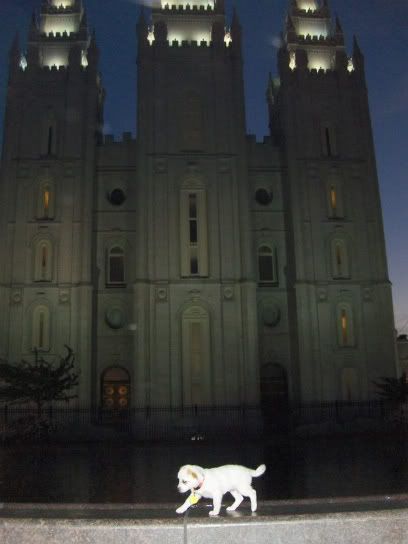
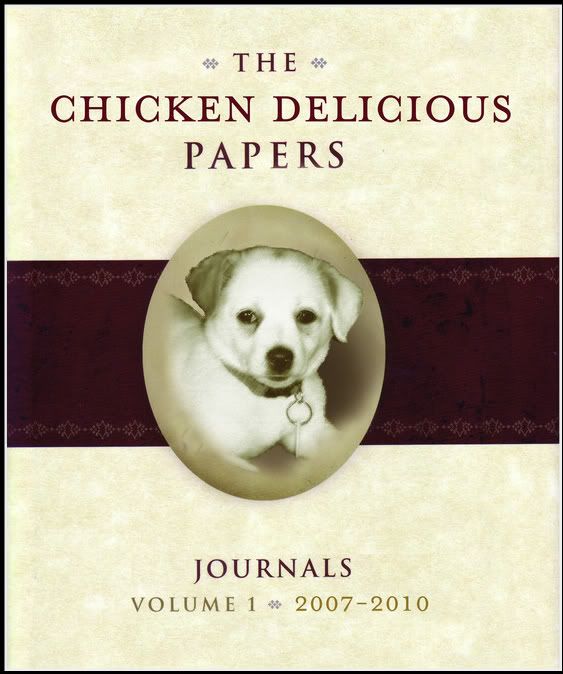 Chicken and I co-edited her papers just in time to present them to my wife for our anniversary. The bound volume includes color photographs of Chicken’s life and times. Page one starts off with an excerpt from Chicken’s first journal entry:

 I’ve been invited to participate in a panel at the upcoming “