“My Husband is a Socialist”

Here is another post that does not fit in with the normal FPR post:

I am taking an independent reading on political economy with a member of the economics department at the institution where I am working on a doctorate in political science. The readings focus on theories of capitalism and socialism with a particular focus on socialist critiques of capitalism. While I am very much on the socialist side of the capitalist-socialist divide, I officially label myself as a liberal because of my joint commitment to individual liberty and economic justice. Yet, my belief that a redistribution of wealth is vital to ensuring liberty to all makes me in many ways fit within what many might call socialism.

I often refer to myself as a socialist when talking politics with my wife. I also refer to myself as a socialist around others both for shock value and to emphasize that I really am on the left and not just another “Democrat” (though I am one of those too).

I mention all this because a few years back my wife and I went to stake center for the stake portion of our temple recommend interviews. I was interviewed by a counselor in the stake presidency and my wife met at the same time with the stake president. The stake president is an active conservative Republican in Utah and a former speaker of the House of Representatives in the Utah State Legislature. He knew that I was Democrat and that I was in graduate school at the Univ. of Utah studying political science. He often stopped to exchange political small-talk when we ran into each other.

As we walked to the car, I asked how her interview went (we both passed). She said that politics had come up while discussing my schooling and then she said “I told him you are a socialist, just like my dad.” I was a bit stunned. While she was more or less right, about both her dad and I, neither of us would have presented it that way to the stake president (my father-in-law was a bishop in the stake at the time). This left me with an appreciation of my wife’s candor. I feel ashamed that my reaction to my wife’s comment was one of embarrassment and not pride.

The Canadian political philosopher Wil Kymlicka, states in his textbook on contemporary political philosophy, that most Marxists and Socialist today are in many ways more liberal egalitarians than they are Marxists. I tend to agree with him. Yet I feel that the socialist voice is an important one. Is it a label that I should try to revive and wear with pride? I will let you know what I discover over the next semester.

How Much Money is Sufficient For Your Needs?


I am interested in the various ways that money gets moralized in Mormonism. While certain aspects of Mormonism moralize money in such a way as to symbolize God’s favor, other sets of Mormons value frugality and even poverty as more moral. Added to this complex dynamic are various scriptures in the Book of Mormon as well as the temple. I wonder what most people consider “sufficient” for their needs. How much is too much?

One of the problems with money is that no one really thinks they have enough, no matter how much they have. There is always something out there that they can’t afford, like a bigger boat, a faster plane, or ritzier vacation. We can all agree that these people who worry about such things have more than they “need,” but where is that threshold? Is it the same in Ft. Lauderdale as it is in Spanish Fork?

Should the question of sufficiency be determined by annual income or by net worth? If it is annual income, how does one determine the morality of that? Should the Mormon CEO who earns a lot more simply only accept a certain amount? Or, is it simply the net worth at which one can retire without needing to work again (approx $1 million for every 10 years of life)?

A Note on Priestly Status for MLK Day

One of the most powerful scenes in Revelation is the moment when the Lamb takes the scroll from the right hand of the one who sits on the throne. His achievement is celebrated by heaven’s citizens like this:

When he took it, the four living creatures and the twenty-four elders fell down before the Lamb. Each of the elders held a harp and gold bowls filled with incense, which are the prayers of the holy ones. 9 They sang a new hymn: “Worthy are you to receive the scroll and to break open its seals, for you were slain and with your blood you purchased for God those from every tribe and tongue, people and nation. 10 You made them a kingdom and priests for our God, and they will reign on earth.”

Have a a second look at the criteria for priestly status. In Revelation’s world, that status comes as a result of the sacrifice of the Lamb. Note especially the absence of any mention of race and gender.

And have nice MLK Day!

The Mormon Tour Industry


While looking on www.deseretbook.com this morning for something, I noticed a link to Time Out Tours. I have also noticed that Meridian Magazine has its own tour business. I am sure that there are many others out there (I’d be interested in collecting these links, so if anyone knows of one, please put it in the comments). These tours are interesting to me because they deal with not only educational tours to Book of Mormon lands, Israel/Palestine, and Church History sites, but also trips to Orlando, Cancun, cruises in the Mediterranean, etc. I am interested in the value that these tours offer to their customers, as well as the values that they express.

One of the curious aspects of the educational tours is the way that they are marketed. The tour guides’ qualifications to lead tours to Israel or Gautemala are usually that they are a BYU Religion profressor or have written some humorous or devotional LDS book. Their education, relevant experience, and publications on the subject matter are never mentioned, presumably because they have none of these things. Their qualifications are that they have held prestigious church callings, are nice people, and enjoy the subject matter. Some of these tours center around a cult of personality, like the Proctors, who advertise trips as an occasion to hang out and learn from them. I am quite sure that there is not a lack of competent LDS who work, research, and publish on matters of church history, archeology, history, etc who are perfectly qualified to run such trips. Why don’t they? What is the attraction of popularizers of LDS folklore as tour guides? Is there not a market for experts (or at least competent guides) for Latter-day Saints?

While the other trips to places like Orlando don’t require guides with any training or expertise, I am curious about the reasons that people would want to go to Orlando with a bunch of strangers who happen to be Latter-day Saints. I suppose that I understand the impulse to be around people that share your values and that you don’t have to explain yourself or your beliefs to (you are on vacation, after all). At the same time, I am concerned that people try to bring LDS insulation with them wherever they go. Rather than have to interact with the actual location around them, including people, these tours encourage members to protect themselves within a bubble, to never have to leave home, even when you leave home.

The Sin Against the Spirit in Mark 3

This bit of light writing was composed in response to an email from a friend. I have left it with that content and format except for a postscript added this afternoon. The question posed was the relationship between blasphemy against the Spirit and all that other business about demons and Beelzebul in Mark 3.

How amazing that your question should concern the binding of the strong man passage! That is precisely the passage we are going to cover in GD this week. Last week we did attitudes of a disciple and attitude of Jesus toward disciples. This week we’ll look at attitudes of anti-disciples and the attitude of Jesus toward anti-disciples.

(Anti-disciples should be distinguished from not-disciples. In Mark, the crowd is something of a group character with its own “personality” and theology. They are the not-disciples; people who are listening, thinking, and in some cases reacting but are neither disciples nor hostile.)

Continue reading “The Sin Against the Spirit in Mark 3”

The Loneliness of the Post-Feminist


JohnR has an excellent and touching entry at FMH on the lack of male feminists in the church. While I am not convinced that not claiming the label “feminist” means that one supports wife-abuse, date rape, eating disorders, or sex trafficking (I thought that Mormons opposed all of those things regardless of whether or not they were feminists…), nor do I think that the Vagina Monologues ritual is really all that great for anybody, I am sympathetic to the sentiment of the post. However, the lack of “male” feminists is not symptomatic of a lack of interest in justice, but a product of the very divisive politics of second-wave feminism.

Second-wave feminism located its ideology in a kind of gender essentialism, where men were men and women were women. Women were uniquely valuable as women. The comments in JohnR’s post are filled with these views. Don’t get me wrong…this kind of strategic essentialism was incredibly powerful politically and perhaps will remain so for a long time. No doubt there is still a lot to do in the second-wave agenda. However, French Feminism managed to be just as successful as American feminism without appeals to essentialized gender, so I am not convinced that essentialism is necessary for a political agenda.

The problem with essentialism is that it is not descriptive of any reality, but a construct that produces certain kinds of gender binaries. The critiques of this essentialism have become increasingly vocal. Voices from different races, the Third World, lesbians, trans, and intersexed persons noted more and more that “feminism” was not made for them. It had a preconceived notion of who was a “woman” that excluded many others. I suspect that the lack of many male voices in the feminist movement is because of the gender essentialism which excludes their experiences a priori. Third wave, post-feminism, queer theory, and other movements fractured traditional feminism and it is in many ways still trying to find a central voice again.

As it relates to Mormon theology, second-wave feminism posed a number of important challenges to institutional Mormonism. However, it is interesting to note that on the theoretical level of gender essentialism, Mormonism and second-wave feminism are actually quite compatible. The issue simply becomes one of working out what makes up the essential female identity. Many Mormons today are able to inhabit both worlds quite comfortably now. This reconciliation is made possible, I think, because of a shared ideological backbone. Sadly, both still exclude the voices of lesbian, Third World, other races, and others.

If ever Latter-day Saints start paying attention to the challenges of third-wave feminism, it will have to grapple theologically with the central tenant of essentialized gender. The ramifications of such an examination are yet to be seen. Since Mormonism survived second-wave feminism with relatively minor bruising, perhaps it can survive third-wave feminism unscathed as well. However, at least in the academy, second-wave feminism was dealt a powerful blow. If traditional feminism couldn’t survive, can traditional Mormonism? For now, we will just have to stay tuned…

Update: JohnR has added a much appreciated post on the varieties of feminism.

The Adulterous Woman, Part 3: Textual Criticism and Narrative Theory

For those who are joining our programming in medias res, this series is looking at the story of the Adulterous Woman in the Fourth Gospel from a narrative-critical standpoint. The first installment dealt with the theory of narrator reliability and the second with various narrative techniques. This one has to do with the challenges inherent in a narrative-critical approach to a story of uncertain authenticity.

The Text-Critical Situation

The story of the Adulterous Woman is now found in Jn 7:53-8:11. But was it always there? Probably not. The traditional exegetical approach divides the pertinent data between the categories of external and internal evidence.

If bizarre manuscript references are not your thing, you can accept my conclusion, that the story of the Adulterous Woman was not originally part of the Fourth Gospel, and move on down to the paragraph heading “Narrative Coherence.”

Continue reading “The Adulterous Woman, Part 3: Textual Criticism and Narrative Theory”

Pilgrimage Sites: Palmyra, NY


By now, pretty much everyone recognizes that church has begun to build up its sacred historical sites by dedicating temples, new visitor centers, and redesigning the experience visitors have. This has produced and encouraged increased pilgrimage by faithful members of the church who travel to these sites for special religious experiences. An industry has built up around these pilgrimage sites including hotels, bookstores, and replica relics. For an “aniconic” culture, we certainly have gone 180 degrees. Is the movement to materiality simply an inevitable development in the history of any particular religious movement? Is this particular development religiously neutral, an act of true piety, or a substitute for true spirituality?

While it is often assumed that Mormonism was aniconic (represented in its rejection of the cross), eschewing material spirituality because of its American Protestant background, the use of the Temple produces a certain tension in this theory. In the temple, a more sacred space is created. I think that it is the temple that has provided the impulse to sacralize Mormon historical sites. The birthplace of Joseph Smith, the Hill Cumorah, Kirtland, Independence, Nauvoo, Carthage, etc. all represent something of the sacred to Mormons. They are sacred history and sacred spaces. One can receive more firm answers to prayers in the temple, but also in these locations. Like invisible magnetic fields, they are places where the veil is thin, where this world and that world meet. As such, they will function in the same way as medieval pilgrimage sites.
Will the pilgrimage sites begin to be specialized in particular ways? Will those seeking healing travel to the banks of the Mississippi near Nauvoo? Will those seeking advice about marriage travel to where Joseph and Emma were married? Will the Susquehanna river become a sacred place to be baptized?

The kitsch-industry that has developed around these sites and experiences focalizes the theological question in important ways. This is still in its infant stages, but can we imagine street vendors selling statues of Joseph Smith and the Christus, vials of dirt from the Hill Cumorah or Sacred Grove, bullet necklaces in Carthage, mosquito medallions from Nauvoo, etc? How will these objects contribute to Mormon spirituality? How will they shape the Mormon home or the Mormon body?

The questions of describing the effect of these present and future practices of course leads to reflection on their religious value. Currently, my experience with many LDS that see Catholic, Orthodox, and some Jewish and Islamic material religiosity is that they see it as strange, even a symptom of false religion. I wonder if as these practices develop in Mormonism, what the response will be as the leaders and people are more self-reflective on our own material religion.

Believing Blood: Mormonism as a New Race


Mormons adopted the language of race and ethnicity to describe themselves from the very early days of the church. This post examines the rhetoric of race in Mormonism and compares it with that of early Christianity. It is inspired by Denise Buell’s amazing book, Why This New Race?, which looks at “ethnic reasoning” in early Christianity. In Mormonism, I see a similar dynamic, though different in some key respects, in the process of describing and creating a new people.

Up to this day, many people still see Christianity as a universalistic religion and Judaism as a particularistic religion. Christianity’s success is credited with its ability to apply to all peoples. Judaism “failed” because it was ethnically exclusivistic. What Buell did was to look at the rhetoric of race and ethnicity in early Christianity. The early Christians saw themselves as a new “race,” in the same category as Romans, Greeks, and Jews, only their citizenship was in heaven. As a claim to a “universal” race, it engaged in the same sorts of “particularistic” exclusionary practices as any other ethnicity. Her critique is that this new universal is simply another particular and that the claims to universalism always involve exclusion.

While this critique is certainly important for the study of early Christianity, in many ways it applies to Latter-day Saints( though we are more comfortable with being labeled “exclusionary”). However, Buell’s argument also tells us a lot more about Mormonism. Mormons claim lineage (literal, adoptive, symbolic, blah, blah, blah) with Israel which establishes them as a distinctive people. In some versions of this, the blood of the baptized member is said to change. In other cases, the blood of the investigator is activated and the ancient kinship bonds are rekindled when the spirit is felt, so that only those literal descendants are gathered again to the family. This diffuse blood was always seen as multi-racial biologically, but all members of the church belonged to the true family of Israel.

The rhetoric of racial unity in Mormonism has died down in recent decades, perhaps as the result of the power scientific discourses of race which may problematize Mormon theories of kinship (there is a lively critique of the biological view of race as well). The result, however, is that biological views of race become the discourse of race in the church, which means that the exclusionary language of that discourse can divide the membership. Yet, our own past exclusionary practice of denying those of African descent membership in the people of Israel reminds us that our rhetoric of universalism rings hollow. Nevertheless, as we have moved away from being a race, to being simply a religion like most others should cause us to reflect on this event. Is one model more effective than another? Should we continue to be a race of Mormons, or should we be just a religion?

Mormon Symbols


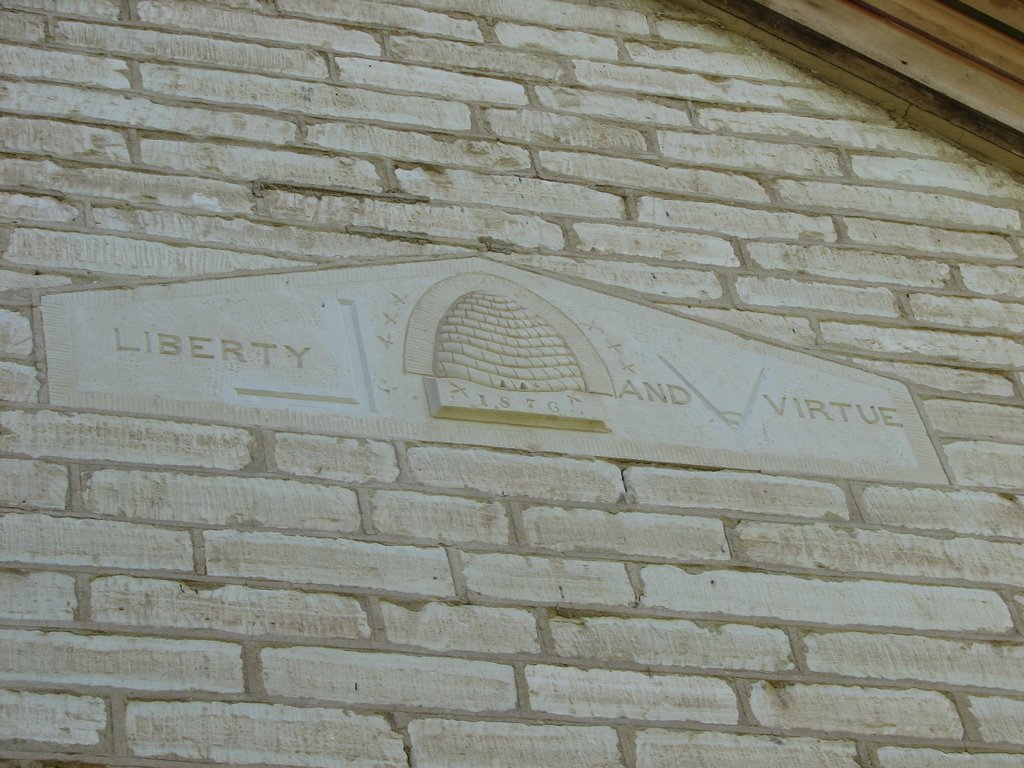
Last month I posted on symbols here. Since then there have been a number of excellent posts on this topic (feel free to add links to your old posts in the comments). One of the questions that I was dealing with is how symbols become symbols and how they acquire meaning. There were some really great comments that you should check out. In this post, I want to deal with the translation of Mormon symbols through time and across space. This image is of the 19th century Endowment House in Spring City, Ut. The building is now an artist studio, but it was the place where endowments and plural marriages were performed. For many Latter-day Saints, these symbols are clearly recognizable, but somehow different. They are displayed above the front door of this building.

What does this image tell us about public display, translation, and multiple meanings? We have a few options:
1) Do these symbols have a different meaning today than they had then? Have we spiritualized away real concrete values that our 19th century rituals upheld? Are our experiences and interpretations of symbols always historically situated and here we get a glimpse of how they were interpreted differently?
2) Or, do these symbols have an exoteric meaning for outsiders and an esoteric meaning for the initiated? Is this public display of these symbols meant as disinformation?
3) Or, are these symbols truly multivalent? Are we free to interpret them in a variety of internally consistent ways?

The larger question, and the one which follows up on my previous post, is how did the interpretation that we have today, of both the private display and oath-bound sacral secretiveness about these symbols come to be? How does any one interpretation of a symbol become the dominant one? Or, is this images’ interpretation of these symbols still valid today? If not, why not?