Nahom and Lehi’s Journey through Arabia: A Historical Perspective, Part 1


The issue of Nahom as evidence of the BoM’s antiquity has recently been a topic of heightened discussion and debate online, inspired by Philip Jenkin’s blog post Nahom Follies, which argues that the presence of the place name Nahom in the story about Lehi’s journey through Arabia is of doubtful historical significance and cannot be used to validate assumptions about the BoM’s historicity. His strong dismissal has not surprisingly engendered various counter responses from LDS apologists, including here and here and here. Among the criticisms made against Jenkins, the chief one is that his rejection of Nahom fails to engage with the extensive research published in LDS venues and so reflects bias against the claims of the BoM.

Now, I personally agree with Jenkins that Nahom should not be regarded as compelling evidence for the antiquity of the BoM. I touched on this issue only briefly in a previous post on the authenticity of BoM names in 1 Nephi, where I noted some broader contextual considerations that militate against taking the reference to Nahom as genuine. But my approach to evaluating the significance of Nahom differs with Jenkins in some respects and I think he may have been unnecessarily derisive and off the cuff in his argument, leading some to take him less seriously than they would otherwise or to focus on certain peripheral matters while failing to see the forest.

Because my thoughts on Nahom have developed substantially since I last wrote, I thought I would take the opportunity to explain in more detail why I don’t find the apologetic argument on the subject of Nahom to be convincing from a critical-historical perspective. Hopefully, what I say will be found to be beneficial and illuminating for people on both sides of the BoM historicity spectrum.


Nahom=Nihm?

As is well known, over the last two decades the reference to the place name Nahom in 1 Ne 16:34 has come to be considered in apologetic circles as perhaps the single most significant piece of information supporting the veracity of the BoM narrative, because of the relatively recent discovery of inscribed altars and inscriptions containing a tribal name with the root NHM at a place and time in ancient south Arabia near to when Lehi would have allegedly been traveling in the area. In 2002 Terryl Givens wrote encouragingly, “Found in the very area where Nephi’s record locates Nahom, these altars may thus be said to constitute the first actual archaeological evidence for the historicity of the Book of Mormon.”[1] During a video interview produced in 2005 about Lehi’s journey through Arabia, Daniel Peterson spoke more forcefully, “The finding of Nahom strikes me as a tremendously significant discovery. What it really is, is a prediction by the Book of Mormon of something that we ought to find; and to find it in the right location at the right time is a real striking bulls eye for the book. There are those who say the book has no archeological substantiation. That’s a spectacular substantiation right there, it seems to me. Something that would have been unexpected, that it’s so unlikely that Joseph Smith could have woven into his story on his own. It’s a direct bulls eye, as precise as you could wish it to be.”[2] In 2007 Brant Gardner concluded, “the data pointing to the connection between the Book of Mormon Nahom and the now-confirmed location of a tribe (and likely place) called NHM are extremely strong. The description fits, the linguistics fit, the geography fits, and the time frame fits. Outside of Jerusalem, NHM is the most certain connection between the Book of Mormon and known geography and history.”[3]


In reading apologetic scholarship on Nahom, one senses a combination of excitement and intellectual self-assurance, that finally believers have material confirmation for anchoring the BoM in the Old World. For many, the evidence that Nahom is an authentic detail supporting traditional belief in the BoM is so straightforward that the case is all but closed, resulting in the tendency to ignore or dismiss any suggestion that the usage of the word in the BoM may have originated from Joseph Smith.


Yet how strong is the argument for correlating BoM Nahom with the proposed inscriptions mentioning a tribal name NHM? Is an ancient BoM the best explanation for how a place name in the BoM narrative matches the root consonants of a tribal group long known to have existed in the highlands of Yemen? What methodology could we possibly apply in order to test this apologetic theory?


Starting from the assumption that the BoM is an ancient document depicting real history, it is fairly easy to see how the argument regarding Nahom has come to be viewed by traditional scholars as strong proof of the BoM’s authenticity. First, we have clear attestation of the tribal name NHM stretching back into the first millennium BCE, showing that it had long existed in the region of Marib both before and after the time of Lehi.[4] Second, based on the common connection of tribal name and territory, it is natural to suppose that the name of the tribe had been given to the region it inhabited and therefore that a place called NHM was recognized in antiquity.[5] Third, the BoM account about the journey through Nahom contains several details that appear on their face to be realistic and match what we know about ancient NHM: 1) The place lay along the ancient incense route that Lehi would have traveled along during much of the journey through Arabia.[6] 2) The passive language used in the phrase “in the place which was called Nahom” (1 Ne 16:34) indicates that it was a preexisting place encountered by the group, whereas other place names recorded in the BoM are depicted as having been improvised by members of the group on the spot (1 Ne 2:8-10, 14; 16:13; 17:5).[7] 3) The trade routes tended to turn eastward in the region of NHM and the BoM also states that after Nahom the group changed direction and “did travel nearly eastward from that time forth” (1 Ne 17:1).[8] 4) Directly east of Nahom on the coast of southern Oman can be found the only place with sufficient fresh water and natural resources to constitute a viable location for BoM Bountiful.[9]


From this limited perspective, archaeological discovery and historical research would appear to bear out the accuracy of the BoM account. Proponents of BoM historicity have maintained that the combination of factors mentioned above and coordination of geographical detail is beyond an explanation of mere coincidence and beyond the information that was available to JS when he translated the BoM. Intensive on the ground investigation has established that throughout the history of Yemen there has been only one major NHM tribe and the reference to Nahom in the BoM just happens to place it precisely in the correct geographical spot.[10]


However, in order to evaluate the strength of this argument it is important that we consider the place name Nahom in its broader literary context and not just as an isolated historical reference. If it can be shown that the general storyline of the journey of Lehi through Arabia and other names and travel information provided in the narrative are unrealistic or lack historical verisimilitude, then this will have an obvious bearing on how we approach the interpretation of Nahom. We will then need to examine the narrative presentation of Nahom itself, paying attention to all details in the text and not just those that support an interpretation in favor of historicity. Because this is the only apparent reference in the BoM to a preexisting place in the Old World of the Near East outside of Jerusalem, care must be taken to assess its plausibility in all facets and whether its depiction and role in the narrative conforms to current scholarly knowledge about ancient South Arabia and the Israelite/Hebrew culture from which Lehi and Nephi originated. Finally, if it is possible to conclude that the BoM presentation of Nahom is in the main problematic and inauthentic, then it will be necessary to explore possible scenarios for how Joseph Smith came to include the tribal name NHM in the BoM located in a place near to where it is found in the real world of southern Arabia.


The Exodus Narrative of Lehi’s Family, Part 1


The first problem that the apologetic argument faces with regard to Nahom as an authentic ancient reference is that the larger journey narrative recounted in 1 Nephi is for the most part implausible as real history. The account contains many story elements and language that indicate it originated as imaginative mythological literature modeled along biblical patterns, whereas it lacks evidence of certain details that we would expect to find if it were in fact a realistic report of an Israelite family journeying from Jerusalem through the deserts of Arabia.


A journey through Arabia to the New World?


In my opinion, the most plausible detail provided in the narrative of 1 Nephi 1-18 is the description of the general route followed by Lehi on his way through Arabia to the coastal location of Bountiful. From all the reporting of events that occurs in this part of the BoM (setting aside the reference to Nahom), the few comments that clarify that the party of Lehi traveled to the Red Sea (1 Ne 2:5-6) and then moved along the Red Sea in a south-southeast direction down the western side of the Arabian peninsula (1 Ne 16:13), “keeping in the most fertile parts of the wilderness, which were in the borders near the Red Sea” (1 Ne 16:14), and then turning east before reaching the coast of Irreantum (1 Ne 17:1, 5) seem to represent informational detail most certainly rooted in real world geography. That is to say, the route appears to accurately account for the shape of the Arabian Peninsula in relation to the Red Sea and Arabian Sea and further agrees in a general way with what we know about the topography of the region and where cross-country travel was most practicable therein. Some of the more “fertile” parts of Arabia are indeed in the high western zones and foothills of the Hijaz, where the climate is slightly more temperate and rare rainfall in the mountains has contributed to the creation of oases on the eastern slopes that sustain more diverse flora and fauna. For millennia this strip of land “bordering the Red Sea” has enabled human transit and trade from north to south and facilitated the development of overland roads. So for Lehi to have followed this general track is notable and in theory could lend support to the assumption that the author of the account was trying to depict real history.[11]


However, when we examine the description of Lehi’s route more closely it becomes clear that its links with real world geography do not provide unequivocal support for the historicity of the narrative. First, the geographical information offered in the text is for the most part vague and highly general in nature, limited mainly to general travel directions and large bodies of water associated with macro-scale Arabian geography, whereas more precise detail about the route is almost wholly lacking, consisting of an occasional generic topographic feature such as a nameless river and valley (1 Ne 2:6) or mountain (1 Ne 16:30; 17:7), or the mention of unspecified “fertile” areas near the Red Sea (1 Ne 16:14, 16). Because of this relative dearth of information about the places visited by the Lehi group, the modern reader is presented with the peculiarity that while he/she can easily grasp the general course of their journey and has a rough idea of where it began and ended, almost everything in between is nebulous and blurry. Not surprisingly, researchers of the BoM have been unable to agree on the precise path followed by Lehi in Arabia or even to identify a single site visited by the group apart from Nahom.[12]


Second, in order to accept the argument that the description of Lehi’s route lends support to the authenticity of the narrative, one would need to be reasonably confident that the level of geographic detail was beyond the capabilities of Joseph Smith or the information that was available to him in the 19th century. However, as was just mentioned, most of the geographic detail is vague and nonspecific and at least the simple unidirectional travel across Arabia (south-southeast, then eastward) and positioning with respect to the Red Sea and Arabian Sea could have been developed simply by examining a map of Arabia and creatively establishing a general course for the group to follow. The geographical information would then be fairly unremarkable, no more than the BoM claim that the New World had a narrow neck of land. We will explore the hypothesis that Joseph had seen and used a map of Arabia in his invention of the story of Lehi’s exodus later after our discussion of Nahom.


Third, it is not at all clear that the route Lehi followed should be identified as corresponding in any real sense to the trails and paths that made up the incense highway associated with more “fertile” areas of the Arabian desert. According to the BoM, the Lehi group journeyed down “by the borders near the shore of the Red Sea,” identified also as the “borders which are nearer the Red Sea” (1 Ne 2:5). Then from here the group traveled in a south-southeast direction, “keeping in the most fertile parts of the wilderness, which were in the borders near the Red Sea” (1 Ne 16:14), a stage of the journey which is implied to have taken a significant period of time (1 Ne 16:15). Because 1 Ne 2:5 specifically identifies the “borders” of the Red Sea as near the shore, it seems that the author of the BoM understood the path Lehi followed to have been relatively close to the shoreline during much of the journey southward. After the episode of the broken bow, the camp moves on, “traveling nearly the same course as in the beginning” (1 Ne 16:33), which eventually leads to Nahom (1 Ne 16:34). But importantly in this stage there is no mention about traveling in the “borders” near the Red Sea or anything about fertile areas, suggesting perhaps that they had moved somewhat away from the shoreline.


If this interpretation is correct, then it means that Lehi’s group would have totally bypassed the incense highway on the eastern side of the Hijaz mountains, moving instead in the coastal plain of the Tihama on the west, crossing the well worn incense route only after arriving somewhere near NHM. Contrary to the assumptions of many commentators, the fact that Lehi is portrayed as journeying on the west side of the Arabian peninsula has nothing to do with the suitability of some parts of this region for long distance travel, but is purely coincidental.[13] On the other hand, this would also mean that the group would have been forced to slog and scramble through an area far more rugged, difficult, and inhospitable for prolonged travel by outsiders. The Tihama is sandy and rocky and considerably more hot and humid, and Richard Wellington and George Potter have stated that a route along the shoreline “would simply have been impossible since there was no trail along the coast, nor an organized string of wells, until the 9th century AD.”[14]


Finally, and perhaps most importantly, if the general description of the route followed by Lehi through Arabia is one of the features of the narrative most certainly rooted in real world geography, it is also ironically the most incredible and far-fetched. If the goal was to take a chosen family of Judahites from Jerusalem and lead them to the New World in order to establish a righteous Israelite colony, why would God direct them on a route through the Arabian peninsula by an order of magnitude more difficult, dangerous, and improbable than the biblical exodus (itself historically questionable), all in order to reach a site on the Arabian coast where they would construct a ship from meager and inadequate materials that would sail the long way to the New World against the prevailing winds of the Pacific ocean and undertake probably the lengthiest voyage in human history up until that date? Everything about the migration to the Promised Land seems to reflect real-world naiveté and ignorance.[15] Historically, there were places far closer at hand on the shores of the Mediterranean where Lehi’s family could have bought or built a ship and made preparations for a perilous trans-Oceanic journey. The route to the New World through the Mediterranean Sea would have also been much more direct, and there would have been numerous places to stop and resupply before moving out into the Atlantic thanks to the existence of Phoenician trading and shipping colonies reaching as far as Spain.[16]


If the God of the BoM is bound by natural/historical law to any meaningful degree, then the journey through Arabia is nothing short of a death wish for the people he has just delivered from destruction. In fact, as we will see, the decision to the lead this branch of Israel to the New World via the deserts of Arabia only makes sense at a literary level, created as a period of wilderness wandering and testing before the journey to the Promised Land, in conformity to the pattern of the biblical exodus.


The narrative about the escape of Lehi’s family from Jerusalem is patterned after the biblical Exodus


Another aspect of the BoM narrative that shows it was not intended to represent factual history is that the account of 1 Nephi 1-18 contains a number of motifs, thematic elements, and language that reflect dependence on the biblical narrative about Israel’s deliverance from Egypt and wandering in the wilderness:


1)   The catalyzing event of the narrative is a vision of God in the countryside in a “pillar of fire” (1 Ne 1:6). Cf. Moses sees God in a “flame of fire” in the countryside (Ex 3:2); elsewhere the presence of God is associated with a “pillar of fire” (Ex 13:21-22; 14:24).


2)   God’s message to the prophet is a promise of deliverance and mercy for his chosen people and destruction for the wicked (1 Ne 1:13-14, 20). Cf. God tells Moses that he will deliver Israel and smite Egypt (Ex 3:8, 19-20). Divine mercy is a major theme of the exodus (Ex 15:13; 20:6; 34:7).


3)   Lehi has “visions and dreams” (1 Ne 1:16; 8:2, 36). Cf. God tells Moses, “If there be a prophet among you, I the Lord will make myself known unto him in a vision, and will speak unto him in a dream” (Num 12:6).


4)   The Jews “seek” to kill Lehi (1 Ne 1:20; 2:1), who “flees” out of the land (1 Ne 3:18). Cf. Egypt “seeks” to kill Moses, who “flees” to Midian (Ex 2:15; 4:19)


5)   Lehi leaves his “gold, silver, and precious things” behind (1 Ne 2:4). Cf. Israel despoils the Egyptians of “jewels of silver and jewels of gold” (Ex 3:22; 11:2).


6)   Lehi’s family travels down from Jerusalem to the Red Sea (1 Ne 2:5). Cf. Israel travels up out of Egypt toward the Red Sea (Ex 13:18).


7)   They go a “three day” journey into “the wilderness” (1 Ne 2:6). Cf. Israel takes a “three day” journey into “the wilderness” (Ex 3:18; 8:27; 15:22).


8)   After the journey Lehi builds an altar, offers sacrifice, and worships God (1 Ne 2:7; 5:9). Cf. Israel takes their journey into the wilderness in order to sacrifice and worship God (Ex 3:12, 18; 8:27; 17:15). After arriving somewhere near Sinai, Jethro presents “a burnt offering and sacrifices” to God (Ex 18:12).


9)   Lehi and others attach names to topographic features on the journey (1 Ne 2:8, 14; 16:13; 17:5). Cf. Moses and Israel give names to topographic features and other objects while journeying to Sinai (Ex 15:23; 17:7, 15).


10) Lehi invokes the names of his sons in poetic statements (1 Ne 2:8-10). Cf. Moses provides poetic interpretations of the names of his sons (Ex 18:3-4).


11)  Laman and Lemuel murmur against Lehi for leading them out of the land of Jerusalem to “perish in the wilderness” (1 Ne 2:11-12). Cf. Israel complains against Moses for leading them out of Egypt to “die in the wilderness” (Ex 14:11-12).


12) The importance of keeping the “commandments,” being “diligent,” and “hearkening” to the “voice of the Lord” is highlighted (1 Ne 2:18-24). Cf. Moses enjoins Israel to “diligently hearken” to the “voice of the Lord” and keep his “commandments” (Ex 15:26; cf. 16:28; 20:6; 34:32).


13)  Lehi and Nephi are promised a “land of promise… choice above all other lands” (1 Ne 2:20). Cf. Moses and Israel are promised a good land “flowing with milk and honey” (Ex 3:8).


14)  Nephi is designated a “ruler and a teacher” over his brothers (1 Ne 2:22). While the reference to “ruler” possibly points to Nephi as a Davidic figure (for David as “ruler,” see 1 Sam 25:30; 2 Sam 6:21; 7:8; Nephi is the youngest of his brothers, is large in stature, cuts off an enemy’s head with the enemy’s own sword, and later becomes king and head of the Nephite dynasty[17]), Moses is often portrayed as a teacher (Ex 4:15-16; 7:1; 18:20). The double title also recalls the Hebrew slave’s complaint to Moses, “Who made thee a prince and a judge over us?” (Ex 2:14).


15)  Nephi is told that the posterity of Laman and Lemuel will be cut off from the presence of the Lord and be a “scourge” to his posterity in the promised land (1 Ne 2:23). Cf. Moses is told that the land to which he will take Israel is a land full of other peoples: “the Canaanites, and the Hittites, and the Amorites, and the Perizzites, and the Hivites, and the Jebusites” (Ex 3:17), a reference that in the context of the biblical narrative foreshadows the “scourge” they will become to Israel (Deut 11: 22-28; 12:29-32; Josh 23:13).


16)  The record of the Jews is said to have a “genealogy” of the forefathers (1 Ne 3:3), tracing back to Jacob and Joseph (1 Ne 5:14). Cf. Genealogical information is prominently featured in Genesis-Exodus (e.g., Gen 46:8-27; Ex 1:1-5; 6:14-25).


17)  Nephi and his brothers struggle against the powerful Laban, who over a period of several interviews refuses to grant their request to give them the brass plates (1 Ne 3:13, 24-25; 4:7). Cf. Moses struggles against the hard hearted Pharaoh, who refuses to grant permission for Israel to go into the wilderness to worship. Moses meets with the Pharaoh in multiple interviews, the dramatic intensity of which progressively increase until finally the Pharaoh’s son is slain (cf. Ex 4:21-23; 5:1-2, 6; 7:10, 20; 8:1, 8, 25; 9:27 etc.).


18)  An angel of the Lord assists Nephi and protects him from his brothers during their expedition against Laban (1 Ne 3:29-30). Cf. An angel of God protects Israel from Pharaoh and the Egyptians (Ex 14:19-20).


19)  Laban is explicitly compared to the Pharaoh and the Egyptian enemy (1 Ne 4:2).


20)  Nephi slays Laban because he understands the Lord “slayeth the wicked to bring forth his righteous purposes” (1 Ne 4:13). Cf “the Lord smote all the firstborn in the land of Egypt, from the firstborn of Pharaoh that sat on his throne unto the firstborn of the captive that was in the dungeon” (Ex 12:29).


21)  Nephi obtains the “law of Moses” written on the plates of brass to take with him to the promised land (1 Ne 3:19-20; 4:14-16); cf. Moses receives the law of Moses from the Lord on mount Sinai (Ex 24:12).


22)  Nephi and Zoram speak about the “elders of the Jews” (1 Ne 4:22, 24, 27). Cf. The elders of Israel are prominently featured in the exodus account (Ex 3:16, 18; 4:29; 12:21; 17:5-6; 18:12; 19:7; 24:1).


23)  Nephi and his brothers are worried about the Jews pursuing them into the wilderness (1 Ne 4:36). Cf. Pharaoh pursues Israel into the wilderness (Ex 14:4).


24)  After Nephi and his brothers are “delivered” from “the hands of Laban” (1 Ne 5:5) and return from their expedition to retrieve the plates, Sariah rejoices and exclaims, “Now I know that the Lord…” (1 Ne 5:8). Cf. After Moses tells Jethro about the deliverance of Israel, Jethro rejoices and exclaims, “Now I know that the Lord…” (Ex. 18:9-11).


25)  Nephi desires to persuade men to follow “the God of Abraham, the God of Isaac, and the God of Jacob” (1 Ne 6:4). Cf. In the Hebrew Bible the title “the God of Abraham, the God of Isaac, and the God of Jacob” is peculiar to the book of Exodus (Ex 3:6, 15; 4:5).


26)  Laman and Lemuel have hard hearts (1 Ne 7:8; 15:10-11). Cf. The Pharaoh has a hardened heart (Ex 7:3, 13-14, 22-23; 8:15, 19).


27)  The sons of Lehi take wives in the wilderness (1 Ne 16:7). Cf. Moses takes Zipporah to wife (Ex 2:21; 4:20) and Aaron and his son Eleazar take wives in the wilderness (Ex 6:23, 25).


28)  Lehi discovers a ball made out of brass that plays a pivotal role in saving the group when they are in dire straits (1 Ne 16:10, 26-29). Later Alma tells us that the Liahona symbolizes the word of Christ and he then associates it with the serpent lifted up by Moses, saying, “for so was it prepared for them, that if they would look they might live…” (Alma 37:46). Cf After the children of Israel are bitten by serpents, the Lord tells Moses to make a “serpent of brass”: “and it shall come to pass, that every one that is bitten, when he looketh upon it, shall live” (Num 21:8-9). This serpent of brass is also interpreted as a symbol of Christ (2 Ne 25:20; Hel 8:14-15; John 3:14). As with the Liahona, one had to only exercise simple faith for it to work (1 Neph 17:41).


29)  The people of Lehi suffer hunger and murmur “against the Lord” (1 Ne 16:19-20). Cf. The congregation of Israel suffer hunger and murmur not only against Moses and Aaron but also the Lord (Ex 16:2-3, 8).


30)  The daughters of Ishmael mourn exceedingly, murmur against Lehi, and express a desire to return to Jerusalem (1 Ne 16:35-36; cf. 1 Ne 7:7). Cf. The congregation of Israel wept, murmured against Moses and Aaron, and said to one another, “Let us make a captain, and let us return into Egypt” (Num 14:1-4).


31)   Laman and Lemuel rebel against Lehi and Nephi and accuse Nephi of usurping power over them (1 Ne 16:37). Cf. Korah, Dathan, and Abiram rebel against Moses and complain that he had usurped authority (Num 16:1-3, 13-14), and earlier a Hebrew slave had similarly protested, “Who made thee a prince and a judge over us?” (Ex 2:14).


32)  The Lord tells Nephi to go up into a mountain. He prays to the Lord, after which he receives instructions to build a ship, “after the manner which I shall show thee” (1 Ne 17:7-8). Cf. The Lord instructs Moses on mount Sinai to build a sanctuary, “According to all that I shew thee, after the pattern of the tabernacle, and the pattern of all the instruments thereof, even so shall ye make it” (Exodus 25:8-9).


33)   The Lord is the “light” for the people of Lehi as they journey in the wilderness, who “leads” them toward the promised land (1 Ne 17:13). Cf. “The Lord went before them by day in a pillar of a cloud, to lead them the way; and by night in a pillar of fire, to give them light; to go by day and night” (Ex 13:21).


34)  The Lord tells the people of Lehi, “After ye have arrived in the promised land, ye shall know that I, the Lord, am God; and that I, the Lord, did deliver you from destruction; yea, and I did bring you out of the land of Jerusalem” (1 Ne 17:14). Cf. “I will take you to me for a people, and I will be to you a God: and ye shall know that I am the Lord your God, which bringeth you out from under the burdens of the Egyptians” (Ex 6:7-8).


35)  Laman and Lemuel tell Nephi that it would have been better for their women to have died before they came out of Jerusalem (1 Ne 17:20). Cf. The congregation of Israel tell Moses and Aaron that it would have been better if they had died “by the hand of the Lord in Egypt” (Ex 16:3; cf. Num 14:2).


36)  Nephi explicitly compares Laman and Lemuel to the hardhearted children of Israel in the wilderness (1 Ne 17:41-42).


37)  Nephi implicitly compares himself to Moses, “If God had commanded me to do all things I could do them. If he should command me that I should say unto this water, be thou earth, it should be earth: and if I should say it, it would be done” (1 Ne 17:50). Cf. “But lift thou up thy rod, and stretch out thine hand over the sea, and divide it: and the children of Israel shall go on dry ground through the midst of the sea” (Ex 14:16).


38)  Nephi works timbers of “curious workmanship” (1 Ne 18:1-2). Cf. Bezaleel, the craftsman of the sanctuary, is “filled him with the spirit of God, in wisdom, in understanding, and in knowledge, and in all manner of workmanship; and to devise curious works” (Ex 35:30-33).


39)   Some time after their voyage on the ship gets underway, Laman and Lemuel and the sons of Ishmael and their wives “began to make themselves merry, insomuch that they began to dance, and to sing, and to speak with much rudeness, yea, even that they did forget by what power they had been brought thither” (1 Ne 18:9). Cf. “He had made it a molten calf: and they said, These be thy gods, O Israel, which brought thee up out of the land of Egypt…. The people sat down to eat and to drink, and rose up to play” (Ex 32:4-6); “And he said it is not the voice of them that shout for mastery, neither is it the voice of them that cry for being overcome: but the noise of them that sing do I hear. And it came to pass, as soon as he came nigh unto the camp, that he saw the calf, and the dancing. . . .” (Ex 32:18-19).


From this list of parallels or points of contact between the two narratives, it seems clear that the biblical account of the exodus deeply informed the story about Lehi’s escape from Jerusalem and journeying in the wilderness. While some of the parallels are fairly minor or insignificant when taken on their own, others are very strong, especially those that employ distinctive terminology (1, 7, 11, 12, 22, 32, 35), repeat larger phrases (25, 29, 34), or show multiple points of contact in one individual motif or passage (8, 17, 24, 28, 30, 31, 33).[18] For example, the passage about Sariah rejoicing after her sons had returned from their expedition to Laban is obviously dependent on the episode about the meeting of Moses and Jethro in the wilderness (Ex 18:7-11), because of the distinctive clustering of phraseology: “rejoicing,” “deliver,” “from the hands of [the enemy], “now I know that the Lord….”


On the other hand, many parallels become significant because of the larger narrative context in which they are found. For example, the scene with Lehi poetically invoking the names of his sons in 1 Ne 2:9-10 can be positively correlated to the narrative interlude about Moses interpreting the names of his sons in Ex 18:3-4, because not only does the latter story show 1) the prophet of the exodus making 2) poetic statements with some religious content about 3) his two sons, but it appears 4) in a context after the initial exodus from Egypt, including a “three-day” journey, 5) in the general vicinity of the Red Sea, 6) at a camp where sacrifices are made, and 7) shortly after Moses and Israel are said to have given names to topographic features, including one connected to their rebellion against Moses. The connections and associations are just too numerous to think they could be chalked up to coincidence.


The importance of the biblical exodus as a major literary influence on the narrative of Lehi’s journey from Jerusalem has been recognized by BoM researchers and commentators for several decades now, who in seeking an explanation have unanimously tended to see it as the product of conscious borrowing on the part of Nephi the author.[19] In a short but worthwhile study of parallels between 1 Nephi and the Exodus account, Terrence Szink concluded, “It appears that Nephi purposefully wrote his account in a way that would reflect the Exodus…. Certainly this connection could not have been a product of Joseph Smith’s writing. The parallels to Exodus occur at dozens of places throughout the Book of Mormon record. No hasty copying of the Bible could have produced such complex similarities, not to mention the differences that remain. In fact, because they are so quiet and underlying, no Latter-day Saint until our day has even noticed these comparisons. Nephi clearly composed a masterpiece full of subtle literary touches that we are only now beginning to appreciate.”[20]


However, because elements of the biblical story are seamlessly interwoven into the language and structure of the account of 1 Nephi is not an argument against attributing the development of the narrative to Joseph Smith. Not only is subtle and selective literary borrowing not a phenomenon limited to ancient authors or even solely writers, but this approach assumes that Joseph Smith was not sufficiently familiar with Old Testament literature and the book of Exodus in particular in order to creatively adapt it to his own purposes, a notion severely challenged by the frequent references to Moses and other figures and events from the Pentateuch in his revelations and revealed scripture, or even the fairly explicit typological patterning of himself after Moses and early church events after the Israelite gathering to Sinai (Moses 1:41; D&C 38:32; 42). It also fails to recognize that the culture in which Joseph grew up was saturated in Old Testament preaching, allusions, and storytelling, providing him with a tacit knowledge he could instinctively call upon.


More importantly, from a historical perspective the author responsible for modeling Lehi’s escape from Jerusalem after the Exodus is very unlikely to have been an ancient Nephi. First, the kind of literary borrowing that we see in the BoM is not merely a case of someone trying to “reflect” aspects of the Exodus story in a personal narrative recounting unique and real historical events, or a matter of accentuating similarities between the respective escape-journeys in order to emphasize God’s active intervention in the contemporary present of Lehi’s family, but actually a full literary patterning after the biblical narrative, so that much of the core content, plotline, structure, and characterization appear to have had their inspiration in biblical sources. This includes Lehi’s initial vision of God and the associated message of deliverance and doom, the exodus into the wilderness to the valley of Lemuel and all that occurs there, the relational dynamics between Lehi and Nephi on the one hand and Laman and Lemuel on the other, the conflict with and slaying of Laban, the salvific appearance of the Liahona, the construction of a ship through divine direction, and the sporadic rebellions in the wilderness and on the waters.


Second, in other known examples where an author constructs a new and independent narrative after the structure or pattern of a previous narrative, these tend to occur as a rule only after a significant length of time has allowed for the earlier narrative to become culturally authoritative and available for literary adaptation. Think, for example, of the Aeneid’s dependence on the Odyssey and the Illiad, the book of Genesis’ dependence on the earlier Epic of Gilgamesh, the Gospel of Matthew’s use of the Book of Exodus to shape a story about Jesus, etc. The free and extensive use of the biblical exodus in the BoM therefore presupposes a cultural situation where the Pentateuchal story has already become canonical and widely familiar to public readership, to such a degree that one could borrow it for literary purposes totally unrelated to its original meaning and use. However, this situation could not possibly have obtained in the time of Nephi. The broad consensus of contemporary biblical scholarship is that while parts of the Pentateuch may have been written during the late monarchy and been in existence when Nephi supposedly lived, the narrative did not become culturally authoritative for Jews in any significant sense until the Persian and Hellenistic periods.[21]


Third, the tendency of ancient Israelite/Jewish literature when interacting with and alluding to a prior text was to use the occasion as a means of commenting on, interpreting, or otherwise revising earlier tradition. For example, Deuteronomy cites the language of the Covenant Code in the process of attempting to revise and supplant the tradition,[22] the story of Elijah in 1 Kgs 19 alludes to the theophany at Sinai in order to provide a distinctive perspective on the nature of Israelite deity and the history of the Israelite cult,[23] the book of Job engages somewhat polemically with certain orthodoxies represented in priestly and psalmic literature.[24] Yet the BoM shows little interest in the ideas and practices described in the literature from which it borrows or in situating its own ideological perspective in relation to them. In fact, the author of the BoM treats the Pentateuchal legal material as though its meaning and function as a unified collection of divinely originated and internally consistent law delivered to Moses were self-evident. For example, there is no attempt to define or specify the “statutes and judgments” that Israel had failed to obey and for which they would be destroyed, or even what constitutes the “Law of Moses.”[25]


Fourth, and perhaps most damagingly, the allusions and references to the book of Exodus in the BoM show that the form of the narrative it presumes corresponds to that found in the Bible, combining both non-priestly (non-P) and priestly (P) material. As is well known, one of the more significant conclusions of two centuries of biblical scholarship is that the story of the Exodus is actually a product of multiple literary sources/strands that were developed and combined over time, including a non-P source (sometimes divided into separate Yahwist and Elohist sources or early non-P and late non-P strands) and a P source that covered similar material but had distinctive theological emphases and content as well. Although many scholars believe that some of the non-P material may date to the pre-exilic or monarchic period, the P source is at the earliest exilic and more likely from the post-exilic/Persian period.[26] The P source would also by necessity have been composed before it and non-P were combined together into one continuous Torah narrative, meaning that the project to conflate the sources would have occurred even later during the Persian period.[27] So in direct opposition to what we would expect if the BoM were ancient, the author of 1 Nephi seems to have known and made use of an Exodus that contained both P and Non-P.


  • The knowledge of P is reflected in 1 Ne 3:3 (Gen 46:8-27; Ex 6:14-25); 4:2 (Ex 14:21-22); 16:19-20 (Ex 16:2-3); 17:7-8 (Exodus 25:8-9); 17:14 (Ex 6:7-8); 17:20 (Ex 16:3); 17:26-27, 50 (Ex 14:21-22); 18:1-2 (Ex 35:30-33).
  • The knowledge of non-P in 1 Ne 1:6 (Ex 3:2); 2:6 (Ex 3:18; 8:27; 15:22); 2:7 (Ex 3:12, 18; 8:27; 17:15; 18:12); 2:11-12 (Ex 14:11-12); 2:18-24 (Ex 15:26); 3:13, 24-25 (Ex 4:21-23; 5:1-2, 6; 7:20; 8:1, 8, 25; 9:27); 3:29-30 (Ex 14:19-20); 5:5-8 (Ex. 18:9-11); 6:4 (Ex 3:6, 15; 4:5); 16:10, 26-29 (Num 21:8-9); 16:35-36 (Num 14:1-4); 16:37 (Ex 2:14; Num 16:1-3, 13-14); 17:13 (Ex 13:21); 18:9 (Ex 32:4-6; Ex 32:18-19).


The extensive borrowing and revisioning of the Exodus story in the BoM is thus most easily reconciled with a modern origin for the narrative. Not only would this provide a setting for such an all-inclusive revisioning to have taken place,[28] but it would explain why various aspects of the borrowing do not reflect the social, intellectual, and literary world of ancient Israel.


Which raises the question, if the reuse of the biblical exodus in the BoM is most amenable to the assumption that Joseph Smith was responsible for constructing the narrative, why would he have made such extensive use of the Exodus pattern, aside from that being a cultural narrative he would have been highly familiar with? Why would he have inserted visible signs and traces of the text that functioned to catalyze his own imagination and provide many of the basic building blocks of the story about Lehi? In his discussion of inner-biblical allusion, Benjamin Sommer offers insight into why some authors recall and appropriate earlier texts: “Literary theorists describe many factors that lead authors to recall the language of their predecessors. A lack of confidence may prompt an author to borrow from a work already acknowledged as great. As Johnson explains, the poet, ‘unsatisfied by his system’s own capacity to create permanence, seeks further security. It founds its sign system and semic-substance on a literary substrate already considered permanent…. The older text is the “iron” the poet chooses to run through the “reinforced concrete” of his poetic world.’ This may be the case even if an audience is unlikely to recognize an older vocabulary in the new text…. Allusion may serve as a way of acknowledging, even asserting influence… By acknowledging a predecessor, an author may seek to gain entry into a canon; through allusion the poet avows, ‘This work is worth reading, just as its predecessors were.’ In such a case, allusion attempts to bolster the authority of the work.”[29]


The absence of mention of pack animals highlights the fanciful character of the narrative


As is generally acknowledged by researchers of the BoM, Lehi’s journey through the Arabian desert would have required the use of pack animals, and specifically camels, since they are reported to have carried significant provisions and gear, including tents, and had need of an animal suited to long-distance travel and prolonged camping in dry and difficult conditions.[30] Hugh Nibley believed there could be no doubt about the group’s reliance on camels,[31] and more recently S. Kent Brown has argued only slightly more cautiously, “The family must have taken pack animals—very probably camels—to carry tents and other essentials (see 1 Nephi 2:4). The sections of the tents would have weighed more than 100 pounds each.”[32] Yet strangely no camels or means of conveyance is mentioned at any point in the narrative, either at the group’s departure from Jerusalem, during the journey proper, or at their final destination in Bountiful, where, presumably, the animals would have been left behind and not taken on the ship to the Promised Land. The absence of any reference to pack animals during the desert journey itself is particularly unexpected, since the work of obtaining water and fodder for the livestock would have constituted one of the main and consistent objectives of the traveling party.


The apologetic response to this problem has been to say that the use of camels in such a context was so normal and commonplace that there was no need to mention it. In his discussion comparing Lehi’s party to Arab camel-nomads, Hugh Nibley explains, “But neither does Nephi mention camels. Why not? For the very reason that they receive no notice in many an Arabic poem which describes travel in the desert, simply because they are taken for granted. In the East the common words for travel are camel-words; thus raḥal and safar, the two basic words, both mean ‘to set out on a journey’ and also ‘to saddle a camel,’ the presence of camels being inferred when no special mention of them is made. When I say I drove from Heber to Salt Lake, no one would think to ask ‘in a car?’ though for all my hearers know I may have driven a chariot or a tricycle. In the same way when the Arab reports that he has journeyed in the desert he never adds ‘on a camel,’ for in his language ‘to travel’ means to go by camel…”[33] Following this line of reasoning, Brant Gardner states: “Even though the Book of Mormon does not mention camels, it is difficult to imagine that anyone familiar with the desert would travel without them. We ought not to suppose that a lack of mention indicates the absence of this ship of the desert. In the high-context culture of the Old World, having camels for such a journey would be expected. As a parallel in our modern day, we might discuss going on a vacation but neglect to note that we drove a car.”[34]


But these rationalizations based on wide ranging analogy hardly suffice as a satisfactory explanation for the absence of mention of pack animals at any point in the narrative. For the BoM account of Lehi’s journey is not an Arabic poem or abbreviated firsthand report of a desert traveler, but rather a autobiographical-historiographical narrative written by a supposedly former urban Jerusalemite containing substantial itinerary material, including details such as place names, travel directions, and chronographic formula, as well as accounts about hunting for food and notable incidents and interactions within the group, in other words, the precise type of context where we would expect to find some mention of the status of the group’s livestock or pack animals.


Furthermore, from the evidence of archaeology and biblical text, it would seem that camels were not used as a regular beast of burden in the central hill country of Judah and Israel, but were confined to areas in the south and southwest/southeast of Palestine close to desert trade routes.[35] Contrary to Nibley, camels were not “as common then as automobiles are today.” So unless one assumes that Lehi was a caravaneer and spent most of his time in the south—an assumption based on a complete lack of evidence and not to mention inconsistent with the notion that Lehi was fully literate and therefore belonging to the highest levels of Judahite society, he and his family would not have owned camels or had experience using them. They would have had to obtain them elsewhere and learn the basics of how to manage and care for them on the fly, which in itself would have been something worth mentioning.


Finally, we can note as a means of methodological control that although the accompaniment of individuals with pack animals and animal property on journey narratives in the Bible is indeed sometimes implied rather than explicitly stated, they nevertheless appear in these same narratives at various points (e.g. Gen 12:5; 13:5; 22:3; 42:26; 43:24; Ex 4:20), showing that they were not so commonplace to justify completely omitting them. In addition, the biblical authors seem to have taken a special interest in the presence of camels in their stories, often in relation to long distance travel, or as a luxury prestige item fit for kings or royal like figures (e.g. Gen 12:16; 24:35; 30:43; Jdgs 6:5; 1 Kgs 10:2; 1 Chron 27:30).[36]


Making sacrificial offerings in the wilderness?


According to the BoM narrative, Lehi makes sacrificial offerings in the wilderness on three occasions: 1) after the initial escape from Jerusalem he builds an altar and makes an “offering” to the Lord (1 Ne 2:7); 2) later after Nephi and his brothers return from their expedition to obtain the brass plates from Laban, Lehi offers “sacrifice and burnt offerings” at the same altar (1 Ne 5:9); and 3) after Nephi and his brothers return from retrieving Ishmael’s family, Lehi again offers “sacrifice and burnt offerings” (1 Ne 7:22). The oddity of Lehi building an altar and making sacrifice in the desert wilderness has been acknowledged or attempted to be made intelligible by some interpreters. Hugh Nibley explained Lehi’s sacrificing as conforming to the standard sacrificial practices of nomadic Arabs, who made use of heaps of stones in place of regular altars and offered sacrifice on the safe return of warriors,[37] whereas David Seely, concerned with the problem of why Lehi would build an altar and offer sacrifice outside Jerusalem in conflict with the centralization law of Deuteronomy, proposed that as a Melchizedek priesthood holder Lehi may not have been constrained by all of the injunctions of the law of Moses and further that the strictures on sacrifice in Deut 12 may have been thought to apply only to the land of Israel.[38]


However, in my opinion these interpretations of Lehi’s sacrifice do not even begin to grasp the problematic nature of the BoM narrative presentation. Thanks to archaeological and historical research, we now have a much better understanding of the role and function of bloody sacrifice in ancient Israel and elsewhere in the Near East, where it was integrally connected to settled agricultural life, the worship of local deities, and the enactment of cult and ritual in particular spaces set apart for this purpose. As a form of gift-giving, the purpose of sacrifice was to express veneration toward particular deities and provide for their care and sustenance and in return elicit continued blessing or achieve some specific favor and engender conviviality and wholeness in the divine-human relationship.[39]


From this perspective, Lehi’s building of a lone altar in an isolated spot in the desert seems strange and culturally out of place. Contrary to the impression that one could get from a superficial reading of the Bible, one did not simply build an altar out in the country when you wanted to make a sacrifice to deity. Altars were in fact inextricably linked to particular cult sites and sanctuaries, where deities were understood to be close at hand as manifested by their iconic representations or memorials and could be communicated with through cultic officiates.[40] Because sacrifice was fundamentally about feeding the deity and engaging in a form of social interaction and reciprocity, one fed the deity where he/she was widely viewed to be present and cultically available.


By contrast, the BoM presents a concept of sacrifice far removed from the world of ancient Israel. The deity is conceived as transcendent, omnipresent, and non-materially bound to any cult site. The implication of Lehi’s construction of an impromptu altar is that the Israelite God could be accessed in some nameless and uninhabited place on the shore of the Red Sea as well as anywhere. Further, the altar is not associated with any other cult paraphernalia, such as a standing stone, but is treated as merely a tool for expressing unidirectional worship to deity.


It is true that the Hebrew Bible describes a number of examples of individuals who construct altars for what appears to be personal use (Gen 13:18; 22:9; 35:7; Ex 17:15; Ex 32:5; 23:14; Josh 8:30; Jdgs 6:24 etc.), which is undoubtedly the source of inspiration for the BoM account of Lehi, but it is important to emphasize that in these cases they are literary presentations of times in the distant past rather than historical narrative and as a rule function as etiologies for the establishment of actual cult sites/sanctuaries. As Wellhausen once explained, “But of course it was not intended to throw dishonour upon the cultus of the present when its institution was ascribed to the fathers of the nation. Rather, on the contrary, do these legends glorify the origin of the sanctuaries to which they are attached, and surround them with the nimbus of a venerable consecration. All the more as the altars, as a rule, are not built by the patriarchs according to their own private judgment wheresoever they please; on the contrary, a theophany calls attention to, or at least afterwards confirms, the holiness of the place… What is of importance is the theophany in and for itself, its occurrence on that particular place. It must not be regarded as an isolated fact, but rather as the striking commencement of an intercourse between God and man which is destined to be continued at this spot, and also as the first and strongest expression of the sanctity of the soil.”[41]


In addition to the unlikelihood of an Israelite refugee building an ad hoc altar to his native deity after journeying in the Arabian wilderness, the accounts of Lehi’s sacrificing are historically unrealistic in other respects. First, in order to have made his consecutive offerings, Lehi would have had to have brought multiple sacrificial animals with him on the journey as part of the caravan train, which would have not only slowed the group down considerably but put greater stress on finding sufficient water and fodder. According to the text, Lehi makes as many as seven offerings at the campsite by the Red Sea, if we count “sacrifice and burnt offerings” as representing at least one sacrificial offering and two burnt offerings.[42]


Second, on each of the occasions when Lehi sacrifices, the literary context indicates that the main purpose of this action was to show gratitude to deity: “made an offering to the Lord, and gave thanks to the Lord our God” (1 Ne 2:7); “did offer sacrifice and burnt offerings unto the Lord; and they gave thanks unto the God of Israel” (1 N 5:9); “they did give thanks unto the Lord their God; and they did offer sacrifice and burnt offerings unto him” (1 Ne 7:22; see also Mosiah 2:3). In other words, the author of the BoM does not seem to differentiate among the variously named offerings and all are leveled to a singular generic function.[43] However, in ancient Israel the terms “offering/sacrifice” and “burnt offering” designated distinct forms of sacrifice and would never have been confused. The simple zebaḥ “offering/sacrifice” denoted the communal offering or šelamim in which humans consumed part of the sacrifice, whereas the ʿolah “burnt offering” was burnt entirely to deity and as such had a special sacred status. Although the šelamim was often used for the purpose of celebration or expressing gratitude, the burnt offering had a totally different range of functions as the main food offering to deity, to cultically actualize the divine presence, often for special ritual occasions, and possibly as a form of atonement.[44]


Third, the phrase to “offer sacrifice and burnt offerings” in 1 Ne 5:9 and 7:22 (also Mosiah 2:3) seems to be dependent on the fairly common biblical formula pairing “burnt offerings and sacrifices” (which notably appears in Ex 10:25; 18:12; 20:24; 24:5). But strangely in each case the BoM has “sacrifice” in the singular and “burnt offering” in the plural, which is not attested anywhere in the Bible (cf. the reverse in Ex 18:12). Because of the consistency in wording in the BoM and the fact that only one cultic function is ascribed to Lehi’s sacrificial actions, it suggests that in the mind of the BoM author the phrase “sacrifice and burnt offerings” functions as if it were a merism or compound expression for the offering of sacrifices, thus further reinforcing the impression that the author had no firsthand knowledge of Israelite sacrificial practice.


Finally, Lehi’s acts of sacrifice are unique in the context of the BoM. They are the only reports of a character engaging in actual sacrifice in the whole of the BoM narrative, appearing consistently after the group or its members successfully abscond from Jerusalem (1 Ne 2:7; 5:9; 7:22), whereas surprisingly after the much more perilous voyage to the New World there is no mention of sacrifice (cf. 1 Ne 18:23-25). This literary oddity can most easily be explained by the fact that the author of the BoM was dependent on the biblical narrative’s representation of sacrifice following immediately upon Israel’s deliverance from Egypt (cf. Ex 18:12).


Lehi’s naming of a river and valley after Laman and Lemuel reflects non-Israelite concepts and naming conventions


Upon arriving at an unnamed valley and river of water near the Red Sea and building an altar and offering sacrifice to the Lord, the BoM describes how Lehi’s first speech-act in the wilderness is to name the river after Laman and the valley after Lemuel, providing an opportunity for him to address his wayward sons and poetically urge them to adopt principles of devotion called to mind by the natural surroundings. Laman is encouraged to be like the river that emptied into the Red Sea, “continually running into the fountain of all righteousness” (1 Ne 2:9), while Lemuel is told to be like the valley, “firm and steadfast, and immovable in keeping the commandments of the Lord” (1 Ne 2:10).


Hugh Nibley famously attempted to paint this episode as reflecting authentic ancient “Semitic” colors, suggesting that it was customary among desert Bedouin to name topographic features for themselves and that Lehi’s rhetoric was comparable to early Arabic poetic forms.[45] But while his discussion of these cultural parallels is certainly interesting and at times ingenious, it is beset by the same basic problem that plagues so much of Nibley’s antiquarian investigations, that is, a tendency to connect diverse phenomena widely separated in time and space when it supports a certain line of argumentation without giving adequate attention to the unique and contingent contexts in which this phenomena arose and had currency. Lehi’s group of Judahite expatriates were not in fact Sinai Bedouin from the early 20th century, so we should not look primarily to this culture’s idiosyncratic naming habits in order to elucidate the frequent naming of topographic features by the Lehi group in the BoM. Furthermore, the short poetic-like statements made by Lehi enjoining his sons to be righteous and keep the commandments can only be linked to early forms of Arabic poetry such as the sajʿ and qasida by virtually ignoring most of their defining features and characteristic content. For example, the sajʿ is a composition used for various stock purposes distinguished by end-rhyme, accent-based meter, and repetition of a syllabic pattern in the colon-final word,[46] whereas the qasida was a polythematic poem of a simple rhyme scheme and uniform meter, usually beginning with amatory verses, then a description of the poet’s camel, and finally verses of self-praise or praise of tribe.[47]


Rather than reflexively seeking to authenticate the BoM narrative, if we examine the episode of Lehi addressing Laman and Lemuel more dispassionately simply in order to ascertain whether its depiction is historically credible, we immediately begin to encounter problems. First, as was already argued earlier, the poetic statements directed to Laman and Lemuel as well as the naming of local topographic features during the journey through Arabia were likely inspired by particular content contained in the biblical account of the Exodus. The poetic declarations of Lehi were stimulated by similar poetic declarations made by Moses about his two sons (Ex 18:3-4), and the naming of local topography was also a prominent feature of Israel’s journey from Egypt to the Promised Land (e.g. Ex 15:23; 17:7, 15).


Second, the BoM treats the spontaneous naming of sites while traveling through unfamiliar territory as though it were something completely normal in an Israelite context. The naming of a new encampment occurs not once but several times, and it is generally the first thing reported after arriving (1 Ne 2:8; 16:13; 17:5; 18:23). However, we have very little reason to think that actual Israelites would have behaved this way in the course of a long distance journey, since the attachment of a name to a place would have been almost meaningless, only to members of the group. Furthermore, biblical scholars have shown that the naming episodes recounted in the Exodus narrative and elsewhere in the Bible, upon which the BoM naming events are most likely modeled, as a rule had a literary function and origin and were not intended to represent factual history. They served as scribal etiologies whose purpose was to explain the origin of place names that already existed in the time of the author and to provide a backdrop upon which narrative action and conflict could be portrayed. For example, the Bible contains two distinct etiologies for the waters of Meribah near Qadesh in the Sinai desert (Ex 18:7; Num 20:1-13).[48]


Third, the BoM suggests that Lehi actually named the river Laman and the valley after Lemuel, as a matter of customary usage and not merely as poetic suggestion (1 Ne 2:8, 14; 9:1; 10:16; 16:6, 12). But as far as we know, ancient Israelites did not name local topography with the names of private individuals. In fact, names tended to be either descriptive (e.g. of a topographic feature, human interest or function, flora and fauna) or related to clan names or patronymics.[49] To name something generally meant to have authority over it, so it is unclear why the Lehi group would name the sites they visited in the first place.


Fourth, the address to Laman and Lemuel reflects non-Hebraic concepts and language. For example, the Red Sea is implied to be a “fountain” and specifically likened to the “fountain of all righteousness.” However, as others have noted, this description is at odds with the conventional understanding of “fountain” in ancient Israel and the Near East more broadly. In ancient Hebrew words for “fountain” (ʿyn, mʿyn, mqwr) referred to springs or outlets of subterranean fresh water, that is, sources from which water flowed on land. Nibley tried to solve this problem by suggesting that the Semitic word yam originally meant “fountain” or “source” and that the Gulf of Aqaba could be understood as a source or feeder for the Red Sea.[50] But this etymology lacks evidentiary support and comparison of various West Semitic and Egyptian sources makes clear that the word yam referred to large bodies of water, such as the ocean, seas, inland lakes, and large rivers.[51] In addition, we have no reason to think that ancient Israelites would have distinguished the Gulf of Aqaba from the Red Sea as a water source, since the Bible specifically labels the Gulf of Aqaba as yam suph (Ex 23:31; Num 14:25; 1 Kgs 9:26). Nibley also misreads the passage when he suggests that the “fountain of the Red Sea” in v. 9 is something different from the Red Sea. The broader context shows clearly that the term “fountain” is being used to describe the Red Sea, or in technical language the construct phrase “fountain of the Red Sea” is a genitive of species, i.e. the Red Sea is designated a specific member of the class “fountain.” We are told that the river “emptied into the Red Sea” in v. 8 and that Laman was to flow “into the fountain of all righteousness” in v. 9, implying that the Red Sea and fountain were equivalent. Another similarly broad/inaccurate usage of the term “fountain” appears later in 1 Ne 8:32.


On the other hand, Paul Hoskisson has argued that calling the Red Sea a fountain is a mark of the BoM’s authenticity, since in ancient Near Eastern cosmological thought the oceans and inland subterranean waters were believed to be connected, to such a degree that “the fountain of a river was conceived of as being the oceanic waters, the river actually drawing from the ocean or fountain in a sense that is not clear to our occidental and empirical understanding.”[52] However, this description is only partially accurate. While it is true that the ocean and subterranean waters were widely seen as somehow interrelated, it reflects a misunderstanding of ancient Syro-Palestinian cosmology to say that inland fountains or springs were drawing directly from the ocean, or that the ocean was in fact the cosmological source of the world’s water. Rather, the two kinds of waters were fundamentally distinct in character. Although both the oceans and subterranean waters were believed to be ultimately derived from a common watery source, originating at the time of creation, the waters of the sea, typically represented in myth as a destructive force, were in fact a chaotic or uncontrollable element, whereas the inland waters of springs were the contained or “cosmic aspect of the primeval water,” associated with beneficent deities.[53] In any case, Hoskisson does not provide any rationale for why a cosmological reading of the word “fountain” is appropriate to the narrative context of Lehi’s address.


The apologetic arguments that attempt to justify calling the Red Sea a fountain are therefore unconvincing and the description remains problematic under the assumption that the BoM reflects an ancient Israelite origin. Because the usage of fountain is conceptually inappropriate to the narrative context, a more likely explanation for the word is that it reflects the peculiar idiom of the modern author of the BoM (cf. 1 Ne 8:32), who in seeking to construct a divine metaphor relevant to the landscape, moved from the familiar homiletic (also modern and non-biblical) trope of God as the “fountain of all righteousness” to the necessity of characterizing the neighboring body of water as a “fountain”: “fountain of all righteousness” + river flowing into the Red Sea –> God = “fountain of the Red Sea.”


Fifth, the above observations about the difference between sea and inland subterranean waters raise an additional feature of the narrative that is plainly anachronistic: the implicit comparison of the waters of the Red Sea to divinity. Lehi encourages Laman to be like the river, “continually running into the fountain of all righteousness,” suggesting that the author of the BoM is comparing the “fountain of the Red Sea” to God. But such a divine metaphor is completely beyond the pale of what would have been possible for an ancient Israelite/Jew to conceive, since the sea was commonly recognized as a force of destruction and had a mythological identity separate from God, always an antagonistic figure threatening the order established by beneficent deities (Ps 18:16; 74:12-17; 89:10; Job 26:12; Nah 1:4; Hab 3:4; Jer 31:35; Isa 27:1; 51:10, 15).[54]


Finally, it is doubtful that an ancient Israelite would have thought to compare mortal individuals to natural/cosmic phenomena such as rivers or valleys as described in the narrative. As sources of life-giving water, rivers tended to be closely associated with deity (Gen 2:10; Ps 46:4; 78:16; Isa 33:21; 41:18; Ezek 47:1-9), who provided water from below and above, unless they were evoked for their destructive power, in which case they could represent foreign imperial invasion (e.g. Isa 8:7; Jer 46:7). On the other hand, valleys and mountains were not typically viewed anthropomorphically, but were rather seen as the objects of God’s creative/destructive activity or places of fertility, war, and death (Ps 33:9; 65:6, 13; Isa 7:19; 28:4; 40:4; 41:18; Jer 49:4; Hosea 1:5; Joel 3:2; Mic 1:4; cf. Ezek 6:3).


Other place names mentioned in the broader literary context are also implausible


Aside from Nahom, the other names given to places by the Lehi group during their journey do not appear to be historically authentic and show signs of having been artificially developed, including Shazer (1 Ne 16:13) and Irreantum (1 Ne 17:5). The closest available Hebrew root to Shazer is שזר “to twist,” which the Book of Mormon Onomasticon suggests may have reference to the twisted aspect of the acacia trees that grew in the vicinity of the oasis where Lehi camped.[55] But words derived from this root in Hebrew and cognate languages seem to consistently have in mind the twisting of threads to produce cloth or textiles (cf. NRSV “to twist finely”). So it seems a dubious stretch to suggest that this sense could be used to apply to the twisting action of a tree, especially since there were any number of terms in Hebrew that could have been better suited to this purpose (עקש, סבך, עבת, חבש, עות). In addition, it seems a highly odd feature of the environment to take much notice of and then to memorialize in one of the few place names mentioned along the journey. Based on the available evidence, Hebrew toponyms tended to be more straightforward and simple in their meaning and inspiration.[56]


Another possible interpretation of Shazer comes from Hugh Nibley, who proposed that the word relates to šajer, the Arabic word for “trees.”[57] Because this derivation fits with the assumption that Lehi camped at some oasis-like setting, the interpretation has become widely adopted by other commentators. For example, Brant Gardner claims, “The name ‘Shajer’ has a collective meaning of ‘trees’ in Semitic languages, and is pronounced ‘shazher’ by many Arabs.”[58] But this kind of loose casting of the philological net that claims simply because a word is attested elsewhere in Semitic or even in non-Semitic languages it can be used to shed light on the language of the BoM is based on a naïve and erroneous picture of ancient Near Eastern languages. The ancient Near East was not some static and relatively homogenous cultural region, as suggested by the use of the term Semitic to describe the family origin of many of its languages, but a vast area characterized by synchronic and diachronic linguistic diversity. Languages were discrete and differentiated and evolved over time.


As Judahites the spoken language of Lehi and Nephi would have been a form of ancient Hebrew, so this should be the starting point for all interpretations of transliterated names bestowed by members of the group. After all, people tend to use their own language in customary matters of naming and we have little reason to believe that Lehi and others in the group commonly spoke some other non-native language.[59] However, if this assumption is correct, then we can conclude that a derivation of Shazer from šajer is not viable philologically: 1) Arabic šajer has no cognate in Hebrew or in fact in any other Semitic language, meaning that it seems to have been a development peculiar to Arabic;[60] 2) Hebrew already has a general term for trees (ʿṣ), as well as names for specific varieties of trees, so there is no need to reconstruct another general term for trees; 3) the Hebrew cognate of šajer would have been pronounced sager with a simple “s” and hard “g” sound, a phonemic combination that is unlikely to have produced the two sibilants of Shazer.[61]


Because we lack a Hebrew root that could be used to explain the origin of Shazer, we have good grounds for assuming that the name was artificially fashioned by the author of the BoM. The word sounds vaguely biblical, and Thomas J. Finley has reasonably speculated that it was inspired by the place name “Jazer” in the KJV.[62] Another possibility that we will consider later is that the name was partially derived from an authentic location in Arabia seen on a contemporary 19th century map.


With regard to Irreantum, the extraordinarily complicated nature of the word and its associated textual gloss as “many waters” has led researchers to devote considerable attention to elucidating its etymological origin. To date a number of different etymologies have been proposed, including one South Semitic and several Egyptian.[63] Because I consider an Egyptian derivation to be inherently implausible—in view of the pragmatic situation of naming by the group as a whole, “And we beheld the sea, which we called Irreantum,” and because we have no reason to think that Egyptian would have been commonly understood by anyone else in the group, I will restrict my focus to the South Semitic etymology.[64]


According to Paul Hoskisson, the use of a textual gloss for Irreantum suggests that the term is not in the language of Nephi and therefore must derive from some other language. As he explains, “The only rational reason for Nephi to include both the transliteration and translation is that he did not expect his audience to immediately grasp the meaning of Irreantum, because it was not a readily recognizable Nephite word.”[65] Following this clue, he proposes that Irreantum may be of South Semitic origin and was constructed from various morphological elements, including a prosthetic aleph, the root RWY, the afformative -an, and the root TMM. The root RWY “to provision with water” is attested in pre-Islamic South Arabian inscriptions, and so the first part of Irreantum could represent a nominal form having to do with “watering,” similar to the place name ʾrwy in ancient South Arabia, whereas the tum element could be construed as a separate word functioning as a simple attributive genitive. Together the two words would form a construct chain meaning “abundant watering of completeness.” In support of this derivation, Hoskisson conjectures that during the eight years Lehi and his family traveled in the wilderness they “could have borrowed elements or whole words from one or more South Semitic languages either on their journey to Bountiful or even after they arrived in Bountiful.”[66]


However, this explanation of Irreantum is unconvincing for several reasons. First, historically and narratively we would rather expect the name given to the sea to correspond to the spoken language of Lehi and Nephi, namely Hebrew: 1) The text specifically says that the Lehi group was responsible for naming the waters: the verb is written in the active voice and the subject is plural (“And we beheld the sea, which we called Irreantum”), suggesting that the name was a product of their cultural interpretation and would have been meaningful to the group as a whole. 2) The phraseology used to describe the naming event of Irreantum is virtually the same as that used in previous cases of naming, so we would not be led to assume that the source language had suddenly changed in this instance. On each occasion of naming, the narrative describes how the group arrives at a certain place or sees something for the first time and then forthwith gives it a name (“… and we did pitch our tents again; and we did call the name of the place Shazer”; “… and we did come to the land which we called Bountiful, because of its much fruit”; “And we beheld the sea, which we called Irreantum”). 3) There is no reference or clear intimation in the text that the group had met any local inhabitants of Southern Arabia or found an opportunity to learn a new language. 4) If they had learned a South Semitic language during their journey, it is far more likely that they would have used this knowledge in their naming of the area of Bountiful, perhaps dependent on local tradition, whereas the sea or ocean was something that they would already have been familiar with from back home on the eastern Mediterranean and could describe with culturally specific terminology (ym, thwm, mym rbym). For them, the waters surrounding dry land already had a name and associated mythology, from which the waters of the southern Arabian coast would not have been fundamentally separated, since in Israelite tradition the seas were all seen as belonging to one great oceanic entity yam.


Hoskisson is correct that the use of a textual gloss to explain the meaning of Irreantum is odd assuming that the BoM narrative were historical and would normally indicate that the word was foreign or unfamiliar to the author’s audience or readers. But it is important to emphasize that this treatment of BoM language as non-translatable is not unique to the naming of Irreantum. Shazer is also transliterated as though it were a foreign term rather than translated into English, in contrast to Bountiful (1 Ne 17:5), the Promised Land (1 Ne 18:23), and Desolation (Alma 22:30). Other terms are transliterated and provided with an explanatory gloss even though it would seem reasonable to presume they also were derived from native vocabulary and could have been translated, including Rabbanah (Alma 18:13), Rameumptom (Alma 31:21), and Liahona (Alma 37:38). In view of this repeated and bizarre irregularity in the translational modus operandi of the BoM, it makes more sense to understand the practice of transliterating and/or glossing particular terms as having been made for the benefit of modern readers of the BoM and therefore to stand as evidence of intentional linguistic artifice. Following biblical patterns from both the Old and New Testaments, names are generally reproduced in transliterated form and allegedly native expressions are provided with explanatory glosses in order to lend the narrative authenticity and historical verisimilitude (cf. John 1:38, 41; Mark 5:41; 15:22, 34; Matthew 1:23).


Second, the proposed etymology from South Semitic is highly dubious. Hoskisson’s identification of morphological elements that would account for the various phonemes represented in Irreantum is ad hoc and conjectural rather than based on a sound understanding of Ancient South Arabian attested in inscriptions: 1) If the initial nominal form were based on the root RWY, there is no reason I can see why it would need to be preceded by an aleph. Noun forms from RWY are well attested in Ancient South Arabian (rwym, mrw, mryt), and they are never spelled with an initial aleph.[67] As the first root letter in the word, the “r” would not have been doubled and neither is there a prefixed definite article in Ancient South Arabian that would explain the need for a prosthetic aleph. In addition, the Sabaean town spelled ʾrwy cannot be used to suggest that RWY was sometimes prefixed with an aleph, since the meaning of the name is unclear and it may in fact be related to ʾrwy, “mountain goat.”[68] 2) The root RWY is nonsensical as applied to the waters of the ocean. Across the Semitic language family as a whole it is clear that RWY was used to refer to the satisfying and nourishing qualities of fresh water or drinkable liquids.[69] For example, in ancient South Arabian the verbal form of RWY means “to provide with irrigation,” and the nominal forms can refer to a “well, watering place,” “water carrying animals,” and “sweet well.”[70] 3) As far as I know, the afformative -an attested in Semitic languages to the North does not play a visible role in Ancient South Arabian.[71] The ending –n is rather used to mark the determinate state similar to the definite article, which in this case would undermine the theory that the two words were in construct.[72] 4) The noun form tm from TMM is unlikely to have been used as an attributive genitive, since it carries the meaning of “complete, nothing lacking,” a concept that an ancient Israelite would have hardly thought to apply to the sea. Contrary to Hoskisson’s insinuation, the word does not generally connote superabundance or anything of the sort.[73] Furthermore, in all of ancient Semitic I have not been able to find a single instance where the noun form is used in place names or personal names.[74] The adjective form frequently appears in personal names, but there it always seems to function as a predicative element describing a personal deity invoked by a theophoric (e.g. yhwtm, “YHW is beyond reproach/ blameless).[75]


Third, the BoM portrays Irreantum as though it were a single word by producing the letters in a continuous sequence. To suppose that Irreantum is made up of two or more words is to diverge from the interpretation of the name provided in the text itself.


Ultimately, I can think of no way that Irreantum can be plausibly derived from any Semitic language. Its combination of an initial vowel/aleph, doubling of the r, multiple consonant clusters, and final -tum ending seem at total variance to the phonological and morphological conventions of known Semitic and Hebrew in particular. Significantly, the concept “many waters” could have very easily been conveyed in Hebrew and the phrase is even attested in the Bible (mym rbym, Ps 18:16; 29:3; 93:4; Jer 51:13), thus further reinforcing the impression that the BoM does not stem from authentic Israelite tradition.


On the other hand, a number commentators on both sides of the historical question have noted that Irreantum is strikingly similar to the Latin name used for the Arabian Sea from late antiquity up into the modern era, Erythraeum.[76] The general pattern of the letters is closely comparable: initial vowel + r + vowel + t/th + um. As we will see later, this name was still known in the 19th century and could be read on maps depicting the sea below Arabia.


The few chronological notices seem unrealistic and dramatically disproportionate


The first chronological notice implies that it took the group three days to travel from Jerusalem to somewhere along the Gulf of Aqaba: “And he came down by the borders near the shore of the Red Sea; and he traveled in the wilderness in the borders which are nearer the Red Sea; and he did travel in the wilderness with his family, which consisted of my mother, Sariah, and my elder brothers, who were Laman, Lemuel, and Sam. And it came to pass that when he had traveled three days in the wilderness, he pitched his tent…” (1 Nephi 2:5-6). In recent years, most BoM commentators have interpreted “when he had traveled three days in the wilderness” to have reference to a discrete phase of travel along the Red Sea, which is to say, Lehi came down to the Red Sea, traveled along its borders, and then three days later pitched his tent.[77] However, close analysis of the broader context and phraseology of the notice suggest that it has in mind a departure from Jerusalem: 1) This is the first chronological report in the narrative since the departure, so we would expect it to be inclusive of the journey up to that point. 2) The three statements about travel in v. 5 appear to have been intended to convey the general idea of traveling in the wilderness toward the borders of the Red Sea, through repetition of similar wording. Parallel or slightly varying language is repeated in each case: “he came down”/“he traveled”/“he did travel”; “by the borders”/“in the borders”; “near the shore of the Red Sea”/“nearer the Red Sea”; “in the wilderness”/“in the wilderness.” On the other hand, the chronological notice in v. 6 is constructed as a dependent clause with a past perfect verb, “when he had traveled,” thus distinguishing it from the previous statements of travel and indicating that it is not a report of further travel. 3) The qualification of the chronological notice by the simple phrase “in the wilderness” implies that this is not a specific wilderness by the Red Sea, but the general wilderness outside Jerusalem into which Lehi departed in v. 4. 4) The heading to the First Book of Nephi specifically states that Lehi took a “three days’ journey into the wilderness,” meaning the trip from Jerusalem to the valley of Lemuel.


If this interpretation of the text is correct, then it is obvious that the stated period of “three days” is fanciful and imaginative rather than historical. We have already argued above that the description of the journey as having lasted three days is likely dependent on a literary motif from Exodus, but the claim is also problematic because it is not anywhere near the length of time it would have taken for a large family to have traveled from Jerusalem to the Gulf of Aqaba. According to Jeffrey Chadwick, “The distance from Jerusalem to the Gulf of Eilat via the Ein Gedi/ Arabah valley route is just under two hundred miles and takes ten days to cover on foot, averaging twenty miles per day.”[78] Twenty miles a day would have been a significant feat in itself, considering the baggage they would have been carrying and that their party consisted of men and women, young and old. With camels they could have made the trip somewhat faster, but even at a brisk 24 miles/40 kilometers a day it would have taken 6-7 days.[79]


The remaining chronological notices become increasingly vague, moving from the four days to Shazer (1 Ne 16:13), to the “many days” along the borders of the Red Sea until Nephi breaks his bow (1 Ne 16:15, 17), to another “many days” until they reach Nahom (1 Ne 16:33), until finally the narrative reports that when the group arrives at Bountiful on the coast of southern Arabia they had sojourned in the wilderness for eight years (1 Ne 17:4)!


As with the first chronological notice, the report that they had wandered for eight years across Arabia is unrealistic and difficult to take seriously: 1) According to S. Kent Brown, the total length of the journey from Jerusalem to Bountiful was about 2200 miles.[80] So even if we were to assume that they went a relatively slow pace of 10 miles on average a day, with a number of longer stops included for every 50 miles, the trip would have taken no more than a year. Historically, we know that the journey from Shabwa in Yemen to Gaza on the Mediterranean along the incense road by camel took only two to three months.[81] 2) From the available chronological notices, it took the group 3 days to travel 200 miles from Jerusalem to the Gulf of Aqaba, whereas the remaining 2000 miles consumed eight years. The two chronological notices are therefore highly disproportionate from one another, the first lightning fast and the second extremely slow and drawn out. 3) As is well known, travel through Arabia was dangerous and exposed one to various threats, including the possibility of dying for lack of water and food. Of crucial importance therefore was that a traveler did not spend more time than was necessary moving through these desolate regions. One had to move quickly from one water resource to the next, surviving on the supplies one carried until other food resources could be obtained. In this environment, spending inordinate amounts of time hunting for occasional wildlife would not have been wise.[82] 4) Camping and traveling for this long in Arabia would have required significant interactions with local inhabitants of the various regions the group moved through, and yet the narrative never mentions any such encounters (see below).


Because the journey through Arabia is so much longer than what we would expect and in fact was humanly feasible, it seems probable that the large number of “eight years” was motivated by the similarly large number of “forty years” that the Bible claims for the wilderness wandering of Israel on their way to Canaan.


The narrative shows no knowledge of any actual people, tribal groups, or oasis communities in Arabia


We know from archaeology, inscriptions, and historical references that there were several major communities and peoples that Lehi would have doubtless encountered or had some interactions with during a journey from Jerusalem to the coast of southern Arabia. Contrary to some popular conceptions, the area was not a vast wasteland, but at a number of points was inhabited and controlled by various tribal groups and polities generally associated with trade routes and water resources/oases, to which were also linked nomadic groups that ranged over a broader area. Starting from the east shore of the gulf of Aqaba, some of the major settlements included the town of Al-Badʿ of the former kingdom of Midian, the kingdom of Dedan at al-ʿUla, the main political power in the northern Hijaz, the oasis Yathrib in the central Hijaz, and the oasis Najran in the south, an old urban center and focal point of all routes leading north from Yemen.[83] The highlands of Yemen from the Jawf to the Hadramawt were even more densely populated with villages and towns, thanks to higher levels of precipitation and developed agricultural practices.[84] The dominant political force in the late 7th century was the kingdom of Sabaʾ with its capital at Marib, but other notable towns included Qarnaw, Sirwah, Tamnaʿ, and Shabwa.[85]


Considering the central locations of many of these communities, lying relatively close to the general route of Lehi’s group described in the BoM, and their control of inland trade and travel, it is hard to see how a party of Judahite refugees from central Palestine could have avoided coming into contact with them. The settlements were favorably positioned in terms of the geography, meaning that in many cases one would have to go out of their way over difficult terrain to get around them, and local governments had a natural interest in knowing who was moving through their territory and what their business was. Even sporadic watering holes and springs would have been closely monitored.[86]


On the other hand, Lehi’s party consisted of a fairly sizeable group of inexperienced desert travelers, men and women, young and old, who at times would have been in need of replenishing their supplies and getting access to water for themselves and their animals. Furthermore, I can see no obvious rationale why Lehi would have turned away from these stopping places, since they posed no danger to him and in fact almost certainly would have been life saving. Once they had arrived in Arabia, the threat of the Jerusalem authorities sending someone to pursue them was far past.


Yet significantly the BoM narrative contains not one mention of any people encountered during the journey or any explicit detail suggesting their existence (again setting aside the “place” Nahom, whose significance is yet unclear), such as names of towns, tribal groups, wells/watering holes/oases, military activity, fortifications, temples, markets, agricultural industry, animal husbandry, bandits, or desert nomads. In other words, the BoM author demonstrates no firsthand knowledge of the social and political landscape of Arabia, despite having allegedly spent eight years wandering through it.


The general practice of not making fire on the trail implies secrecy and as a practical matter would have posed severe challenges for a group relying on hunted food


After arriving in Bountiful and describing how he had made fire in order to molt ore for tools, Nephi reveals that “the Lord had not hitherto suffered that we should make much fire, as we journeyed in the wilderness; for he said: I will make thy food become sweet, that ye cook it not” (1 Ne 17:12). The clear implication of the narrative is that God had not permitted the group to make “much fire” during their eight-year sojourn through Arabia and as an expedient had miraculously altered the meat obtained through hunting so that cooking was unnecessary. But why does the author fail to mention this important point earlier in the narrative, during the account of the journey itself? The disclosure feels unexpected and post-hoc (cf. 1 Ne 17:2)? And why would God instruct the group not to make fire in the first place?


When we pair the fact that no other people are ever mentioned as having been encountered by the group in the wilderness and the immediately following passage that suggests the issue with fire was its visibility (“And I will also be your light in the wilderness…”), then it seems clear that the reason God instructed Lehi not to make fire was to avoid attracting notice from others in the general region. This is how most BoM commentators have understood the passage,[87] and literarily it would cohere with the idea that Lehi and Nephi wanted to escape from Jerusalem incognito (1 Ne 4:36). Later Omni 1:6 speaks of God having preserved Lehi’s party from “falling into the hands of their enemies” while traveling from Jerusalem (cf. Alma 9:10). However, if this interpretation is correct, then it raises all sorts of problems: 1) It implies that the Lehi group actually did avoid contact with other peoples on their journey through Arabia, which as we have already discussed would have been virtually impossible; 2) What would be the purpose in having Lehi’s family covertly steal away through Arabia? Although the need to avoid bandits and marauders would make the non-use of fire conceivable for limited periods, the sense from Nephi’s statement is that they did not make “much fire” as a general rule, such that the decision to make a fire at Bountiful represented a break from the norm (the only other implied use of fire on the journey is the several instances when Lehi sacrificed in the valley of Lemuel). As we have already mentioned, historically there would have been many cases along the trail when Lehi’s family was not in danger from local tribes and in fact would have benefited greatly from their assistance and access to water resources. 3) The general non-use of fire would have made surviving for eight years in the desert with Bedouin-style camping impracticable, since they would have not been able to cook their meat or bake bread.


Recognizing some of the problems with the BoM claim that Lehi’s group did not use “much fire” during the journey, commentators have offered various theories that attempt to elucidate the passage. Jeffrey Chadwick has proposed that the term “suffered” could be understood “as Nephi attributing to the Lord the fact that, for practical reasons, they had simply not made much fire on their journey.”[88] In other words, God here is rhetorically invoked as fate or providence, whereas the real reasons why Lehi’s group did not regularly cook with fire include 1) the lack of available firewood in some areas; 2) the possibility that they traveled mostly at night; and 3) because they cooked rather infrequently and sun-dried most of their meat.[89] However, the meaning of this transitive use of “to suffer” is clear from the broader narrative context, where it consistently has reference to someone—generally deity—allowing or permitting something else (1 Ne 1:14; 13:30-32; 17:55; 18:11; 22:16 etc.); and in any case the following line, “for he said: I will make thy food become sweet…” presumes that the Lord is the one who had dictated the non-use of fire. Furthermore, the BoM does not give any indication that the group merely cooked irregularly or that dried meat formed a substantial part of their diet, but rather that they did not cook and had been living upon raw meat as a general practice (1 Ne 17:2, 12). The whole point of the motif about raw meat eating is to underscore the miraculous nature of the divine intervention in the exodus of Lehi’s family from Jerusalem and therefore Chadwick’s reading is simply a rationalistic attempt to secularize the narrative and make it intelligible in modern historicist terms.


Another unpersuasive suggestion is that because the claim to have not used “much fire” is made in the narrative only after having passed through Nahom that this practice was peculiar to the final stage of the journey.[90] But the language used by Nephi is not so qualified, “For the Lord had not hitherto suffered that we should make much fire” (1 Ne 17:12), meaning the Lord had not permitted them to make fire from the beginning of their wandering in the wilderness. Furthermore, the larger context of first person speech in 1 Ne 17:12b-14 is presented as if it were a flashback, containing words spoken to Nephi by the Lord in the valley of Lemuel shortly after their escape from Jerusalem and in anticipation of their subsequent journeying toward the Promised Land (“I will prepare the way before you, if it so be that ye shall keep my commandments… ye shall be led towards the promised land….”). Finally, Nephi’s initial report about the group’s experience living on a diet of raw meat is formulated, “And so great were the blessings of the Lord upon us, that while we did live upon raw meat in the wilderness” (1 Ne 17:2), the “while” pointing to a durative condition of their traveling.


Liahona is superfluous in the context of the narrative


Although the story about the Liahona or magical brass ball given to the Lehi group in order to guide them in the wilderness sounds fictitious and imaginative simply because of the conception of God it presupposes, i.e. an extraordinary miracle worker who dramatically intervenes in the mundane world to aid his chosen people, even within the world of the narrative the role of the Liahona seems superfluous and contrived. For Lehi is already a prophet or “visionary man” (1 Ne 2:11), capable of receiving various kinds of revelatory information (1 Ne 1:13, 19; 2:2; 3:2; 5:5, 18; 7:1; 8:1; 16:9). We are even told once that Nephi goes to Lehi to find a place where to hunt (1 Ne 16:23), the same type of information for which the Liahona was used (1 Ne 16:16). So in practical terms there was no need for any additional revelatory instrument to relay divine communication to the party. The motif serves rather to accentuate the theme of supernatural assistance as a mysterious divine object used to test the faith of the Lehi group, comparable to the brass serpent that saved the Israelites (see above), and to provide a more technological means of explaining how the refugee Jews made their way to the Promised Land. As Dan Vogel has explained, “Nineteenth-century debates about whether the ancients crossed the ocean to America often turned on the question of navigation. Many doubted if such a crossing could be accomplished without a mariner’s compass.”[91] Further, whereas “the Jaredite colony had simply drifted on the ocean’s current… the Lehi colony had use of both sail and rudder and thus a compass or some kind of directional device was imperative (18:9-22).”[92]


In addition, it is probably not coincidental that the idea of the Liahona as a ball upon which words appeared is closely analogous to the seer stone JS used to translate the BoM and has no relation to documented divinatory techniques or technology practiced in ancient Israel.[93]


The relative non-significance of water to the narrative


Another detail that attracts attention is the role of water in the narrative, or rather its irrelevance. As we have already discussed, the search for water resources would have been one of the main and consistent objectives of the traveling party, for themselves and their animals. In the desert one can live for a while without food, but without water only hours or days, so having places where one can regularly access water is key to survival. Consequently, it is highly peculiar that in the narrative of the Lehi group’s wandering through Arabia water plays such a minimal role. Water or the lack thereof is rarely mentioned. Only once during the whole journey through Arabia is a water source associated with the establishment of a campsite (1 Ne 2:6)! And only once do we hear about the group complaining for thirst while traveling, and even then it is tertiary in a litany of afflictions that give priority to hunger (1 Ne 16:35).


In fact, the account of travel down the shore of the Red Sea suggests that the primary concern for the group was not water, but rather the search for food. The party camps at Shazer and then they “go forth into the wilderness to slay food” with their bows and arrows (1 Ne 16:14). Then again, they travel for “many days, slaying food by the way” (1 Ne 16:15). Again they stop to rest in order to hunt for food (1 Ne 16:17), and when Nephi breaks his bow the narrative emphasizes that this development was devastating on the group because they “did obtain no food” (1 Ne 16:18); “they did suffer much for the want of food” (1 Ne 16:19); “insomuch we could obtain no food” (1 Ne 16:21). In other words, water is implied to be a non-issue compared to the search for animal food. Based on the prominence of the hunting theme, it would seem that the references to the “more fertile parts of the wilderness” that occur in the same section (1 Ne 16:14, 16) allude to places where wild game was available and not primarily to water resources.


On the other hand, the one instance where a water source is associated with a campsite is diluted in significance because it is described as a “river of water” (1 Ne 2:6, 8, 9) that “emptied” into the Red Sea (1 Ne 2:8, 9) and was continually “running” or flowing (1 Ne 2:9). It is well known that there are no actual rivers flowing from Arabia into the Red Sea due to the harsh desert climate, a state of affairs that has changed only marginally since the time of Lehi.[94] Although BoM researchers have identified some seasonal wadis along the east side of the Gulf of Aqaba as possible candidates for the river Laman,[95] it is only with considerable semantic stretching and a dose of wishful thinking that we can possibly consider calling these small waterbeds rivers. In ancient Hebrew full continuously flowing rivers were typically distinguished from small watercourses, streams, or seasonal wadis,[96] and the same is the case with the English of Joseph Smith’s day,[97] so the repeated use of “river” in the context of the narrative would appear to be intentional and meaningful.


Jeffrey Chadwick has argued that a perennial stream or river is “not required to fulfill Nephi’s description or Lehi’s exclamation. Lehi said ‘continually running,’ not ‘continually flowing.’ A Near Eastern wadi’s streambed can run all the way to the sea whether water happens to be flowing in it or not.”[98] But this reading of the passage is forced and motivated by apologetic concerns. In context the participial phrase “continually running” modifies the word “river”—no riverbed is mentioned—and in the English of Joseph Smith’s period “running” was commonly used as a synonym of “flowing.”[99]


Furthermore, the river Laman is portrayed at various points as though it were a full flowing river. The waters are said to “empty” into the Red Sea (1 Ne 2:8, 9), and the poetic address urging Laman to flow into the fountain of all righteousness (1 Ne 2:9) gains rhetorical force only under the assumption that the amount of water was substantial. Later the narrative reports that in resuming their journey along shore of the Red Sea they departed “across the river Laman” (1 Ne 16:12), a detail that would hardly seem necessary if it were only a small stream. Finally, the phrase “river of water” is used elsewhere in the general context of 1 Nephi to describe water in which one could drown (1 Ne 8:32).


Thus on the whole there is continuity in the unrealistic representation of water in the narrative of 1 Nephi. At the beginning of the journey the author of the BoM places a river carrying abundant water in a desert environment where there should be nothing of the sort, whereas later while traveling through Arabia no particular concern is attached to finding resources of water.


The lack of differentiation in Arabian geography


While journeying from Jerusalem to Bountiful on the southern coast of Arabia, a historical group of Judahite refugees would have walked over, explored, and personally experienced a spectacular range of natural geography, traveling along the rocky, wadi ridden, and hot and humid coast of the Red Sea, traversing long swathes of sand and volcanic fields, at some point moving up the rocky escarpment bordering the Tihamah into the foothills of the Asir mountains. From here they would have climbed into the highlands of Yemen, a steep mountainous region characterized by a favorable subtropical climate, otherwise known as Arabia Felix. Once having entered this area, travel would have become considerably more pleasant and practicable, following well-worn paths and taking advantage of the food and water resources of local settlements. Continuing southeast, they would have eventually found their way to the more arid central Yemen plateau, with its valleys inhabited by large oasis-like communities that harnessed seasonal floods for irrigation and were situated close to the incense trade route, finally arriving somewhere near NHM.


After departing from NHM, if the party went east as alleged in the BoM, they would have been forced to cross the Ramlat Al-Sabʿatayn desert, a southern branch of the Rubʿ al-Khali, lying in the depression between the Jawf and the Hadramawt.[100] Treading close to one of the driest regions on earth, this stretch of the journey would have been particularly desolate and perilous. Although a route through the dunes is known to have existed in ancient times and was used by caravans as an alternative to the main road to the south that skirted around the desert, the trip required preparation and skill, and even then it was “eight to ten days of difficult traveling, the main challenge being lack of water.”[101] Arriving at Shabwa the group would have continued the journey eastward into the wadi Hadramawt following the main caravan trail. Then, instead of heading south via the wadi Masila, they would have set off into the Mahra upland desert, a maze of hills, wadis, and stony gravel plains largely uninhabited except by nomadic peoples and lacking any direct routes to the Dhofar region.[102] Because of the difficult nature of the landscape, travel here would have been slow going, constant exposure and scarcity of food and water making it as formidable as any previous stage of the journey. Finally, at some point the group would have crossed over the mountainous divide separating the desert interior of the Mahra, entering a small wadi and coming out at the relatively fertile site of Bountiful on the coast of southern Arabia.


Yet in comparison to this hypothetical account of the journey, the BoM seems largely ignorant of Arabia’s geographic diversity and complexity. Distinct climates and environmental terrain, which would have powerfully shaped the context in which the party traveled and struggled to survive, go unmentioned or undescribed in the narrative (e.g., the Tihama, the highlands of Yemen, the crossing of the Rubʿ al-Khali), whereas reports or hints of geographic variation are few and far between, limited to 1) a valley and river near the shore of the Red Sea (1 Ne 2:6); 2) some “fertile parts” said to be in the coastal area of the Red Sea (1 Ne 16:14, 16); 3) a mountain in the vicinity where Nephi breaks his bow (1 Ne 16:30); 4) the much fruit and timber found at Bountiful (1 Ne 17:5; 18:1); and 5) the existence of a mountain at Bountiful (1 Ne 17:7). Even more strangely, in the two cases where the presence of a mountain is recorded they are each appended with a definite article with no additional information about their location (“the mountain”), suggesting that they are somehow known or particular mountains.


Furthermore, the land from Jerusalem to Bountiful is presented as if it were an undifferentiated, almost monolithic, wilderness, “the wilderness.” Lehi and his family depart from Jerusalem into “the wilderness” (1 Ne 2:4) and travel in “the wilderness” (1 Ne 2:5) down to the Red Sea. After camping in the valley of Lemuel for a period, the group again departs into “the wilderness” (1 Ne 16:12), with no language clarifying that this is a wilderness utterly different from the Judean wilderness near Jerusalem. From Shazer, “And we did go forth again in the wilderness… keeping in the most fertile parts of the wilderness” (1 Ne 16:14). After Nahom, “we did again take our journey in the wilderness… And we did travel and wade through much affliction in the wilderness” (1 Ne 17:1). Rounding out the narrative and summarizing the trip as a whole, Nephi reports that they sojourned for eight years in “the wilderness” (1 Ne 17:4).


We have already seen that the description of the valley and river near the Red Sea is problematic based on the use of the word “river.” The mention of “fertile areas” is similarly of doubtful historical value, since as was argued earlier, Lehi’s route along the shore of the Red Sea was not anywhere near the oasis settlements of the incense road. Further, in view of the many significant mountains the group would have climbed over and passed by during the journey, the two references to generic mountains can hardly be seen to reflect accurate knowledge of the topographic realities of Arabia, especially since the mountain at Bountiful appears only in relation to reports of Nephi’s experience of revelatory theophanies (1 Ne 17:7; 18:3), borrowing from the biblical representation of Moses on mount Sinai.


Perhaps the only geographic detail with an apparent connection to real world Arabian geography is the description of Bountiful on the coast of southern Arabia, which is portrayed as something of a garden paradise, with abundant fruit (1 Ne 17:5), trees (1 Ne 18:1), and wild honey (1 Ne 17: 5; 18:6). As BoM apologists have been wont to emphasize, several sites in the Dhofar region of southern Oman resemble this picture and boast of significantly greater fertility and vegetation than almost anywhere along the Arabian coast, including Wadi Sayq, Mughsayl, and Khor Rori. Arguments identifying one site or another as Bountiful have been advanced, and many now believe that the general vicinity of the spot where Nephi built a ship to cross to the Promised Land has been established beyond reasonable doubt.[103]


However, if we examine the narrative about Bountiful more closely, we see that there are substantial problems with the assumption that the author of the BoM had any of the Dhofar sites in mind or that he was drawing upon real world personal experience. First, the narrative implies that Bountiful was uninhabited of people from the time of the group’s arrival, its natural abundance having been “prepared of the Lord” so that they would not perish (1 Ne 17:5). Not only are no other people ever mentioned as having been seen or encountered at Bountiful, but 1 Nephi 17 contains many clues that in the world of the narrative the whole area was bereft of human occupants. This includes the group giving the place a new name upon arrival (1 Ne 17:5), camping alone by the seashore (1 Ne 17:6), Nephi smelting ore to make his own tools (1 Ne 17:9-11), the construction of a uniquely designed ship revealed of God (1 Ne 17:8; 18:2), and the need for Laman and Lemuel to assist in building the ship as the only available manpower (1 Ne 17:18, 49).[104]


If this understanding of the narrative is correct, then it highlights its inauthentic and imaginary character, since we know from archaeology that the Dhofar was inhabited and its natural geography exploited from very early times, including the time of Lehi. The recent archaeological survey of the southern region of Oman by Lynne S. Newton and Juris Zarins has documented human occupation from the Neolithic to the Iron Age (1100 BCE-600 CE), and although urbanization and the creation of towns only began in the 5th century CE, during the early Iron Age smaller settlements could be found in both the Dhofar hills and coastal plains. Overall, the archaeology of the region suggests a transhumant pastoral lifestyle of seasonally inhabiting the hills and coastal area, “at least from the Bronze Age.”[105] In this context the fresh water and natural resources of the coast were certain to be utilized. According to Newton and Zarins, “One of the conclusions after completing this survey is that water catchment systems and dams appear to be a hallmark of Iron Age settlements along the coastal plain of Dhofar, particularly to the west of Raysut where coastal areas tend to be enclosed by sheer cliffs. Four sites stand out as examples: Rakhyut North, Kherfut, al-Hawta, and al-Hawta East.”[106]


Thus virtually all of the proposed Bountiful sites would have seen significant human activity, and it is simply impossible that Lehi could have found a pristine garden spot on the coast far from human civilization. To rephrase William Revell Phillips, “Wherever he reached the sea, Lehi [would have] had neighbors, and if he tried to avoid them and was not curious about them, they [would] certainly [have been] curious about him. In a short time, he [would] have become aware of significant population centers along the coast and of a major commercial port at Khor Rori, where a wide variety of supplies and amenities were probably available.”[107]


Second, another reason to doubt the authenticity of the narrative is that it describes Nephi building a sailing vessel from timber available at Bountiful (cf. 1 Ne 18:1-2). The narrative provides several clues that the craft was similar to a modern sailing ship. To quote Aston, “First, the fact that the people went ‘down into’ the ship (1 Nephi 18:5, 6 [twice], 8) suggests a decked vessel, as does the mention of dancing on board (see 18:9). Second, sails and at least one mast were involved since the ship was ‘driven forth before the wind’ (18:8, 9) and ‘sailed again’ (18:22). Third, some type of rudder system was used, because after binding him, Nephi’s angry brothers ‘knew not whither they should steer the ship’ (18:13).”[108] In addition, the ship must have been very large in order to accommodate the party of Lehi.[109] We are told that both the families of Lehi and Ishmael had grown during their eight-year sojourn in the wilderness: Lehi and Sariah had had two children (1 Ne 18:7), Nephi, his brothers, and their wives had had multiple children (1 Ne 17:20; 18:19; 2 Ne 4:3, 8), and presumably the same was the case with the sons of Ishmael and their wives. BoM researchers have estimated there were anywhere between forty-three to seventy-five people onboard.[110] On top of this, the ship would need to be able to carry water and food sufficient to sustain everyone for a long trans-oceanic journey.


However, the construction of a sailing vessel from the timber available in the Dhofar would have been highly impracticable, and for a large sailing ship, simply impossible. As explained by Richard Wellington and George Potter, “nearly all of the woods native to Dhofar in southern Oman are permeable softwoods and could not be used for shipbuilding. The hardwoods that are found in Oman are short, gnarly, and unsuitable for the fabrication of the massive structural components of a large sailing vessel.”[111] This is why historically Oman has imported most of its hardwood for shipbuilding from elsewhere, generally India.[112]


To get around this problem, proponents of historicity have offered two alternative theories to support the BoM claim with regard to Nephi’s shipbuilding. The first is that Nephi built an unconventional sailing craft, such as a raft, which would have been a better match to the meager materials available.[113] But this interpretation can be excluded based on the various clues mentioned above that the ship was a large sailing vessel with a deck, mast, and rudder. Further, the craft is never referred to only as a “ship” (1 Ne 17:8, 9, 17, 18, 19, 49, 51; 18: 1, 2, 4, 5, 6, 8, 13, 22). By contrast, some have argued because of the long history of exporting goods from Dhofar by sea Nephi must have purchased imported timber from a shipping port elsewhere along the coast.[114] However, this theory is problematic in several respects: 1) The clear implication of the narrative is that Nephi obtained timber to build the ship from nearby at Bountiful, based on the description of the site as abundant in fruit and vegetation and the statement, “[they] did go forth with me, and we did work timbers” (1 Ne 18:1), implying timber was readily available. 2) The idea that Nephi purchased wood and interacted extensively with locals contradicts the literary evidence described above that the group was living alone at Bountiful and knew of no other neighbors. If Nephi was able to purchase timber and learn about shipbuilding from locals, there would have been no need to make his own tools or for God to dramatically intervene and reveal a unique design of ship, built not “after the manner of men” (1 Ne 18:2). 3) As Warren Aston notes, we have no evidence that anyone was building ships in the Dhofar at the time of Lehi or even later.[115]


Finally, the narrative about Bountiful is plagued with other historical and literary implausibilities, for example: 1) Nephi smelting ore and forging his tools from scratch: this project would have been a massive undertaking, requiring time, resources, and labor completely asymmetrical to life as a hunter-gatherer, all in order to achieve a fairly modest product, i.e. a few tools that could have been much more easily purchased during the journey and brought with them to Bountiful. We know that the smelting and forging of iron in antiquity was labor intensive, entailed specialized knowledge and skills, and was generally dependent on some sort of administrative or communal sponsorship.[116] 2) The construction of a ship facilitated solely by divine revelation (1 Ne 17:18): in order to build a ship, Nephi needed far more than knowledge or divine instruction. He needed practical skills and experiential know-how in order to even begin to apply any knowledge he may have received. At countless steps along the way, he would have had to translate revelatory ideas into a physically constructed reality, which is hardly conceivable outside of Nephi having real world experience with shipbuilding. 3) In addition to borrowing language and motifs from the biblical exodus (see above), the story about Nephi building an unusual ship based on divine instruction for the purpose of preserving God’s chosen people was likely dependent on the biblical account of Noah and the ark (cf. Ether 6:7, which shows that the author of the BoM had Noah’s ark in mind there as well). But this only underscores the literary origin of the narrative, since biblical scholars agree that the story of Noah’s ark is mythological and symbolic in nature and was not written to convey real history.[117]


In sum, there are many features in the narrative about Bountiful pointing to its origin as imaginative and invented story, including ignorance about the native inhabitants of southern Arabia, reliance on local timber for shipbuilding, naiveté about the pragmatic requirements of ancient metallurgy and shipbuilding, and literary borrowing and adaptation of various biblical texts.


Nevertheless, this raises the question of how the author of the BoM knew to describe a location eastward of Nahom on the seacoast corresponding so nearly to Dhofar, a place of plentiful vegetation and fruit? It is this correlation of narrative detail with real world geography that has had such a decisive influence in lending plausibility to the BoM account, since it is very unlikely that Joseph Smith could have known anything about the Dhofar or the environmental conditions prevailing along the coast of southern Arabia.


On closer examination, Bountiful’s alleged fertility may have no relation to Dhofar at all and possibly arose fortuitously. Taken broadly, the description of Bountiful as abounding in natural fertility resembles the legend of Arabia Felix, or the idea that southern Arabia was “endowed with natural bounty in prodigious measure,”[118] which had a long history in Western culture and was still fairly common in the English speaking world of Joseph Smith’s day. For example, a commentator who had never been to Arabia writing in an English journal in 1817 could say, “Arabia Felix, a land to which nature has been so bountiful, is now inhabited only by wandering hordes, instead of being studded with flourishing towns and smiling villages which ensure competence and happiness to the industry of their inhabitants.”[119]


Furthermore, the knowledge that southern Arabia was fertile and had fruit and wild honey could have been discovered fairly easily, either directly from popular geographies or guidebooks or secondhand from someone else. Jedidiah Morse’s 1806 Geography: “But the southern part of Arabia, deservedly called the Happy, is blessed with an excellent soil, and, in general, is very fertile. There the cultivated lands, which are chiefly about the towns near the seacoast, produce balm of Gilead, manna, myrrh, cassia, aloes, frankincense, spikenard, and other valuable gums, cinnamon pepper, cardamom, oranges, lemons, pomegranates, figs, and other fruits; honey and wax in plenty, with a small quantity of corn and wine.”[120] Sidney E. Morse’s 1822 Modern Geography: “The soil, wherever it is well watered, exhibits an uncommon fertility, but where this is not the case it degenerates into a waste, affording a barely scanty support to a few wild animals and the camels of the wandering Arabs. The most fertile district is Yemen or Arabia Felix, which in many parts is cultivated like a garden. The principal productions are coffee, myrrh, aloes, frankincense, pepper, and tropical fruits.”[121] Josiah Conder’s 1824 Modern Traveller: “Like the rough and russet coat of the Persian pomegranate, which gives little promise of the rich and crimson pulp within, so Arabia, all forbidding as she looks, can boast of Yemen and her sparkling springs, of her frankincense-and precious gums, her spices and coffee-berries, her luscious dates, and her honey of the rock.”[122]


Of course, the fact that southern Arabia was famous for its fruit and wild honey still does not explain why Joseph Smith chose to locate the fertile qualities of Arabia Felix where he did, far away from its original home in Yemen. But as we will see later, Smith probably only had a very limited knowledge of Arabia and his positioning of Bountiful may have been stimulated, on the one hand, by the need to have a place on the coast from which the people of Lehi could set sail to the New World, and on the other, by some topographical information contained on a map he had seen, which just happened locate a prominent feature indicative of fertility east of the tribal area NHM on the seacoast of southern Arabia.


Conclusion to Part 1


The aim of this part of the study has been to consider the broader context of the journey from Jerusalem to Bountiful in 1 Nephi in which the reference to Nahom appears and to ascertain whether the details and presentation of the narrative are plausible or realistic to any degree based on what we know about the Israelite cultural background of Lehi and Nephi and the geographical, social, political, and linguistic realities they would have encountered. As a result, we can conclude that the account lacks details or information that would unambiguously support the assumption of historicity, while on the other hand the narrative carries many story elements, tensions, and informational gaps that are most easily explained if we assume it was developed artificially as imaginative literature by someone with no firsthand knowledge of the ancient world of Judah and Arabia. Part 2 will evaluate the historical plausibility of the reference to Nahom in 1 Nephi 16:34 and part 3 will propose the hypothesis that Joseph Smith had seen and used a map of Arabia to construct his narrative about the exodus of Lehi’s family from Jerusalem.


[1] By the Hand of Mormon: The American Scripture that Launched a New World Religion (New York: Oxford, 2002), 120.

[2] Journey of Faith: From Jerusalem to the Promised Land (Maxwell Institute, 2006).

[3] Second Witness: Analytical and Contextual Commentary on the Book of Mormon (Salt Lake City, Utah: Greg Kofford Books, 2007), 1:289.

[4] Warren P. Aston, “A History of NaHoM,” BYU Studies 51 (2012): 79-98.

[5] S. Kent Brown, “On Nahom/NHM” [accessed Aug 22, 2015]. Online: https://www.nephiproject.com/on__nahom.htm.

[6] Lynn M. Hilton and Hope A. Hilton, Discovering Lehi: New Evidence of Lehi and Nephi in Arabia (Springville, UT: Cedar Fort, 1996), 20-21.

[7] S. Kent Brown, “The Place that was Called Nahom,” JBMS 8 (1999), 67.

[8] S. Kent Brown, “New Light: Nahom and the ‘Eastward’ Turn,” JBMS 12 (2003): 111-112.

[9] Warren P. Aston, “The Arabian Bountiful Discovered? Evidence for Nephi’s Bountiful,” JBMS 7 (1998): 4–11, 70.

[10] Warren P. Aston, “Identifying our Best Candidate for Nephi’s Bountiful,” JBMS 17 (2008): 59, 63, n. 2. Cf. Jan Retsö, The Arabs in Antiquity: Their History from the Assyrians to the Umayyads (New York: RutledgeCurzon, 2003), who states that Nihm was the name of “two distinct groups, one northeast of Ṣanʿaʾ and another one on the northern slopes of the land of ʾAmir,” 564.

[11] S. Kent Brown, “New Light from Arabia on Lehi’s Trail,” Echoes and Evidences of the Book of Mormon (ed. Donald W. Parry, Daniel C. Peterson, John W. Welch; Provo, UT: FARMS, 2002), 55-125; Brant Gardner, The Book of Mormon as History (Salt Lake City: Greg Kofford Books, 2015), 101-102.

[12] Cf. Richard Wellington and George Potter, “Lehi’s Trail: From the Valley of Lemuel to Nephi’s Harbor,” JBMS 15 (2006): 26-43, 113-116; Jeffrey R. Chadwick, “The Wrong Place for Lehi’s Trail and the Valley of Lemuel,” The FARMS Review 17 (2005): 197-215; S. Kent Brown, “New Light from Arabia on Lehi’s Trail,” Echoes and Evidences of the Book of Mormon (ed. Donald W. Parry, Daniel C. Peterson, John W. Welch; Provo, UT: FARMS, 2002), 55-125; Hilton and Hilton, Discovering Lehi; Warren P. Aston, and Michaela Knoth Aston, In the Footsteps of Lehi: New Evidence for Lehi’s Journey across Arabia to Bountiful (Salt Lake City: Deseret Book, 1994). Cf. the survey of research in Gardner, The Book of Mormon as History, 83-112.

[13] Cf. Gardner, The Book of Mormon as History, 101-102.

[14] Richard Wellington and George Potter, “Lehi’s Trail: From the Valley of Lemuel to Nephi’s Harbor,” 27.

[15] Cf. Gardner, The Book of Mormon as History, 112-114.

[16] See María Eugenia Aubet, The Phoenicians and the West: Politics, Colonies and Trade (2nd ed; Cambridge: Cambridge University Press, 2001).

[17] Cf. Ben McGuire, “Nephi and Goliath: A Case Study of Literary Allusion in the Book of Mormon,” JBMS 18 (2009): 16–31.

[18] Brent Metcalfe argues for direct dependence on the Exodus in the case of the three day journey from Jerusalem to the Red Sea, “Apologetic and Critical Assumptions about Book of Mormon Historicity,” Dialogue: A Journal of Mormon Thought 26 (1993): 161-162.

[19] Brant Gardner, Second Witness: Analytical and Contextual Commentary on the Book of Mormon,1:44-47; Terrence L. Szink, “Nephi and the Exodus,” Rediscovering the Book of Mormon (ed. John L. Sorenson and Melvin J. Thorne; Provo, Utah: Foundation for Ancient Research and Mormon Studies, 1991), 39-42; Alan Goff, “Mourning, Consolation, and Repentance at Nahom,” Rediscovering the Book of Mormon, 92–99; S. Kent Brown, “The Exodus Pattern in the Book of Mormon,” BYU Studies 30 (1990): 112. Cf. Grant Hardy strangely pays relatively little attention to the Exodus theme in 1 Nephi in his Understanding the Book of Mormon (New York: Oxford University Press, 2010), 41-42.

[20] Szink, “Nephi and the Exodus,” 42.

[21] Cf. Diana V. Edelman, Philip R. Davies, Christophe Nihan, Thomas Römer, Opening of the Books of Moses (Sheffield: Equinox Publishing, 2012), 11-50; Gary N. Knoppers and Bernard M. Levinson, The Pentateuch as Torah: New Models for Understanding Its Promulgation and Acceptance (Winona Lake, IN: Eisenbrauns, 2007).

[22] Bernard M. Levinson, Deuteronomy and the Hermeneutics of Legal Innovation (New York: Oxford University, 1997).

[23] Jon D. Levenson, Sinai & Zion: An Entry into the Jewish Bible (San Francisco: HarperCollins, 1985), 89-90.

[24] Katharine Dell, The Book of Job as Sceptical Literature (Berlin: Walter de Gruyter, 1991); Reading Job Intertextually (ed. Katharine Dell and Will Kynes; New York: Bloomsbury T&T Clark, 2012).

[25] These gaps in the text, of course, have not stopped commentators from trying to fill them in so as to historicize the BoM, cf. Brant Gardner, The Book of Mormon as History, 74-75.

[26] Konrad Schmid, The Old Testament: A Literary History (trans. Linda Maloney; Minneapolis: Fortress Press, 2012), 147-152; Christophe Nihan, From Priestly Torah to Pentateuch: A Study in the Composition of the Book of Leviticus (Tübingen: Mohr Siebeck, 2007), 379-394.

[27] Konrad Schmid, The Old Testament: A Literary History, 178-181.

[28] For the significance of the Exodus narrative during this period of American history, see Eran Shalev, American Zion: The Old Testament as a Political Text from the Revolution to the Civil War (New Haven: Yale University Press, 2013), 6-7, 19-21, 118-119.

[29] A Prophet Reads Scripture: Allusion in Isaiah 40-66 (Stanford: Stanford University Press, 1998), 18.

[30] George Potter and Richard Wellington, Lehi in the Wilderness (Springville, UT: Cedar Fort, 2003), 22; Lynn M. Hilton, “In Search of Lehi’s Trail—30 Years Later,” JBMS 15 (2006): 5.

[31] Lehi in the Desert; The World of the Jaredites; There Were Jaredites (Salt Lake City: Deseret Book, 1988), 54.

[32] “Refining the Spotlight on Lehi and Sariah,” JBMS 15 (2006): 116, note 5.

[33] Lehi in the Desert, 56.

[34] Second Witness, 1:276.

[35] David Dorsey, The Roads and Highways of Ancient Israel (Baltimore: Johns Hopkins University Press, 1991), 8; Philip J. King and Lawrence E. Stager, Life in Biblical Israel (Louisville: Westminster John Knox Press, 2001), 117-118; 186-187; Oded Borowski, Every Living Thing: Daily Use of Animals in Ancient Israel (Walnut Creek, CA: AltaMira Press, 1998), 116-120; Roland Boer, The Sacred Economy of Ancient Israel (Louisville: Westminster John Knox Press, 2015), 64, n. 29.

[36] Camels were not domesticated until the end of the second millennium and so are anachronistic in the stories about the patriarchs, Israel Finkelstein, “Patriarchs, Exodus, Conquest: Fact or Fiction?” The Quest for the Historical Israel: Debating Archaeology and the History of early Israel (ed. Brian Schmidt; Atlanta: Society of Biblical Literature, 2007), 46-47. The prominence of camels reflects the later time period of the biblical authors, who employed them to enable the long distance travel of the patriarchs and to emphasize their wealthy royal-like status.

[37] Lehi in the Desert, 62-63.

[38] David Rolph Seely, “Lehi’s Altar and Sacrifice in the Wilderness,” JBMS 10 (2001): 62–69, 80.

[39] See the various contributions in “Sacrifice, Offerings, and Votives,” Religions of the Ancient World: A Guide (ed. Sarah Iles Johnston; Cambridge, MA: Belknap Press, 2004), 325-339.

[40] Diana Edelman, “Cultic Sites and Complexes Beyond the Jerusalem Temple,” Religious Diversity in Ancient Israel and Judah (ed. Francesca Stavrakopoulou and John Barton; New York: T&T Clark, 2010), 82-103.

[41] Prolegomena to the History of Israel (trans. J. Sutherland Black and Allan Menzies; Edinburgh: Adam & Charles Black, 1885), 31.

[42] Cf. S. Kent Brown, “What Were Those Sacrifices Offered by Lehi?” From Jerusalem to Zarahemla: Literary and Historical Studies of the Book of Mormon (Provo, UT: Religious Studies Center, Brigham Young University, 1998), 1–8; Hilton and Hilton, Discovering Lehi, 10-11, who suggest Lehi purchased sacrificial animals from locals.

[43] My reading therefore disagrees with S. Kent Brown’s interpretation that the first offering made by Lehi was fundamentally different from the second and third with burnt offerings, S. Kent Brown, “What Were Those Sacrifices Offered by Lehi?”

[44] Gary Anderson, “Sacrifice and Sacrificial Offerings (OT),” ABD 5: 870-86, JoAnn Scurlock, “The Techniques of the Sacrifice of Animals in Ancient Israel and Ancient Mesopotamia: New Insights through Comparison, Part 1,” Andrews University Seminary Studies 44 (2006): 13-49.

[45] Lehi in the Desert, 74-92.

[46] Devin J. Stewart, “Rhymed Prose,” Encyclopedia of the Quran (ed. Jane Dammen McAuliffe; Leiden: Brill, 2004), 4:476-483.

[47] Renate Jacobi, “The Origins of the Qasida Form,” Classical Traditions and Modern Meanings (ed. Stefan Sperl; Leiden: Brill, 1996), 21-34.

[48] For the role of etiologies in biblical narrative, see John Van Seters, Prologue to History: The Yahwist as Historian in Genesis (Louisville, Kentucky: John Knox Press, 1992); The Life of Moses: The Yahwist as Historian in Exodus-Numbers (Louisville, Kentucky: John Knox Press, 1994).

[49] Anson F. Rainey, “The Toponymics of Eretz Israel,” BASOR 231 (1978): 6-7.

[50] Lehi in the Desert, 76-77. Nibley quotes Albright, who speaks metaphorically of inland lakes and the Mediterranean as “sources,” but not in the sense of “fountains.”

[51] H. Ringgren, “ים” TDOT, 6:87-92; Ludwig Koehler and Walter Baumgartner, The Hebrew and Aramaic Lexicon of the Old Testament (electronic version under ים).

[52] “Textual Evidences for the Book of Mormon,” First Nephi, The Doctrinal Foundation (ed. Monte S. Nyman and Charles D. Tate Jr.; Provo, UT: Religious Studies Center, 1988), 283–95.

[53] F. Stolz, “Sea,” Dictionary of Deities and Demons in the Bible (2nd Edition; Leiden: Brill, 1999), 739.

[54] See Jon D. Levenson, Creation and the Persistence of Evil: The Jewish Drama of Divine Omnipotence (Princeton: Princeton University Press, 1994).

[55] “Shazer” [accessed Aug 21, 2015]. Online: https://onoma.lib.byu.edu/onoma/index.php/SHAZER.

[56] Cf. Anson F. Rainey, “The Toponymics of Eretz Israel,” BASOR 231 (1978): 1-17.

[57] Lehi in the Desert, 78-79.

[58] Second Witness, 1:277.

[59] Though it is true that sometimes an exceptional scribe would receive training in a non-native language and its scribal literature, David Carr, Writing on the Tablet of the Heart (New York: Oxford University Press, 2005), 156-158.

[60] Martin Zammitt, A Comparative Lexical Study of Quranic Arabic (Leiden: Brill, 2002), 235.

[61] Cf. Thomas J. Finley, “Does the Book of Mormon Reflect an Ancient Near Eastern Background?” The New Mormon Challenge (ed. Francis Beckwith, Carl Mosser, and Paul Owen; Grand Rapids: Zondervan, 2002), 361; John A. Tvedtnes and Matthew Roper, “One Small Step,” FARMS Review 15 (2003): 181.

[62] Thomas J. Finley, “Does the Book of Mormon Reflect an Ancient Near Eastern Background?” 362.

[63] “Irreantum,” [accessed Aug 21, 2015] Online: https://onoma.lib.byu.edu/onoma/index.php/IRREANTUM; Paul Y. Hoskisson, with Brian Hauglid and John Gee, “Irreantum,” JBMS 11 (2002): 90-93.

[64] Hoskisson also judges an Egyptian derivation to be less likely on philological grounds, “Irreantum,” 93.

[65] “Irreantum,” 91.

[66] Ibid, 92.

[67] Joan Copeland Biella, Dictionary of Old South Arabic: Sabean Dialect (Chico, CA: Scholars Press, 1982), 482-83.

[68] Biella, Dictionary of Old South Arabic, 483.

[69] Paul Maiberger, “רוה” TDOT, 13:357-358; Ludwig Koehler and Walter Baumgartner, The Hebrew and Aramaic Lexicon of the Old Testament (electronic version under רוה).

[70] Biella, Dictionary of Old South Arabic, 482-83.

[71] Edward Lipiński, Semitic Languages: Outline of a Comparative Grammar (Leuven: Peeters, 1997), 228.

[72] Norbert Nebes and Peter Stein, “Ancient South Arabian,” The Ancient Languages of Syria-Palestine and Arabia (New York: Cambridge University Press, 2008), 151-152.

[73] Hoskisson, “Irreantum,” 92. This interpretation of Isa 47:9 is specifically labeled by Koehler and Baumgartner a “free rendering.”

[74] For example, I see no place name from the root TMM in Nigel Groom, A Dictionary of Arabic Topography and Place Names: Transliterated Arabic-English with an Arabic Glossary (London: Longman, 1983). See also J. Hoftijzer and K. Jongeling, Dictionary of the North-West Semitic Inscriptions (Leiden: Brill, 1995), 2:1216-1219.

[75] Cf. Rainer Albertz and Rüdiger Schmitt, Family and Household Religion in Ancient Israel and the Levant (Winona Lake: Eisenbrauns, 2012), 573; G. Lankester Harding, An Index and Concordance of Pre-Islamic Arabian Names and Inscriptions (Toronto: University of Toronto Press, 1971), 137-139; F. Gröndahl, Die Personennamen der Texte aus Ugarit (Rome: Pontificium Institutum Biblicum, 1967), 201.

[76] Hilton and Hilton, Discovering Lehi, 21.

[77] Brown, “New Light from Arabia on Lehi’s Trail,” 55-125; Chadwick, “The Wrong Place for Lehi’s Trail and the Valley of Lemuel,” 207; Hilton and Hilton, Discovering Lehi, 49; Paul R. Cheesman, “Lehi’s Journeys,” First Nephi, The Doctrinal Foundation, 241–50.

[78] “The Wrong Place for Lehi’s Trail and the Valley of Lemuel,” 202.

[79] For rates of travel, see Dorsey, The Roads and Highways of Ancient Israel, 12-13.

[80] “Refining the Spotlight on Lehi and Sariah,” 49.

[81] Nigel Groom, “Trade, Incense, and Perfume,” Queen of Sheba: Treasures from Ancient Yemen (ed. St. John Simpson; London: British Museum, 2002), 91; Jean Francois Breton, Arabia Felix from the time of the Queen of Sheba: Eighth Century B.C. to First Century A.D. (trans. Albert LaFarge; Notre Dame, Indiana: University of Notre Dame Press, 1999), 67.

[82] Francoise Demange, “The Frankincense Caravans,” Roads of Arabia: Archaeology and History of the Kingdom of Saudi Arabia (ed. Ali Ibrahim Al-Ghabban; Paris: Musee du Louvre, 2010), 132-135.

[83] See Christian Robin, “Antiquity,” Roads of Arabia: Archaeology and History of the Kingdom of Saudi Arabia (ed. Ali Ibrahim Al-Ghabban; Paris: Musee du Louvre, 2010), 80-99, as well as the other entries, Abdulaziz bin Saud al-Ghazzi, “The Kingdom of Midian,” 210-217; Said F. Al-Said, “Dedan (al-Ula),” 262-269; Saleh Al-Marih, “Najran,” 364-371.

[84] See Tony Wilkinson, “Agriculture and the Countryside,” Queen of Sheba: Treasures from Ancient Yemen, 102-103; Klaus Schippmann, Ancient South Arabia: From the Queen of Sheba to the Advent of Islam (trans. Allison Brown; Princeton: Marcus Wiener Publishers, 2001), 9-14; Jean Francois Breton, Arabia Felix from the time of the Queen of Sheba: Eighth Century B.C. to First Century A.D., 11-22.

[85] On the history of Sabaʾ, see Christian Robin, “Sabaʾ and the Sabaeans,” Queen of Sheba: Treasures from Ancient Yemen, 51-66; Robert Hoyland, “Kings, Kingdoms, and Chronology,” idem., 67-72.

[86] Francois Demange, Roads of Arabia: Archaeology and History of the Kingdom of Saudi Arabia, 134-135.

[87] Nibley, Lehi in the Desert, 63-64; Brown, “New Light from Arabia on Lehi’s Trail,” 91-92; Potter and Wellington, Lehi in the Wilderness, 118; Warren P. Aston, “Across Arabia with Lehi and Sariah: ‘Truth Shall Spring out of the Earth,’” JBMS 15 (2006): 12; Gardner, The Book of Mormon as History, 108-109.

[88] “An Archaeologist’s View,” JBMS 15 (2006): 74.

[89] Ibid.

[90] Neal Rappleye and Stephen O. Smoot, “Book of Mormon Minimalists and the NHM Inscriptions: A Response to Dan Vogel,” Interpreter: A Journal of Mormon Scripture 8 (2014): 166-167; Aston, “Across Arabia with Lehi and Sariah,” 12; Brown, “New Light from Arabia on Lehi’s Trail,” 91-92.

[91] Joseph Smith: The Making of a Prophet (Salt Lake City: Signature Books, 2004), 139.

[92] Indian Origins and the Book of Mormon (Salt Lake City, Signature Books, 1986), 46.

[93] Ann Jeffers, Magic and Divination in Ancient Palestine and Syria (Leiden: Brill, 1996), 144-229.

[94] Paul Sanlaville, “Geographic Introduction to the Arabian Peninsula,” Roads of Arabia: Archaeology and History of the Kingdom of Saudi Arabia, 61-66. John A. Tvedtnes’ claim that classical sources suggest that rivers were once flowing in the western part of Arabia reflects a misunderstanding of climate history and the nature of his sources, “More on the River Laman,” Insights 25 (2005): 2-3.

[95] George D. Potter, “A New Candidate in Arabia for the “Valley of Lemuel” JBMS (1999): 54–63, 79; Jeffrey Chadwick, “The Wrong Place for Lehi’s Trail and the Valley of Lemuel,” 197-215.

[96] L. A. Snijders, “נהר,” TDOT, 9: 264.

[97] Webster’s 1828 Dictionary (under “river”).

[98] “The Wrong Place for Lehi’s Trail and the Valley of Lemuel,” 211.

[99] Webster’s 1828 Dictionary (under “running”).

[100] Cf. Aston, “Across Arabia with Lehi and Sariah,” 12.

[101] Breton, Arabia Felix from the time of the Queen of Sheba, 66-67.

[102] Wm. Revell Phillips, “Mughsayl: Another Candidate for Land Bountiful,” JBMS 16 (2007): 50; Aston, “Across Arabia with Lehi and Sariah,” 12.

[103] Gardner, The Book of Mormon as History, 110-112; Aston, “Across Arabia with Lehi and Sariah,” 8–25; idem, “Identifying Our Best Candidate for Nephi’s Bountiful,” 58–64; Phillips, “Mughsayl: Another Candidate for Land Bountiful,” 48–59, 97; Richard Wellington and George Potter, “Lehi’s Trail: From the Valley of Lemuel to Nephi’s Harbor,” 68–77, 112; Lynn M. Hilton, “In Search of Lehi’s Trail—30 Years Later,” 4–7, 110; Brown, “New Light from Arabia on Lehi’s Trail,” 55-125.

[104] Aston, “Across Arabia with Lehi and Sariah,” 16.

[105] Lynne S. Newton and Juris Zarins, “Preliminary Results of the Dhofar Archaeological Survey,” Proceedings of the Seminar for Arabian Studies 40 (2010): 247-248.

[106] Ibid, 254.

[107] “Mughsayl: Another Candidate for Land Bountiful,” 56.

[108] Aston, “Across Arabia with Lehi and Sariah,” 22.

[109] Wellington and Potter, “Lehi’s Trail: From the Valley of Lemuel to Nephi’s Harbor,” 38-39.

[110] John L. Sorenson, “The Composition of Lehi’s Family,” By Study and Also by Faith: Essays in Honor of Hugh W. Nibley (ed. John M. Lundquist and Stephen D. Ricks; Salt Lake City: FARMS and Deseret Book, 1990), 174–96; John A. Tvedtnes, “Multiply Exceedingly: Book of Mormon Population Sizes,” Review of Books on the Book of Mormon 6 (1994): 24–29; George Potter, Frank Linehan, and Conrad Dickson, Voyages of the Book of Mormon (Springville, UT: Cedar Fort, 2011), 38-39.

[111] “Lehi’s Trail: From the Valley of Lemuel to Nephi’s Harbor,” 38.

[112] Dionisius A. Agius, Seafaring in the Arabian Gulf and Oman: People of the Dhow (London: Kegan Paul, 2005), 29-33; Potter et al, Voyages of the Book of Mormon, 49-53.

[113] Aston, “Across Arabia with Lehi and Sariah,” 22-23; Phillips, “Mughsayl: Another Candidate for Land Bountiful,” 56.

[114] Wellington and Potter, “Lehi’s Trail: From the Valley of Lemuel to Nephi’s Harbor,” 39; Phillips, “Mughsayl: Another Candidate for Land Bountiful,” 56.

[115] “Identifying Our Best Candidate for Nephi’s Bountiful,” 60.

[116] For background on the technology and social contexts of iron making in the world of ancient Israel, see Naama Yahalom-Mack and Adi Eliyahu-Behar, “The Transition from Bronze to Iron in Canaan: Chronology, Technology, and Context,” Radiocarbon 57 (2015): 285–305; James D. Muhly, “Metals,” The Oxford Encyclopedia of Archaeology in the Near East (ed. Eric M. Myers; New York: Oxford University Press, 1997), 4:13-14. The historical unlikelihood of Nephi smelting his own tools is brushed over by Wm. Revell Phillips, “Metals of the Book of Mormon,” JBMS 9 (2000): 36–43, 82.

[117] See Cory Crawford, “Noah’s Architecture: The Role of Sacred Space in Ancient Near Eastern Flood Myths,” Constructions of Space IV: Further Developments in Examining Ancient Israel’s Social Space (ed. Mark K. George; New York: Bloomsbury T&T Clark, 2013), 1-22.

[118] Breton, Arabia Felix from the time of the Queen of Sheba, 6.

[119] New Monthly Magazine, March 1818.

[120] Geography Made Easy: Being an Abridgment of the American Universal Geography (Boston: J.T. Buckingham for Thomas & Andrews, 1806), 388, quoted also in Dan Vogel, Joseph Smith: The Making of a Prophet, 138.

[121] A New System of Modern Geography (Boston: G. Clark, 1822), 499.

[122] The Modern Traveller: A Popular Description, Geographical, Historical, and Topographical, of the Various Countries of the Globe, Arabia (London: J. Moyes, 1825), 308.
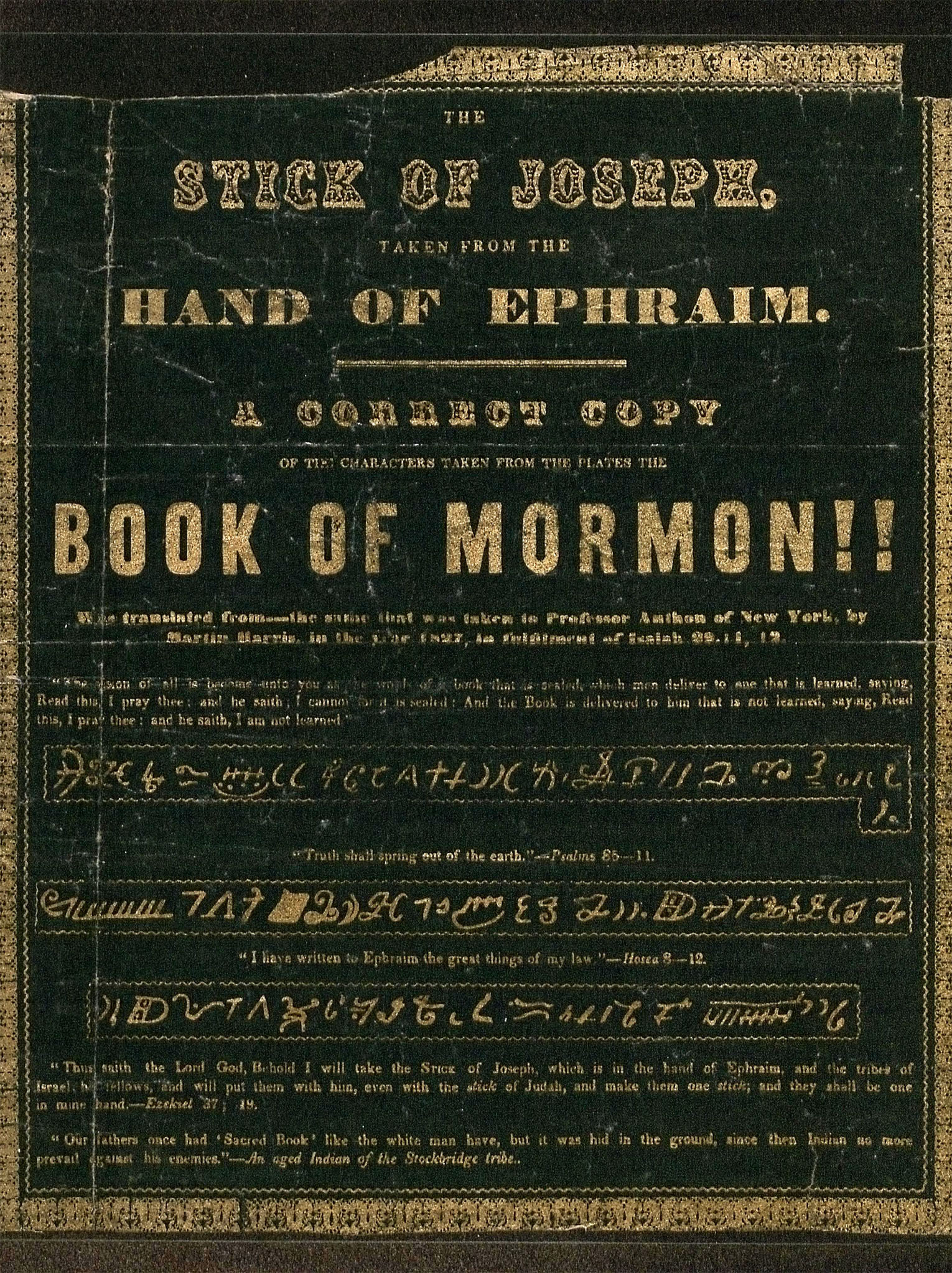
New Article at Dialogue

For those who do not have a subscription to Dialogue or have not yet heard, I wanted to point out an important new article in the Summer 2015 issue called “The Struggle for Female Authority in Biblical and Mormon Theology,” by Cory Crawford. The article represents a detailed investigation of the major scriptural sources that bear on the question of female authority in the Church and pays particular attention to how such traditions have been interpreted and shaped over time, tracing larger historical trajectories from ancient Israelite, to Christian, and then on into early and contemporary Mormon thought. By showing how these traditions were constructed in their cultural settings, either to the validation or diminishment of female authority, and even how Joseph Smith participated in the process of engaging with prior tradition to develop new concepts of authority and priesthood, Crawford aims to show how the scriptural canon as a whole could be used to reinvigorate the discussion of female priesthood and that the LDS tradition is well situated to take advantage of this new knowledge.

It is impossible to do justice here to the extensive discussion, fresh insight, and broad historical perspective contained in the article. Although there are a few places where I would quibble with Crawford’s depiction and interpretation of certain female figures in the Old Testament, this does nothing to vitiate his overall argument, since as he explains, “the role of this inquiry is not so much to uncover an objective reality, but rather to take the patches and fragments and assemble therefrom a quilt or a mosaic image of the past.” As a theologically-attuned exploration of the historical lives of LDS scripture, Crawford’s narrative about repeated and cyclical struggle for female authority from ancient Israel into the contemporary period, or in Mormon parlance apostasy and restoration, is certainly credible and convincing.

The only questions I have is whether Crawford is not somewhat too optimistic in his estimate that the Church is capable of integrating this new knowledge about the Bible into its theology and religious practice. He asserts that “the Mormon destabilization of biblical inerrancy opens unique space for the incorporation of alternative readings and for the integration of the voluminous body of research on the role gender and power played in ancient Israel and in early Christianity. The LDS tradition provides robust resources for telling new stories, for going, as did Nabonidus, back to the texts, for (re)new(ed) understandings of old ways.” But I can see little evidence for such a dynamic theology having any place in the Church and its leadership over the last half century, as it has grown and become more institutionalized, correlated, and global in reach. If Crawford is correct that cultural centralization and institutionalization often correlate with decreased opportunities for the expression of female religious authority, then what reason do we have to expect the Church to change any time soon?

In any case, I would strongly encourage people to get a hold of the article and read it carefully. If you are interested in thinking about the future of the LDS Church and how it could better support the interests and spiritual and cultural development of its women, this article provides what I think is the most comprehensive, knowledgable, and hermeneutically self-conscious treatment of scriptural resources on female authority in an LDS framework to date.


Biblical Texts and Historicity

There’s been quite a lot of concern reflected in comments in discussions here and elsewhere about whether the Old Testament contains reliable history, so I thought I would link to a valuable recent treatment of the issue by biblical scholar Marc Brettler in Thinking, Recording, and Writing History in the Ancient World (ed. Raaflaub; 2014), where an up-to-date bibliography can also be found:

“No direct evidence explains why Israelites told and wrote history. No ancient Near Eastern historical text, including the Hebrew Bible, contains introductions similar to those in Herodotus or Thucydides. Such Greek prefaces, though they might not be taken at face value, offer useful starting points. At the minimum, they identify and contextualize the authors as Herodotus of Halicarnassus and Thucydides the Athenian, living at particular times. The biblical historical texts, as ancient Near Eastern literature, are anonymous and do not have an explicit place or time setting. Therefore, biblical scholars ask about each text: What is the best explanation for why particular types of biblical “historical” texts were composed?….

The title of a recent article, “Conjuring History from Texts” (Tomes 2007), aptly captures the difficulty of using biblical texts to recreate the past, as does the important 1997 collection of essays which initiated the European Seminar in Historical Methodology: Can a ‘History of Israel’ Be Written? (Grabbe 1997). As noted earlier, our preserved texts are typically centuries later than the events they depict, and they are very heavily edited. Often we do not know in what circles particular parts of them developed and how, and under whose influence, they were changed and changed again. There are cases where biblical accounts are likely accurate, and may even suggest that we can reconstruct reliable sources within the biblical text (Grabbe 2007: 212–13; Brettler 2007), but in many other cases external sources indicate that the Bible got it wrong (Grabbe 2007: 214–15).

Biblical historical texts look nothing like the small number of “real,” excavated historical documents:

“The rarity of material in the Deuteronomomistic History [= Deuteronomy, Joshua, Judges, Samuel, Kings] that is at all close in form or style or narrative technique to the stories preserved in the one virtually intact royal inscription from southern Syria–Palestine or the fragments from Tel Dan argues against the supposition that the Judean historians in general quoted extensively from – or indeed were signifi-cantly influenced by – campaign narratives preserved in Israelite or Judean royal inscriptions” (Parker 1997: 75).

Furthermore, “the retelling of stories involves their reinterpretation” (ibid. 9), as can be seen in a recent close study of the book of Esther (Dalley 2007). To complicate issues further, “[a]longside transcription, invention is a primary source of biblical texts” including historiography (van der Toorn 2007: 118). It is very difficult to know which texts have been invented – they may aim at verisimilitude and thus look the same as those that may have been transcribed. Furthermore, given that many believe that oral traditions transmitted over more than one hundred and fifty years are useless for reconstructing the events that these traditions portray (Kirkpatrick 1988: 101–12), and that long periods of oral transmission must stand behind many biblical stories, it is especially difficult to use most biblical traditions to uncover the history they depict.

This idea, that biblical history was invented or created, does not single out ancient Israel in a detrimental fashion. In the introduction to The Invention of Sacred Tradition, a work whose title mirrors the famous collection edited by Hobsbawm and Ranger (1983), the editors note; “From the early records of Israelite or Zoroastrian religion to the present-day Scientologists and Pagans, the invention of sacred tradition is … a persistent and ubiquitous phenomenon” (Lewis and Hammer 2007: 16). Nor is this tendency unique to religious traditions (Hobsbawm and Ranger 1983; Kohl et al. 2007).”

The Anthon Transcript: Fulfillment of Prophecy, Reformed Egyptian, and the Evolution of a Story, Part III

The Evolution of a Story  (See Part I and Part II)


In Part I I discussed Joseph Smith’s reinterpretation of Isaiah 29 and the insertion of this reinterpretation into the prophetic narrative of 2 Nephi 27 and in Part II I identified Smith as the ultimate author and creator of the various transcripts of Book of Mormon Reformed Egyptian. A final element that has powerfully shaped the traditional understanding of the Anthon story is Smith’s official 1838 account itself. According to this narrative, which claims to be a secondhand report from Martin Harris,


“I went to the city of New York, and presented the characters which had been translated, with the translation thereof, to Professor Charles Anthony, a gentleman celebrated for his literary attainments. Professor Anthony stated that the translation was correct, more so than any he had before seen translated from the Egyptian. I then showed him those which were not yet translated, and he said that they were Egyptian, Chaldaic, Assyriac, and Arabic; and he said they were true characters. He gave me a certificate, certifying to the people of Palmyra that they were true characters, and that the translation of such of them as had been translated was also correct. I took the certificate and put it into my pocket, and was just leaving the house, when Mr. Anthony called me back, and asked me how the young man found out that there were gold plates in the place where he found them. I answered that an angel of God had revealed it unto him. He then said to me, ‘Let me see that certificate.’ I accordingly took it out of my pocket and gave it to him, when he took it and tore it to pieces, saying that there was no such thing now as ministering of angels, and that if I would bring the plates to him he would translate them. I informed him that part of the plates were sealed, and that I was forbidden to bring them. He replied, ‘I cannot read a sealed book.’ I left him and went to Dr. Mitchell, who sanctioned what Professor Anthony had said respecting both the characters and the translation.”


The account is short and compact, with very little detail provided about the individuals Harris interviewed or the circumstances of their meetings. The emphasis is rather on how some scholars of eminent worldly status had once affirmed the translation and ancient origin of the characters brought to them by Harris and that one of them had even written a certificate to this effect but at the last second withdrew his support upon hearing the story about the divine origin of the plates. Also, the statement, “I cannot read a sealed book” is clearly an allusion to the fulfillment of Isaiah’s prophecy.


Yet as is well known this report of Harris’s meeting with scholars in New York materially contradicts Anthon’s own version of the events, as found in two letters published in 1834 and 1841. First, according to Anthon, Harris met with Samuel L. Mitchell first, who was the one who directed him to Anthon. Second, Anthon reports that Harris showed him only a sheet containing characters and symbols and specifically states that “no translation had been furnished at the time by the young man with the spectacles”. Lastly and most importantly, Anthon denies having ever affirmed the authenticity of the characters for Harris, whether in a certificate or otherwise, and suggests that the same was the case for Mitchell.


So how do we explain and reconcile the dramatic divergences between these accounts of Harris’ interviews with Anthon and Mitchell? Are one of them lying or substantially misrepresenting the facts? Or are both correct in some respects and simply bending the truth to advance their particular interests? Is Anthon trying to avoid the impression of having been associated with or lent any legitimacy to the Mormonite delusion? Or has Harris or Smith embellished upon Anthon’s first blush assessment of the symbols?


In the following I will attempt to reconstruct a basic outline of what happened during Harris’s interviews with Anthon and Mitchell by examining a variety of sources both earlier and later than the 1838 official history. Through synthesizing the information contained in these sources, I will then argue that while Anthon’s report of the meeting with Harris is not without its issues, the 1838 account is not only factually inaccurate to a greater degree, but the story has been consciously adapted and embellished by Joseph Smith from the historical reality of the event that was known to him, or in other words, that he purposefully misrepresented the facts of the case for his own ends.


1. Harris visited Samuel L. Mitchell first, who referred him to Charles Anthon.


As was already mentioned, the 1838 account implies that after arriving in New York Martin Harris made his way directly to Charles Anthon, who is portrayed as a famous literary scholar and the natural candidate for an inquiry into the subject of ancient languages. Later, Harris reports that he visited with Samuel Mitchell, with no indication that the two meetings were connected or that one had led to the other. Rather, the impression is simply that Harris had visited with two eminent scholars in succession and that the second had independently confirmed the judgement of the first.


However, there are a number of problems with this description of the relationship between the two interviews. First, Anthon specifically states in both his 1834 and 1841 accounts that Harris had visited Mitchell first and then came to him “with a note from Dr. Mitchell of our city, now deceased, requesting me to decypher, if possible, a paper, which the farmer would hand me, and which Dr. M. confessed he had been unable to understand.” In other words, according to Anthon, the two meetings were inextricably linked: Mitchell had more or less been a stopover who because of his inability to interpret the symbols on the transcript had directed Harris to someone else.


Second, there are several reports by early Mormons that support Anthon’s claim that the meetings were interconnected and that Harris had visited with Mitchell first. In his January 15, 1831 letter to E. D. Howe, W. W. Phelps stated, “”When the plates were said to be found, a copy of one or two lines of the characters, were taken by Mr. Harris to Utica, Albany and New York; at New York, they were shown to Dr. Mitchell, and he referred to professor Anthon who translated and declared them to be ancient shorthand Egyptian” (Mormonism Unvailed, 1834). Phelp’s inclusion of the relatively minor detail that Mitchell had referred Harris to Anthon is highly significant, first, because the letter was written before Anthon’s 1834 account and therefore could only have been based on an independent source of information, and second, the broader context of the letter, which speaks of Harris declaring his testimony of the Book of Mormon, suggests that the source may have been Harris himself. Joseph Knight’s recollection of the event similarly seems to assume that Mitchell was visited first. He mentions the cities that Harris visited in sequence and then names Mitchell before Anthon, “[Harris] went to Albeny and to Philadelpha and to new york and he found men that Could Translate some of the Carictors in all those places. Mitchel [Samuel L, Mitchill] and Anthony [Charles Anthony of New York ware the most Larded [learned]” (Reminiscences, 1833-1847). Another document that possibly reflects knowledge that Harris first met with Mitchell includes the ‘Stick of Joseph’ broadside published in 1844: “The following is a correct copy of the characters taken from the plates which the Book of Mormon was translated from: the same that was taken to Professor Mitchell, and afterwards to Professor Anthon of New York, by Martin Harris in the year 1827 [sic] in fulfillment of Isaiah 29: 11-12.”


Third, a sequence in which Harris first met with Mitchell before Anthon is by far historically more plausible. At the time Samuel L. Mitchell, vice president of Rutgers Medical College, was at the end of a long career and popularly viewed as one of the most knowledgeable experts living on all things scientific, literary, and historical. He was the go-to man on difficult questions and linguistic curiosities and only five years previously had been sent a copy of similarly unknown and ancient looking characters found buried in the foundation of an old house in Detroit for examination. Perhaps not coincidentally the man who found what is now known as the Detroit Manuscript was a business partner of Stephan Mack, the uncle of Joseph Smith, who also lived in Detroit. [1] On the other hand, Charles Anthon was a young instructor of classical languages at Columbia College just at the beginning of his career. According to Richard E. Bennett, “in 1828 [Anthon] was but an ‘adjunct professor’ of Greek and Latin, more an accomplished grammarian than a prestigious scholar. It was not until 1830, two years after Harris’s visit, that he became ‘Head Master’ or rector of Columbia College Grammar School (its students would have been high school age today) and was promoted to professor in the Greek and Latin Languages Department.” [2] While circumstantial evidence suggests he was familiar with Champollion’s efforts to decipher Egyptian hieroglyphics and was as knowledgeable of the language as anyone in America, he was nevertheless an obscure figure compared to Mitchell. Thus considering the respective backgrounds and notoriety of Mitchell, it is likely that Anthon’s understanding of how Harris came to visit him is essentially correct, “As Dr. Mitchell was our ‘Magnus Appollo’ in those days, the man called first upon him.” But after being unable to make sense of the characters, Mitchell then referred Harris to a talented young linguist he knew to be acquainted with the Oriental and Egyptian realm.


Fourth, the prominence of the figure of Anthon in virtually all early and later preserved accounts of Harris’ meeting with scholars in New York and the relative absence of Mitchell from them accords with the general notion that Mitchell had simply made a referral, as per Anthon’s account. Aside from one exceptional second hand report (see below), Anthon is the special focus of these narratives and tends to be the only one who engages in dialogue with Harris about the Book of Mormon characters (W. W. Phelps, Joseph Knight, Henry Harris, Martin Harris via David B. Dille, John A. Clark, Joseph Smith Sr. via Fayette Lapham, David Whitmer). For example, Anthon is clearly the “learned” individual alluded to by Joseph Smith in his 1832 history requesting that Harris bring to him the plates. If Mitchell had pronounced upon the authenticity of the characters as alleged in the 1838 account, then we would expect for this to have left more traces in the available reports about Harris’ meeting with Mitchell and Anthon.


There is one final account that differs from all others in asserting that Harris visited with Anthon first and then Mitchell and that it was Mitchell who had pronounced on the linguistic origin of the characters. James Gordon Bennett, from the Morning Courier and New York Inquirer, wrote a feature story on the Mormons from interviews he had previously conducted in upstate New York. Published in August 1831, the article contains one of the earliest accounts of Harris’ trip to New York to authenticate Book of Mormon characters, based on an interview with Charles Butler, a lawyer-philanthropist from whom Harris had earlier requested money to pay for the printing of the Book of Mormon. According to the information obtained from Butler,


“Harris with several manuscripts in his pocket, went to the city of New York and called upon one of the Professors of Columbia College for the purpose of shewing them to him. Harris says that the Professor thought them very curious, but admitted that he could not decypher them. Said he to Harris, “Mr. Harris you had better go to the celebrated Doct. Mitchell and shew them to him. He is very learned in these ancient languages, and I have no doubt will be able to give you some satisfaction. “Where does he live,” asked Harris. He was told and off he posted with the engravings from the Golden Plates to submit to Doc. Mitchell—Harris says that the Doctor received him very “purlitely,” looked at his engravings—made a learned dissertation on them—compared them with the hieroglyphics discovered by Champollion in Egypt—and set them down as the language of a people formerly in existence in the East, but now no more.”


Because of the early date of the Bennett report and the additional detail it provides about the substance of the interviews with Anthon and Mitchell, the account is of considerable historical interest. Even as a secondhand communication, it is the earliest known recital of Harris’ visit to New York that can be assumed to derive from the mouth of Harris himself. As a consequence, Richard E. Bennett has recently argued for the possibility that it may contain reliable information about the original sequence of the interviews with Anthon and Mitchell and that Mitchell may in fact have had a pivotal role in confirming the Book of Mormon characters and inspiring Harris to mortgage his farm. [3]


Yet on closer analysis the account’s unexpected ordering of the interviews and the highlighting of Mitchell presents no fundamental challenge to the scenario reconstructed from other accounts discussed above and was rather a product of misidentification or confusion on the part of Butler about the individuals that Harris had interviewed. If we ignore the names and other identifying information of the scholars and concentrate solely on their statements and actions, then it becomes obvious that they correspond closely to how Mitchell and Anthon are known to have responded to Harris’ request for them to translate the characters. The first scholar interviewed says that he is a) unable to decipher the characters and as a consequence b) sends Harris to another scholar who he thought would be better equipped to ascertain their meaning. The second scholar then c) has an apparently long discussion with Harris about the engravings and d) compares them to Egyptian hieroglyphics. As has already been mentioned, this sequence of events lines up to what can be reconstructed to have occurred between Harris and Mitchell and Anthon from a variety of sources. According to Anthon and Phelps, Mitchell was a) not able to read the characters and so b) directed Harris to Anthon for a second opinion. On the other hand, the mention of a “long dissertation” is reminiscent of accounts that Anthon had c) spoken at some length with Harris about the characters and d) had compared them to some ancient Oriental scripts: Egyptian (W. W. Phelps); Egyptian, Chaldaic, Assyriac, and Arabic (Martin Harris via Joseph Smith); Egyptian, Chaldaic, and Arabic (Martin Harris via Martin Harris Jr.); Egyptian (David Whitmer); Hebrew, with a mixture of Egyptian (William Smith); and Arabic (Joseph Smith Sr via Fayette Lapham).


Bennett’s account is a secondhand report via Charles Butler, so it is understandable how confusion about the individuals Harris interviewed could have arisen. Butler would have naturally been more familiar with Mitchell and his intellectual and linguistic capacities and thus easily transposed Mitchell for Anthon. Further evidence for some confusion in the account is found in the journal note made by Bennett at the time of the interview as the basis for his later article: “[Harris] showed them to Prof. Anthon who said that he did not know what language they were—told him to carry them to Dr. Mitchill. Dr. Mitchill examined them and compared them with other hieroglyphics— thought them very curious—and [said] they were the characters of a nation now extinct which he named. Harris returned to Anthon who put some questions to him and got angry with Harris.” [4] According to this summary, Harris first visited with Anthon, then Mitchell, and finally returned to Anthon again. But we know from Anthon’s own accounts that he was visited by Harris only once, and then later a second time after the publication of the Book of Mormon. Thus either Butler is telescoping events from the second visit so that they occurred soon after the first, or better he has correctly recalled that Anthon became angry with Harris during the first interview and so had to imagine a second meeting on top of the one where he referred Harris to Mitchell. In any case, it seems dubious that Harris would have visited either Mitchell or Anthon so soon again after the initial interview.


2. Harris did not present any translation to Mitchell or Anthon.


The 1838 account conspicuously highlights the role of a document containing a translation of some of the Book of Mormon characters in its depiction of Harris’ interviews with Mitchell and Anthon. According to this narrative, the first thing that Harris presented to Anthon was “the characters which had been translated, with the translation thereof,” immediately after which Anthon affirmed that “the translation was correct, more so than any he had before seen translated from the Egyptian.” Then Anthon wrote a certificate saying among other things that “the translation of such of [the characters] as had been translated was also correct.” Finally, Harris showed the translation to Mitchell who verified Anthon’s opinion with regard to its accuracy.


But the claim that Harris presented to Anthon and Mitchell a sample of translated Book of Mormon characters in addition to a sample of untranslated characters is problematic and inconsistent with various earlier and later sources. First, as was already mentioned, Anthon specifically states that when Harris came to him he was asked to interpret a single paper with curious symbols but that “no translation had been furnished at the time by the young man with the spectacles.” In other words, according to Anthon, the only document he saw was a transcript of Reformed Egyptian. There was no division of the interview into an analysis of translated and untranslated characters, because such a translation was simply not available. If Anthon had been given a translation for examination, it is difficult to understand why he would have failed to mention it. From reading his letters Anthon appears to have been scrupulous and methodical in describing the content of the transcript delivered to him and its background, so we have little reason to think that such an important detail would have been carelessly omitted or forgotten. This is especially because as a scholar of languages a sample of characters accompanied by their translation would have substantially impacted the way he went about interpreting their origin and meaning.


Second, a number of early reports or accounts left by knowledgeable informants fail to mention anything about a translation and indeed suggest that Harris presented only a copy of plain characters to the scholars he visited and that the primary purpose of the trip was to find out whether they could translate what appeared on the document. For example, Joseph Smith’s 1832 history states,


“the Lord had shown him [Martin Harris] that he must go to New York City with some of the characters so we proceeded to coppy some of them and he took his Journy to the Eastern Cittys and to the Learned read this I pray thee and the learned said I cannot but if he would bring the blates [plates] they would read it but the Lord forbid it and he returned to me and gave them to me to translate and I said I said [ I ] cannot for I am not learned but the Lord had prepared spetticke spectacles for to read the Book therefore I commenced translating the characters and thus the Prop[h]icy of Isiaah was fulfilled which is written in the 29 chapter concerning the book” (1832 History).


Similarly, Lucy Mack Smith,


“he was instructed to take off a facsimile of the alphabet Egyptian charecters <composing the alphabet> <which were called reformed egyptian> Alphabetically and send them to all the learned men that he could find and ask them for the translation of the same… it was agreed that Martin Harris… should take the characters to the East, and on his way, he was to call on all the professed linguists, in order to give them an opportunity to display their talents in giving a translation of the characters” (History, 1844-45).


Joseph Knight Sr. recalled, “He therefore with his wife Drew of[f] the Caricters exactley like the ancient and sent Martin Harris to see if he Could git them Translated” (Reminiscences, 1833-1847).


Within these accounts and others (W. W. Phelps, John A. Clark, James Gordon Bennett; Joseph Smith Sr. via Fayette Lapham), there is little room for the possibility that Smith had already produced a formal translation accompanying some characters and that Harris had brought this translation with him to submit for scholarly analysis and verification. The sense is rather that Smith was at a fairly preliminary stage of interpreting the characters, that he wanted the Book of Mormon translated but he himself had not engaged in full scale translation. At this point he therefore had little interest in having his translational abilities analyzed or confirmed to the world. In addition, sending a translation document on top of the simple characters document implies a rather high degree of confidence in the scholars’ ability to read and translate the characters and is inextricably connected to the 1838 account’s claim that Anthon and Mitchell both affirmed the correctness of the translation, whereas we will see below that there are compelling reasons to doubt that any such validation ever occurred.


3. Neither Mitchell nor Anthon were able to translate the Book of Mormon characters. At the most, Anthon seems to have identified some of the characters as resembling certain ancient Near Eastern languages, including Egyptian.


The most controversial claim made in the 1838 retelling of Harris’ visit with scholars in New York is that both Anthon and Mitchell affirmed the translation and the antiquity of the characters and that Anthon had even written a certificate to this effect. This element is stressed throughout the narrative and can even be seen to be its unifying theme: “Professor Anthony stated that the translation was correct, more so than any he had before seen translated from the Egyptian.” … “he said that they were Egyptian, Chaldaic, Assyriac, and Arabic” … “he said they were true characters” … “He gave me a certificate, certifying to the people of Palmyra that they were true characters, and that the translation of such of them as had been translated was also correct.” … “I took the certificate and put it into my pocket” … “I accordingly took it out of my pocket and gave it to him” … “I left him and went to Dr. Mitchell, who sanctioned what Professor Anthony had said respecting both the characters and the translation.”


The difficulties with these statements about scholars authenticating the Book of Mormon are well known.  First, as was mentioned above, Anthon in his accounts claims that neither Mitchell nor he was able to make any sense of the characters. He reports in 1834 that when Harris visited his office he came with a note from Mitchell who had already examined the transcript and “confessed that he had been unable to understand.” He then states, “Upon examining the paper in question, I soon came to the conclusion that it was all a trick, perhaps a hoax.” After describing the shapes and forms of the characters in some detail, he concludes, “I am thus particular as to the contents of the paper… and well remember that the paper contained any thing else but ‘Egyptian Hieroglyphics.’”  Second, we have already noted various considerations that support Anthon’s claim that Harris was in fact directed to him through a referral from Mitchell, which tallies with the idea that Mitchell had not himself been able to decipher the characters and so sent Harris to Anthon for another opinion. At the very least, this evidence undermines the claim that Mitchell had ever affirmed the authenticity of the characters or a purported translation per the 1838 account.


Third, as knowledgeable as Mitchell and Anthon were for their time, neither had anywhere near the ability to verify a translation from Egyptian. The Rosetta Stone had only been deciphered by Champollion in 1822 and knowledge of Egyptian in America was still very primitive. We have little evidence that Mitchell in all his scholarly pursuits was even interested in Egyptian hieroglyphs, and while the evidence for Anthon is substantially better, as Richard E. Bennett has explained, “While it is reasonable to conclude that [Anthon] may have been interested in ancient Near Eastern languages, he was by no means a scholar of these languages.” [5] Thus the assertion that Anthon had pronounced the translation of Book of Mormon characters to be correct, “more so than any he had before seen translated from the Egyptian” is dubious on the face. Anthon simply did not have the knowledge or training to make such a judgement. At the most, he could have speculated at an informed level about similarities shared between the characters and other ancient scripts of which he was aware. Because of this technical inability to read Egyptian, the possibility has been suggested that perhaps Anthon “pretended knowledge that [he] did not have” and was simply acting as though he could translate. [6] But this theory seems hardly credible. What interest would Anthon have in putting on airs for a country farmer like Harris, especially to the extent that he would completely lie and act as though he could translate from Egyptian? How would he benefit, considering that the meeting was private and he would likely never meet Harris again? As far as can be known from the historical record, Charles Anthon appears to have been very much a scholar’s scholar, a pure academic who placed a higher value on books and study more than social interaction. As one who was rigorous and strict in his teaching and scholarship, he was not the type to dissemble about the languages he knew for the sake of impressing others.


Fourth, virtually all accounts of the Anthon story that come earlier than the 1838 History and even those that come after emphasize that the scholars interviewed by Harris were unable to translate or decipher the characters:


1) “So blindly enthusiastic was Harris, that he took some of the characters interpreted by Smith, and went in search of some one, besides the interpreter, who was learned enough to English them; but all to whom he applied (among the number was Professor Mitchell, of New York,) happened not to be possessed of sufficient knowledge to give satisfaction!” (Jonathan Hadley, Palmyra Freeman, Aug 11, 1829). Cf. “Facsimiles of these pretended hieroglyphics were shown to some of the most learned in this section of the country, but they proved quite too ignorant to render them into English. Some lines of them were even sent to the late Dr. Mitchell, of New-York, but notwithstanding his profound literary researches, he was equally unsuccessful” (Jonathan Hadley, Wayne County Whig, Sept 14, 1842).


2) “Harris with several manuscripts in his pocket, went to the city of New York, and called upon one of the Professors of Columbia College for the purpose of shewing them to him. Harris says that the Professor thought them very curious, but admitted that he could not decypher them. Said he to Harris, “Mr. Harris you had better go to the celebrated Doct. Mitchell and shew them to him. He is very learned in these ancient languages, and I have no doubt will be able to give you some satisfaction.” “Where does he live,” asked Harris. He was told, and off he posted with the engravings from the Golden Plates to submit to Doc. Mitchell—Harris says that the Doctor received him very “purlitely,” looked at his engravings—made a learned dissertation on them—compared them with the hieroglyphics discovered by Champollion in Egypt—and set them down as the language of a people formerly in existence in the East, but now no more” (James Gordon Bennett, Morning Courier and New York Inquirer, Aug 31, 1831).


3)  “… the Lord had shown him [Martin Harris] that he must go to New York City with some of the characters so we proceeded to coppy some of them and he took his Journy to the Eastern Cittys and to the Learned read this I pray thee and the learned said I cannot but if he would bring the blates [plates] they would read it” (Joseph Smith, 1832 History).


4) “After his return [Harris] came to see me again, and told me that, among others, he had consulted Professor Anthon, who thought the characters in which the book was written very remarkable but he could not decide exactly what language they belonged to” (John A. Clark, Gleanings by the Way, 1842).


5) “I took a transcript of the characters of the plates to Dr. Anthon, of New York. When I arrived at the house of Professor Anthon, I found him in his office and alone, and presented the transcript to him, and asked him to read it. He said if I would bring the plates, he would assist in the translation. I told him I could not, for they were sealed. Professor Anthon then gave me a certificate certifying that the characters were Arabic, Chaldaic, and Egyptian. I then left Dr. Anthon and was near the door, when he said, “How did the young man know the plates were there?” I said an angel had shown them to him. Professor Anthon then said, “Let me see the certificate!” – upon which I took it from my waistcoat pocket and unsuspectingly gave it to him. He then tore it up in anger, saying there was no such thing as angels now – it was all a hoax. I then went to Dr. Mitchell with the transcript, and he confirmed what Professor Anthon had said” (Martin Harris, 1853, as reported by David B. Dille, Millennial Star, 1859).


6) “but not until after the most learned men had exhausted their knowledge of letters in the vain effort to decipher the characters…. after, all human means had failed to secure a translation, Smith was commissioned to undertake the task” (Martin Harris, as reported in the Iowa State Register, 1870).


7) “He went by the request of the Prophet Joseph Smith to the city of New York, and presented a transcript of the records of the Book of Mormon to Professor Anthon and Dr. Mitchell and asked them to translate it. He also presented the same transcript to many other learned men at the different schools of learning in Geneva, Ithica, and Albany with the same request but was unsuccessful in obtaining the translation of the transcript from any of them” (Martin Harris, as reported by Martin Harris Jr., 1875).


8) “He therefore with his wife Drew of[f] the Caricters exactley like the ancient and sent Martin Harris to see if he Could git them Translated. He went to Albeny and to Philadelpha and to new york and he found men that Could Translate some of the Carictors in all those places. Mitchel [Samuel L, Mitchill] and Anthony [Charles Anthony of New York ware the most Larded [learned] But there were some Caricters they could not well understand” (Joseph Knight Sr., Reminiscences, 1833-1847).


9) “He examined them; but was unable to decipher them correctly; but he presumed, that if the original records could be brought, he could assist in translating them” (Orson Pratt, An Interesting Account of Several Remarkable Visions and of the Late Discovery of Ancient American Records, 1840).


10) “The professor pronounced the characters to be ancient Hebrew corrupted, and the language to be degenerate Hebrew, with a mixture of Egyptian. He could decypher only one entire word” (William Smith, as reported in the Peoria Register, Sept 3, 1841).


11) “But Joseph was not willing to give up the matter, without further trial; and from Franklin county he went to New York city, where the most learned man then in the city told him that, with few exceptions, the characters were Arabic, but not enough to make any thing out” (Joseph Smith Sr., as reported by Fayette Lapham, Historical Magazine, May 1870).


12) “Smith made facsimilies of some of the plates, and sent them by Martin Harris to Profs. Anson and Mitchell, of New York city, for examination. They pronounced the characters reformed Egyptian, but were unable to read them” (David Whitmer, as reported in Kansas City Journal, June 5, 1881).


The exceptions to this overwhelming trend to understand the importance of Harris’ interviews in terms of the scholars’ inability to read the characters are few and generally admit of other interpretations. For example, in his 1831 account W. W. Phelps claims that Anthon “translated [the characters] and declared them to be ancient shorthand Egyptian.” But this usage of “translate” seems to be rather loose, with the emphasis falling more on the identification of the language of the transcript than that Anthon had actually recovered its underlying structure and meaning. Similarly, at a fairly late period of his life Martin Harris began to insert the language of “translation” from the official 1838 History into his testimonies about the significance of his meeting with Anthon, perhaps in response to some people inquiring for clarification on what Anthon had said with regard to the translation. In 1870 Harris wrote to H. B. Emerson in Ohio about the origin of the Book of Mormon, “Further, the translation that I carried to Professor Anthon was copied from these same plates; also, that the professor did testify to it being a correct translation.” But here again the word “translation” seems to reflect an idiosyncratic usage; the context of the statement suggests that what Harris is referring to by “translation” is actually the transcript of Book of Mormon characters described by Anthon and not a rendering of the characters in English.


The implications of these reports for understanding the development of the “Presentation of the Characters to the Learned” story among first generation Mormons are rather clear. For the earliest Mormons the story was commonly received and understood that when Harris visited with Mitchell and Anthon neither was able to read or effectively translate the characters presented to them. At the most some accounts state that Anthon was able to identify the script of the language or a possible ancient origin (James Gordon Bennett, W. W. Phelps, William Smith, Martin Harris via David B. Dille, Joseph Smith Sr. via Fayette Lapham, David Whitmer), while others are more limited in their claims and indicate that he and Mitchell simply did not understand the characters (Jonathan Hadley, Joseph Smith Jr., Joseph Knight Sr., Orson Pratt) or even what language they represented (John A. Clark).


Taking all this information, we are now in a position to reconstruct a basic outline of what can be assumed to have occurred between Harris and Anthon during their meeting. On the one hand, Anthon is probably correct in his assertion that he never directly authenticated the Reformed Egyptian of the Book of Mormon characters and that at some point during the interview he came to realize that the symbols were fictitious and counterfeit. This assumption is substantiated by the following: 1) The earliest accounts about Harris’ experience agree that Anthon was ultimately unable to make sense of the characters. Although some accounts state that Anthon made a more positive identification of the language represented by the characters (“the language of a people formerly in existence in the East”; “shorthand Egyptian”; Egyptian, Chaldaic, Assyriac, and Arabic; “ancient Hebrew corrupted… with a mixture of Egyptian”; Arabic, Chaldaic, and Egyptian; Arabic), the substantial variation and vagueness characterizing this element across accounts suggests that not too much weight should be put on it. This rather seems to have been a part of the story that grew and changed with time and was capable of significant distortion, depending on the situation and who was doing the telling. A more plausible scenario is that reflected in the John A. Clark account, that according to Harris “[Anthon] could not decide exactly what language they belonged to”. 2) Various accounts support the idea that at some point during the interview Anthon became upset and ill tempered at Harris (James Gordon Bennett, Joseph Knight Sr., Martin Harris via David B. Dille). This detail is most easily explained if we assume that indeed Anthon had eventually come to the conclusion that the transcript was fraudulent and that Harris and by extension himself were being duped. 3) Anthon’s memory of the transcript and interpretation of various elements shows that he had correctly ascertained the derivative and artificial nature of the characters: “Greek and Hebrew letters, crosses and flourishes, Roman letters inverted or placed sideways” (1834); “Greek, Hebrew and all sorts of letters, more or less distorted, either through unskilfulness or from actual design” (1841). As was already argued earlier, distorted alphabetic characters accurately describes the origin of many of the symbols contained in surviving Book of Mormon character transcripts.


On the other hand, Anthon in his recollection does not seem to have been fully honest about how quickly he came to the realization that the Book of Mormon characters were of modern origin. According to Anthon, almost immediately upon “examining the paper in question, I soon came to the conclusion that it was all a trick, perhaps a hoax” (1834); “A very brief examination of the paper convinced me that it was a mere hoax, a very clumsy one too…. The conclusion was irresistible, that some cunning fellow had prepared the paper in question for the purpose of imposing upon the countryman, who brought it, and I told the man so without any hesitation.” (1841). However, we have a number of clues and indications that this portrayal is inaccurate and misleading. First, various reports suggest that after having the document presented to him Anthon initially devoted considerable attention to examining the characters and comparing them to some ancient Near Eastern languages, particularly Egyptian (W. W. Phelps; James Gordon Bennett; John A. Clark; Orson Pratt; William Smith; Martin Harris via David B. Dille; Joseph Smith Sr. via Fayette Lapham; David Whitmer). In his 1841 letter Anthon himself cryptically admits to having compared the characters to “alphabetical characters” of various languages. Whether this investigation of a possible resemblance to ancient Egyptian was stimulated by comments by Harris himself is unclear. In any case, the above reports lend support to the idea that at least at first Anthon did not identify the Book of Mormon transcript as an obvious hoax.


Second, in his 1834 letter Anthon states that after hearing the story about the origin of the transcript and the Book of Mormon he changed his mind about the document, “and, instead of viewing it any longer as a hoax upon the learned, I began to regard it as part of a scheme to cheat the farmer of his money.” This admission points to the likelihood that Anthon’s opinion about the transcript developed over the course of the interview and the reference to it as a “hoax upon the learned” implies that even he was initially taken off guard and had treated the examination of the characters with greater interest and seriousness than he later realized was warranted.


Third, in his 1834 account Anthon denies having written any opinion about the characters for Harris, whereas his 1841 account acknowledges that he had and his explanation for why he did so is effusive with self-legitimation, “I did so without hesitation, partly for the man’s sake, and partly to let the individual ‘behind the curtain’ see that his trick was discovered.” Yet the very fact that Harris requested an opinion from Anthon in writing about the characters’ similarities to other scripts suggests that at least up to that point Anthon had not explicitly identified them as fraudulent and spurious. He may not have been able to make any sense of the characters and was cautiously suspicious of them, but more than anything he was curious. As the John A. Clark account states, “[Anthon] thought the characters in which the book was written very remarkable.” Further confirmation for the idea that Anthon at this stage was merely suspicious and somewhat undecided about the authenticity of the characters is provided by the Joseph Knight account, which uniquely connects the writing of an opinion for Harris with a request to send the original plates of Reformed Egyptian: “But there were some Caricters they could not well understand therefore Anthony told him that he thot if he had the original he culd translate it and he rote a very good piece to Joseph and said if he would send the original he would translate it.” It is difficult if not impossible to know whether any of the elements of this description are based in reality rather than the stories that were subsequently circulated about the interview. But the idea that one of Anthon’s purposes in writing the letter to Joseph Smith was to request for him to send the plates for further examination and study is very plausible and indirectly supported by the appearance of the request motif in the 1838 History. It is also plausible that in the same letter Anthon had described the various scripts to which he had compared the characters and explained that he had been unable to interpret their meaning. This earlier openness to the possibility of trying to interpret the plates would then explain Anthon’s tendency to obfuscate and spin around the existence of the letter and the nature of its content. He did not want to damage his reputation by admitting the degree to which he had taken an interest in attempting to decipher the characters.


Finally, the various accounts about Anthon becoming angry suggest that it was only after hearing more about the origin and discovery of the Book of Mormon, the strictures on who could see the plates, and the monetary purpose for which Smith had sent Harris to verify the characters that it fully dawned on him that the transcript was fraudulent and an artificial creation of its author (James Gordon Bennett, Joseph Knight Sr., Martin Harris via David B. Dille). Anthon was angry because in his mind not only was Harris being used and hoodwinked, but by extension he himself had been initially taken in and pressed to seriously consider what he now recognized to be a fraud.


In sum, according to this reconstruction Anthon never affirmed the authenticity or ancient origin of the characters for Harris, but merely noted some similarities to some other ancient scripts, a point that was probably included in his letter to Joseph Smith as well. This detail was then developed and expanded upon by others in later retellings of the story.


Of course, if this reconstruction is for the most part correct, then it raises the question of why Harris returned to Pennsylvania to throw his support behind the translation and production of the Book of Mormon. If Anthon had not been able to read the characters and forthrightly declared the transcript of Reformed Egyptian to be a fraud, contrary to the 1838 History, then why didn’t this discourage Harris from going forward with the project of translation? For apologists the fact Harris went on to function as a scribe of the Book of Mormon and eventually to mortgage his farm in support of publication has long seemed to represent strong confirmatory evidence that something along the lines of the traditional 1838 interview between Harris and Anthon had occurred and that Harris had been given some sort of scholarly validation of the Book of Mormon.


To answer this question, we will have to reevaluate why Martin Harris went to present Reformed Egyptian characters to learned scholars in the first place. According to the 1832 history, “the Lord appeared unto him in a vision and shewed unto him his marvilous work which he was about to do and he imediately came to Su[s]quehanna and said the Lord had shown him [Martin Harris] that he must go to New York City with some of the characters so we proceeded to coppy some of them and he took his Journy to the Eastern Cittys,” implying that the proximate cause had been a divine revelation and that Harris had come to the idea almost independently from Smith. But the claim that a revelation from God to Harris is what led him to take a transcript to New York for scholarly analysis is problematic. As Johnny Stephenson has noted, Martin Harris himself never mentions any such revelation or makes a connection between the personal spiritual experience he had after first hearing about the golden plates and the decision to go to New York several months later. According to Harris, he had merely been spoken to by “the still small voice” that the project to bring forth the Book of Mormon was God’s work.


Furthermore, we have a number of reports that the primary instigation for Harris taking the trip came from Joseph Smith himself: 1) Lucy Mack Smith spoke to the church in Nauvoo in 1845 and recalled that after Joseph had dug up the plates, he “came to me and told me he had taken those plates out of the ground. Tell all three of them (Harris[es]) that I have got them I want Martin to assist me and take some of the characters off to send them to N.Y.” Another recording of Lucy’s speech similarly recounted that she had been “cal[l]ed upon by Joseph Smith to go & tell Mar=tin Harris & family that he had got the Plates & he wanted him to take an alphabet of the characters & carry them to the learned men to decypher.…” [7].


2) Lucy’s history also implies that the idea had come to Joseph through divine revelation: “he was instructed to take off a facsimile of the alphabet  Egyptian charecters <composing the alphabet> <which were called reformed egyptian> Alphabetically and send them to all  the learned men that he could find and ask them for the  translation of the same” (History, 1844-45).


3) Oliver Cowdery’s rendering of Smith’s initial vision of Moroni indicates that the angel had told him that it would be his privilege to translate the plates and also that “the scripture must be fulfilled before it is translated, which says that the words of a book, which were sealed, were presented to the learned, for thus has God determined to leave men without excuse, and show to the meek that his arm is not shortened that it cannot save” (Messenger and Advocate, 1835). Or in other words, the idea of presenting the characters to the learned had come to Joseph long before he had ever met Harris.


4) Professor Anthon in his 1834 letter claimed that according to Harris “he had been requested [by Smith] to contribute a sum of money towards the publication of the ‘golden book,’ the contents of which would, as he had been assured, produce an entire change in the world and save it from ruin. So urgent had been these solicitations, that he intended selling his farm… As a last precautionary step, however, he had resolved to come to New York.” Later in his 1841 letter he expanded upon this point, “To convince him more clearly that there was no risk whatever in the matter, and that the work was actually what it claimed to be, he was told to take the paper, which purported to be a copy of one of the pages of the book, to the city of New York, and submit it to the learned in that quarter, who would soon dispel all his doubts, and satisfy him as to the perfect safety of the investment.” From the context, it is clear that it was Smith who had encouraged Harris to come to New York with the transcript.


Following Lucy Mack Smith’s statement that after obtaining the plates Joseph was “very solicitous about the work but as yet no means had come into his hands of accomplishing the same,” hints that full scale translation of the Book of Mormon began only after Smith’s relocation to Pennsylvania, and the possibility that the transcript taken by Harris was a kind of alphabet of Reformed Egyptian, several LDS historians have speculated that Smith was initially unable to translate and his intention in sending Harris to learned scholars was to seek out their assistance in interpreting the characters. [8] By having a large sample of characters translated, this would then enable Smith to proceed on his own in creating a formal translation of the Book of Mormon.


But this explanation for why Harris presented Book of Mormon characters to learned scholars is doubtful as well. First of all, Lucy Mack Smith’s statement that “as yet no means had come into his hands of accomplishing the same” should not be taken as evidence that Joseph was unable to translate prior to Harris’ journey to New York. The word “means” in this context does not indicate that he did not yet have the seer-like gift to interpret with the Urim and Thummim. He simply did not have the means, or rather the physical and social circumstances were inadequate to the task (cf. D&C 5:34). Several accounts show that the hounding of Joseph Smith by neighbors and other interested parties in search of the gold plates and the lack of peaceable surroundings had made the situation in Palmyra untenable and contributed to his decision to move to Pennsylvania. He did not have a place to go forward with the translation project undisturbed and neither did he have the necessary financial and material support (Martin Harris via William Pilkington, Joseph Knight Sr., Joseph Smith Sr. via Fayette Lapham).


Second, the story about the miraculous visitation of an angel revealing the golden plates indicates that Joseph Smith claimed from a fairly early date that he was the one destined to translate the Book of Mormon and that the translation would be performed mystically or magically through the Interpreters/Urim and Thummim, not through a formal translation process made possible by scholars from the secular world. According to various reports of the story, an angel had discovered the plates to Joseph and explained that despite not understanding the language of the record it would be his special calling to translate it through the Urim and Thummim when the appropriate time came. In Oliver Cowdery’s 1835 account of the vision of Moroni Joseph was told that it would be his “privilege, if obedient to the commandments of the Lord, to obtain and translate the [Book of Mormon], by the means of the Urim and Thummim, which were deposited for that purpose with the record.” Similarly, in the 1838 account Smith said he was was told by the angel that the Urim and Thummim were deposited with the plates and that “God had prepared them for the purpose of translating the plates.” Thus if the narrative that Joseph Smith promoted after obtaining the plates was that God had chosen him to translate the record through supernatural means, it hardly makes sense for him to suddenly think that he would now attempt a formal or secular word for word translation.


Third, while it is true that full scale translation can generally be correlated with the period after Harris’ return from New York, we have a number of indications that Smith had successfully employed the Urim and Thummim and interpreted some of the content of the plates prior to the meeting with Mitchell and Anthon: 1) According to John A. Clark, Martin Harris met with him in the Fall of 1827 and claimed that by means of the Spectacles Joseph was already able to read the Golden Bible and understand its meaning. 2) Joseph Knight reports that during the middle of the Winter after the move to Pennsylvania, Emma and Reuben at first served as scribes to Joseph. This would possibly have been before Harris came down from Palmyra in February. 3) Charles Anthon’s 1841 account states that Harris had told him that the spectacles had already been used by Joseph to translate before their meeting: “My informant assured me that this curious property of the spectacles had been actually tested, and found to be true. A young man, it seems, had been placed in the garret of a farm-house, with a curtain before him, and having fastened the spectacles to his head, had read several pages in the golden book, and communicated their contents in writing to certain persons stationed on the outside of the curtain.”


Fourth, several accounts imply that the main purpose in having Harris make the trip to New York was to strengthen his conviction that the plates were authentic and that the story Joseph had been telling about their origin was true, not to seek a scholarly tool by which to facilitate a systematic translation of the plates. According to Anthon’s 1834 account, Harris had told him that “he had been requested to contribute a sum of money towards the publication of the ‘golden book’…. So urgent had been these solicitations, that he intended selling his farm and handing over the amount received to those who wished to publish the plates. As a last precautionary step, however, he had resolved to come to New York, and obtain the opinion of the learned about the meaning of the paper which he brought with him, and which had been given him as a part of the contents of the book.” This rationale for the meeting is substantiated by Lucy Mack Smith’s history, which situates the decision for Harris to take the transcript to the learned in the context of efforts by Joseph to convince Martin and his wife Lucy of the truthfulness of his claims.


Finally, we have already seen earlier that a linguistic analysis of available Book of Mormon character transcripts suggests that the characters were an artificial creation of Joseph Smith, so it would hardly make sense for him to seek out scholarly assistance in translating them, or for that matter, to send Harris to verify their authenticity. As their creator, Smith would have already known that they were untranslatable and inauthentic.


So why would Smith send Harris to have the characters examined by scholars, since this would possibly lead him to find out that the Reformed Egyptian was counterfeit and expose Smith to charges of fraud, thus defeating the purpose for which Harris had been sent? A plausible explanation is that Smith sent Harris to scholars to see if they could translate as an ingenious authenticating experiment that he believed would result in his vindication. Because Smith knew that the characters corresponded with no existing language and were in fact unreadable–since he had altered an existing set of symbols at his disposal to such an extent that they were something sui generis and mixed in other symbols of his own creation–he was very confident that no one Harris met would be able to translate the transcript. In the event that this occurred and scholars failed to interpret or translate, this would then lend credence to his story that the characters were an ancient unknown tongue that could only be interpreted through his divinely bestowed facility. It would also confirm that he was the one intended to fulfill the prophecy of Isaiah 29 about the book being given first to the learned and then to the unlearned.


This hypothesis is supported by several considerations:


First, a major thematic element of the rhetoric surrounding the production of the Book of Mormon is a kind of anti-intellectual insistence that the scholars of the day were unable to translate the plates; this was a work that only Joseph Smith was chosen for: 1) The Wayne Sentinel described the Book of Mormon in 1829 as “an ancient record, of a religious and divine nature and origin, written in ancient characters, impossible to be interpreted by any to whom the special gift has not been imparted by inspiration.” 2) Henry Harris of Manchester recalled an earlier conversation he had with Smith, “I then asked him what letters were engraved on them, he said italic letters written in an unknown language, and that- he had copied some of the words and sent them to Dr. Mitchell and Professor Anthon of New York. By looking on the plates he said he could not understand the words, but it was made known to him that he was the person that must translate them, and on looking through the stone was enabled to translate.” 3) Oliver Cowdery’s 1835 history reports that the angel had told Smith that it would be his privilege to interpret the plates, but that “they cannot be interpreted by the learning of this generation.” 4) Lucy Mack Smith satirically recounted how Harris was to take the Egyptian alphabet “to the east and through the country in every direction to all who were professed linguists to give them an opertunity of showing their talents.” 5) Joseph Knight said that after Harris returned from meeting with Mitchell and Anthon Joseph Smith had power to translate, “Then ware the Larned men Confounded, for he, By the means he found with the plates, he Could translate those Caricters Better than the Larned.”


Second, Martin Harris seems to have found confirmation for the authenticity of the plates merely in the fact that the learned were unable to translate the characters. 1) The Rochester Gem reported in 1829, “Harris states that he went in search of some one to interpret the hieroglyphics, but found that no one was intended to perform that all important task but Smith himself,” implying that the fact that no one was able to interpret was meaningful in itself. 2) John A. Clark said that after examining some Book of Mormon characters presented to him by Harris and being unable make any sense of them, “My ignorance of the characters in which this pretended ancient record was written, was to Martin Harris new proof that Smith’s whole account of the divine revelation made to him was to be entirely relied upon.” Then after Harris returned from his meeting with Anthon, who had been unable to read the transcript, he informed Clark that he “had now become a perfect believer. He said he had no more doubt of Smith’s commission, than of the divine commission of the apostles. The very fact that Smith was an obscure and illiterate man, showed that he must be acting under divine impulses” (Gleanings by the Way, 1842) 3) Pomeroy Tucker wrote that even though the scholars Harris visited had realized that the Reformed Egyptian characters were a hoax, “Harris, nevertheless, stood firm in his position, regarding these untoward results merely as ‘proving the lack of wisdom’ on the part of the rejecters, and also as illustrating the truth of his favorite quotation, that ‘God hath chosen the foolish things of the world to confound the wise’” (Origin, Rise, and Progress of Mormonism, 1867). 4) John Gilbert, printer of the Book of Mormon, remembered that “Martin returned from his trip satisfied that ‘Joseph’ was a ‘little smarter than Professor Anthon’” (Memorandum, 1892).


Finally, allusions and references to Isaiah 29 have a prominent role in virtually all of Joseph Smith’s early visionary narratives and revelations. A substantial amount of Isaiah 29:11-14 is featured in Smith’s 1832 History, Cowdery’s 1835 history, and Smith’s 1838 History: “they draw near to me with their  lips while their hearts are far from me…. marvilous work….  read this I pray thee and the learned said I cannot … and I said I said cannot for I am not learned” (1832 History); “Therefore, says the Lord, I will proceed to do a marvelous work among this people, even a marvelous work and a wonder; the wisdom, of their wise shall perish, and the understanding of their prudent shall be hid…. while those who draw near to God with their mouths, and honor him with their lips…. ‘Yet,’ said he, ‘the scripture must be fulfilled before it is translated, which says that the words of a book, which were sealed, were presented to the learned…. a part of the book was sealed’” (1835 history); “‘they draw near to me with their lips, but their hearts are far from me, they teach for doctrines the commandments of men’…. that God had a work for me to do… seers… part of the plates were sealed… He replied, ‘I cannot read a sealed book.’” (1838 History). In addition, the language of a “marvelous work” as a reference to the end time dispensation is a major theme of the Book of Mormon and Smith’s early revelations (1 Nephi 14:7; 22:8; 2 Nephi 25:17; 27:26; 29:1; 3 Nephi 21:9; 28:31-32; Mormon 9:34; Ether 3:22-24; D&C 4:1; 6:1; 11:1; 12:1; 14:1 etc).


From this we can conclude that Isaiah 29 had a decisive early influence in shaping Joseph Smith’s conception of himself and his prophetic work and in providing the scriptural roadmap for a new dispensation of Christian-Israelite renewal centered around the Book of Mormon. [9] The passage spoke about a special book coming forth from the dust (v. 4), the importance of prophets and seers (v. 10), a book that is sealed (v. 11), the role of the unlearned in receiving the book (v. 12), people drawing near to God with their lips but not with their hearts (v. 13), a marvelous work and a wonder and the wisdom of wise men perishing (v. 14), people rejoicing in the Lord (v. 19), and the house of Jacob coming to fear the God of Israel and learning correct doctrine (v. 24). Perhaps when Joseph first read and interpreted the passage, the reference to a “sealed book” was understood not literally as in “fastened by seals,” but rather an “indecipherable,” “hidden,” or “unreadable” book. [10]


Because Oliver Cowdery’s 1835 account claims that the angel told Smith that “the scripture must be fulfilled before it is translated, which says that the words of a book, which were sealed, were presented to the learned,” and this is in fact what we know to have occurred, Joseph Smith’s first undertaking in preparing for the translation project was to send Harris to the learned to see if they could translate the characters, it seems likely that the event was planned by Smith and that he knowingly attempted to fulfill the prophecy of Isaiah 29 so as to place himself in the position of the unlearned who received the book in contrast to the learned. Smith knew that the learned would not be able to read the sample of Reformed Egyptian characters, and because he would then demonstrate that he could read the plates through supernatural power this would allow him to identify himself to others as the person foretold in the familiar Old Testament prophetic narrative.


Returning to Joseph Smith’s 1838 official account, we are now finally in a position to consider its accuracy and origin as a historical document. As our analysis of a variety of early and later sources has shown, there are a number of problems with this version of the story about Harris’ presentation of the characters to the learned in New York.


1) It incorrectly places the meeting with Anthon before the meeting with Mitchell. As was discussed earlier, the order of the meetings was likely the reverse.


2) It incorrectly identifies Anthon as Anthony and describes him as a “gentleman celebrated for his literary attainments.” At this point Anthon was somewhat of a lesser known figure and had not yet truly distinguished himself as a scholar and teacher.


3) It incorrectly claims that Harris presented a translation of Reformed Egyptian to the scholars he met. Based on the earliest accounts and the purpose for which Harris went to visit these scholars, we have strong reason to doubt that this was the case.


4) It incorrectly states that Anthon affirmed the translation and unambiguously identified the characters with other ancient languages. Anthon did not affirm any translation or unequivocally identify the origin of the characters. At the most, he pointed to some similarities with some other ancient scripts.


5) It incorrectly claims that Anthon gave Harris a certificate asserting the same things. More likely, Anthon wrote a letter containing an opinion of the transcript along the lines as those above, asserting that he had not been able to make any sense of the characters, but that he would be willing to examine the original if it could be sent to him.


6) It incorrectly implies that Anthon’s rejection of the transcript was based merely on his non-belief in the miraculous. Rather, Anthon ultimately came to the conclusion that the transcript was an artificial creation based on a variety of factors, including his analysis of the characters themselves and Harris’ explanation for why he was involved in the affair.


7) It incorrectly asserts that Anthon promised if the plates were brought to him that he would translate them. Harris probably promised only that he would give them further study.


8) It is also unlikely that Anthon and Harris had any discussion about the sealed part of the plates or that Anthon said, “I cannot read a sealed book.” This is patently a quotation of Isaiah, and according to Joseph Knight’s account, the crux of the argument was over Anthon not being allowed to read the original plates, not about whether he could read the sealed portion of the Book of Mormon.


9) It incorrectly claims that Mitchell confirmed Anthon’s assessment. In fact, Mitchell did nothing of the sort. He was unable to make any sense of the characters and so referred Harris to Anthon at Columbia College.


The 1838 account is thus on the whole an unreliable representation of the circumstances and substance of Harris’ meetings with Mitchell and Anthon. The story has been developed and distorted considerably from what can be assumed to have been the historical reality and stands out from virtually all earlier and later accounts in claiming that both Anthon and Mitchell affirmed the translation and antiquity of the Book of Mormon characters.


So the question naturally arises, to whom should the formulation and development of this distinct and idiosyncratic version of the story be attributed? In his introduction to the narrative, Joseph Smith claims that he is borrowing from Martin Harris’ own account of what happened, “as he related [it] to me after his return,” and places the whole in quotation marks, thus giving the story the appearance of a firsthand report. As a result, the tendency of many LDS historians has been to treat the narrative as a faithful representation of Martin Harris’ views, whether from an oral or written source.


But it seems highly unlikely that Harris as the one who personally visited with Mitchell and Anthon would have been responsible for so many inaccuracies and distortions. First, in all of the reports stemming from Harris, he consistently spells Professor Anthon’s name correctly (W. W. Phelps, John A. Clark, Martin Harris via David B. Dille, Martin Harris via Martin Harris Jr.). The spelling Anthony seems to have originated from someone other than Harris and was fairly commonly employed by Mormons in the late 1830’s. [11] Second, a number of early accounts show that Harris knew and clearly communicated to others the correct sequence of the meetings with Mitchell and Anthon (W. W. Phelps, James Gordon Bennett, John A. Clark). It seems implausible that Harris would introduce such a glaring error on his own. Third, Harris consistently claims in his later reports that Mitchell and Anthon were unable to translate (Martin Harris via David B. Dille; Martin Harris, as reported in the Iowa State Register; Martin Harris via Martin Harris Jr.). They did not verify any English translation, but merely that the characters had some ancient analogues (W. W. Phelps, James Gordon Bennett, Martin Harris via David B. Dille). In fact, the account reported by David B. Dille includes the significant detail that Anthon declared “it was all a hoax.”


On the other hand, standing nestled in the broader context of a carefully constructed and narratively unified account about the origin of the Latter-day Saint church, the report about Harris’ experience authenticating the Book of Mormon makes sense as having been freely composed by Smith. First, at the time the 1838 account was written Harris had already separated himself from the saints who followed Smith and was living in Ohio. Therefore, not only did Smith have no direct access to Harris, but Harris was not available to correct or offer an alternative view on various aspects of Smith’s rendering of the events. Second, the strong emphasis placed on secular scholars affirming the translation from Egyptian and the ancient Near Eastern origin of the characters, though dramatically different from what we can assume to have actually occurred at Harris’ interviews with Mitchell and Anthon, reflects the changed circumstances of Smith’s prophetic calling and experience as a translator. When Harris first took a transcript of Book of Mormon characters to New York in 1828, Smith was at the very beginning of his career as a translator of ancient records and narratives; his gift to recover lost and mysterious languages was only starting to take shape. But by the time of 1838 Smith had already moved from the Book of Mormon to the New Translation of the Bible and then to Egyptian papyri and the Book of Abraham. His role as a translator had become cemented and now was crucial to his prophetic persona and public identity. He had spent a considerable amount of time studying Hebrew and interpreting Egyptian hieroglyphs and so wanted to be portrayed as more than a local visionary seer who could magically translate, but as someone whose translational abilities were technically precise and as good or better than what the secular world could provide.


Finally, the allusion to the fulfillment of the prophecy of Isaiah marks the narrative as reflecting the literary and ideological interests of Joseph Smith. As was discussed earlier, Isaiah 29:11-12 was prominently featured in Smith’s earlier revelatory narratives about the coming forth of the Book of Mormon and was in fact the prophetic template that originally guided him in sending Harris to New York in the first place. But whereas in these earlier narratives the Isaiah passage was recognized as fulfilled merely because the learned were unable to interpret or read the characters, as Dan Vogel has observed, the new emphasis in the 1838 account on scholars affirming Smith’s translation abilities “necessitated a change in the interpretation of Isaiah. According to the 1832 version, Harris took the characters to Anthon ‘saying read this I pray thee and the learned said I cannot but if he would bring the plates they would read it but the Lord forbid it.’ In this instance, Isaiah 29:11 was fulfilled because the learned could not read the words of the book. In the 1838 version, Anthon reads the characters and verifies Smith’s gift of translation. This shifting account of the interview drifted from the original interpretation of Isaiah so that the passage was no longer fulfilled. Therefore, the 1838 account placed the words from Isaiah ‘I cannot read a sealed book’ into Anthon’s mouth.” [12] In other words, Smith inserted discussion about the sealed plates into the dialogue so that the words of Isaiah could still be fulfilled. Now what the learned was not able to read was merely the sealed portion rather than the Book of Mormon as a whole.


Accepting the likelihood that Joseph Smith rather than Martin Harris was the original author of the 1838 account of Harris’ visit with scholars in New York, we can thus conclude that in constructing the narrative he has consciously adapted and embellished the story as it was known to him. While it is possible that some of the factual inaccuracies, such as the misspelling of the name Anthon and the placement of the meeting with Mitchell after Anthon, may have arisen accidentally through mistakes of memory or even through reliance on faulty sources, such as the James Gordon Bennett article, others could only have occurred intentionally and with knowledge. Based on 2 Nephi 27, Smith’s 1832 account, and the Oliver Cowdery 1835 account, it is clear that Smith knew that Anthon and Mitchell had originally been unable to read or interpret the characters given to them by Harris. This inability was in fact crucial to Smith’s assertion that the event fulfilled the prophecy of Isaiah 29. He would have also known that Harris took no translation with him to present to the learned for verification. So the strong emphasis that Smith placed in the narrative on secular scholars affirming his translational abilities and unequivocally identifying the characters as ancient and of Near Eastern origin can only be described as willfully deceptive, even if done for the sake of elaborating upon a religiously driven narrative of himself as an exceptional translator of ancient languages.


[1] For one particular investigation of the connection between the Detroit Manuscript, Samuel Mitchell, and the Smith family, see Richard Stout, “A Singular Discovery: The Curious Manuscript, Mitchell, and Mormonism,” The Evangel 2001-2.

[2] Richard E. Bennett, “’Read This I Pray Thee’: Martin Harris and the Three Wise Men of the East,” JMH 36 (2010): 190.

[3] Richard E. Bennett, “’Read This I Pray Thee’: Martin Harris and the Three Wise Men of the East,” JMH 36 (2010): 178-216.

[4] Leonard Arrington, “James Gordon Bennett’s 1831 Report on ‘the Mormonites,’ BYU Studies 10 (1970): 355.

[5] Richard E. Bennett, “’Read This I Pray Thee’: Martin Harris and the Three Wise Men of the East,” JMH 36 (2010): 191.

[6] Stanley Kimball, “The Anthon Transcript: People, Primary Sources, and Problems,” BYU Studies 10 (1970): 325-352.

[7] Dan Vogel, Early Mormon Documents (Signature Books: 1996), 1:223, as discussed in Johnny Stephenson’s post, “The ‘Caractors’ from the Gold Plates.”

[8] David Sloan, “The Anthon Transcripts and the Translation of the Book of Mormon: Studying It Out in the Mind of Joseph Smith,” Journal of Book of Mormon Studies (1996): 57-81.

[9] Compare Emily M. Austin’s recollection that around 1827-1828 Smith “declared an angel had appeared to him and told him of golden plates, which were hidden up to come forth on a certain day; and also that the plates were sacred, containing a history of a people who inhabited this continent in ancient days; also it was that which Isaiah the prophet had spoken of; a vision which should become as the words of a book that is sealed; which was delivered to one that was learned, saying “Read this, I pray thee;” and he said, “I cannot, for it is sealed;” and the book is delivered to one that is unlearned, saying: “Read this, I pray thee;” and he said, “I cannot, for I am unlearned; moreover, inasmuch as this people draw near me, with their mouths and with their lips do honor me, therefore I will proceed to do a marvelous work and a wonder; for the wisdom of their wise men shall perish, and the understanding of their prudent men shall be hid.” This is what was circulated throughout the country, and this is the rumor which was now afloat. Smith brought up many prophecies to show that the Lord was about to do a marvelous work in the last days. He also affirmed that he had seen the angel, and had talked with him face to face; and the angel told him at a certain time he would conduct him to the place where the plates could be obtained; also that he was a chosen vessel in the hands of God, to translate them and bring them to the world” (Mormonism; or Live Among the Mormons, 1882)

[10]  Robert Hullinger, Joseph Smith’s Response to Skepticism (Signature Books, 1992), 82

[11] Compare Johnny Stephenson, “The ‘Caractors’ Go to new York.”

[12] Dan Vogel, Joseph Smith: The Making of a Prophet (Signature Books, 2004), 115-116.


The Anthon Transcript: Fulfillment of Prophecy, Reformed Egyptian, and the Evolution of a Story, Part II


Reformed Egyptian  (See Part I here)


More problematic in terms of the credibility of Joseph Smith is the evidence of what is commonly known as the “Anthon Transcript,” an alleged transcription of characters taken from the plates of the Book of Mormon housed in the Community of Christ archives. The importance of this document for evaluating Joseph Smith’s claim to have translated an ancient Reformed Egyptian text can hardly be exaggerated. All indications are that the curious symbols on the document originated from Smith, and though there is a long history of LDS apologists who have tried to suggest otherwise, they bear no demonstrable relation to any phase of ancient Egyptian and in fact likely do not represent any discrete humanly-evolved writing system at all.


Recent research on the Community of Christ document has shed considerable light on its origin and background. We now know that the document is not the transcript taken to Professor Anthon by Harris, but is a later copy of Book of Mormon characters made by either Christian or John Whitmer. Based on a photo discovered by Johnny Stephenson in the Clay County Museum the document is actually a fragment of what had been a larger document containing a line from the Joseph Smith translation of Genesis. At the bottom of the page and perpendicular to the characters we read, “The Book of the Generations of Adam,” a quote from the Book of Moses 6:8. [1] The inclusion of this text is significant and provides additional material with which to clarify the document’s origin and authorship. According to the analysis of Brent and Erin Metcalfe the handwriting of both the line from the Book of Moses and the sample of Book of Mormon characters corresponds to the 3rd (until recently unidentified) scribe of the original Book of Mormon manuscript, now established to be Christian Whitmer. [2] In addition to helping to identify the author of the ‘Caractors’ document, the reference to the Book of Moses also points to the general context in which it may have been produced, namely, the activities of John Whitmer as church historian before he relocated to Missouri in 1831. John Whitmer had been heavily involved in gathering and copying church documents, including the Genesis revision, and when he was sent to Zion to assist in the publication of the Book of Commandments, he brought a personal copy of the Genesis revision with him. This historical setting would explain among other things the rationale for making a separate copy of Book of Mormon characters, the connection to the Genesis revision present in the document, and why the manuscript was kept as an exclusive possession of the Whitmer family, being passed down from John Whitmer to David Whitmer. [3]


We now also know that the Whitmer ‘Caractors’ document was not the only copy of Book of Mormon characters used by early Mormons, but that there were several transcripts of Reformed Egyptian in circulation. Aside from the form preserved in the Whitmer document, there are two other character traditions presently known, including a three-line transcript published both in The Prophet by Samuel Brannan and a broadside promoting the Book of Mormon called the ‘Stick of Joseph’ in 1844 and another three line transcript found by Brent and Erin Metcalfe in a 19th century journal. [4] Careful examination and comparison of the three transcript traditions allows for several preliminary observations:


First, the various character traditions are closely related, showing a high degree of similarity in their representation of Reformed Egyptian characters and their arrangement into a continuous sequence. In fact, the first three lines of the Whitmer document conform very nearly to the two other traditions, suggesting a common authorial origin and that they are relatively faithful reproductions of what Joseph Smith claimed to be the language found on the plates.


Second, despite the high degree of agreement and repetition among the various transcript traditions, there are small but perceptible variations in detail in the three lines shared by all the samples, showing that they are not merely copies of a common underlying source but are independent textual traditions with their own unique histories. For example, by my count the Whitmer transcript and the transcript published in The Prophet and the ‘Stick of Joseph’ broadside share about 60 characters or signs that are found in basically the same order. But in the context of this general overlapping of traditions the Whitmer transcript has 3 characters at the end of the third line unique to that tradition, whereas the version in the The Prophet has 4 unique characters present at the end of the first and third lines. In addition, 14 of the characters shared between the two transcripts are not fully identical, but manifest slight variations in shape and form, to such a degree that at least some of them can be assumed to have originated that way and are not to be explained as simple copying errors.


Third, the Whitmer ‘Caractors’ document is actually a composite text containing two separate Book of Mormon character traditions. Not only is the long seven-line transcript out of step with the other three-line transcripts, but the document divides rather naturally into two sections, the first four lines and the last three lines: 1) The size of the characters in the two sections are distinct, with all of the characters in the last three lines being written in smaller handwriting. 2) The second section contains at least 30 new characters not encountered in the first section or in the other Reformed Egyptian transcripts, thus setting it apart from all other character traditions. 3) The second portion is distinguished by an enigmatic dash (-) appearing at regular intervals and which apparently divides up the characters into groups or sequences. 4) The fourth line of the first section ends before having reached the end of the line and with extra space to spare for the writing of additional characters. The fact that no characters from the second portion were written here suggests that the latter were added separately from the first three lines as one continuous block. [5]


Other evidence for the existence of multiple Reformed Egyptian character traditions used by early Mormons is preserved only in literary sources that refer to them. As is well known, Professor Anthon’s description of the document presented to him by Martin Harris differs markedly from the Whitmer transcript and the other character traditions mentioned above. According to Anthon’s 1834 account, “This paper was in fact a singular scrawl. It consisted of all kinds of crooked characters disposed in columns, and had evidently been prepared by some person who had before him at the time a book containing various alphabets. Greek and Hebrew letters, crosses and flourishes, Roman letters inverted or placed sideways, were arranged in perpendicular columns, and the whole ended in a rude delineation of a circle,” which he thought to be a representation of the Mexican calendar. Later in 1841 Anthon essentially repeats this description of the layout and form of the document only adding a few additional details: “The characters were arranged in columns, like the Chinese mode of writing, and presented the most singular medley that I ever beheld. Greek, Hebrew and all sorts of letters, more or less distorted, either through unskilfulness or from actual design, were intermingled with sundry delineations of half moons, stars, and other natural objects, and the whole ended in a rude representation of the Mexican zodiac.”


Although Anthon’s interpretation and identification of the various elements he saw in the document may be questioned, there can be little doubt because of the consistency of his testimony over a span of several years that he was attempting to accurately describe the content of the document as he remembered it. His reference to a peculiar and idiosyncratic assortment of alphabetic characters, “more or less distorted,” immediately calls to mind the mixture of symbols we find in available Book of Mormon character traditions. Furthermore, we have later recollections from knowledgeable informants that tend to substantiate Anthon’s claim that the document shown by Harris included some unusual symbols and shapes and would also perhaps account for its exceptional columular structure, including a report by Orsamus Turner that Harris had once exhibited the title page of the plates of the Book of Mormon and “on it was drawn, rudely and bunglingly, concentric circles, between above and below which were characters, with little resemblance to letters” (History of the Pioneer Settlement, 1851). Fayette Lapham remembered that Joseph Smith Sr. had told him that inside the plates “were representations of all the masonic implements, as used by masons at the present day” and that “the remaining pages were closely written over in characters of some unknown tongue, the last containing the alphabet of this unknown language” (Historical Magazine, 1870),  Finally, Lucy Mack Smith more than once characterized the document taken by Harris to the East as containing an “alphabet” of Reformed Egyptian characters. [7] Harmonizing these various statements, it is possible that the document taken by Harris to Anthon was a copy of the last page of the Book of Mormon and that it contained, among other things, an alphabet of the Nephite language, which would explain why it was arranged so differently from the other character traditions.


In addition to the transcript taken to Anthon now lost, we have a few other references to Reformed Egyptian transcripts that can possibly be correlated with one or more of the above mentioned character traditions. John A. Clark, a minister from Palmyra, recalled that in the Fall of 1828 Martin Harris had visited him and shown “a slip of paper, which contained three or four lines of characters, as unlike letters or hieroglyphics of any sort…” (Gleanings by the Way, 1842). Based on his description, this sample of Book of Mormon Egyptian may have been the source behind either the four line tradition found at the top of the Whitmer transcript or the three line tradition found in The Prophet or the private journal insertion found by Brent and Erin Metcalfe. Or, less likely, it could be an entirely independent tradition. Furthermore, we know that Joseph Smith kept his own copy of Book of Mormon characters independent of the Whitmer transcript, since we have reports of him showing a sample of Reformed Egyptian to curious visitors both in Kirtland and Nauvoo. [8] Again, this particular character tradition associated with Joseph Smith may be identifiable with the version eventually published by the church in The Prophet and the ‘Stick of Joseph’ broadside after Joseph Smith’s death.


In sum, we can conclude that there were multiple traditions of Book of Mormon characters in circulation in the early church and that all known versions are actually copies of alleged copies. We do not have the original transcript that Harris showed to Anthon, though it is likely that many of the same characters that appear on the Whitmer and other transcripts were featured in it.


Nevertheless, despite the essentially secondary nature of the extant Book of Mormon character traditions, we can be confident in assuming that they are reliable copies of sources whose common point of origin was Joseph Smith. This is because 1) the overwhelming agreement of the transcripts in their depiction of Reformed Egyptian is most conducive to a theory of unified origin/authorship. 2) During the translation process Smith was the only person who claimed to have access to the plates and could read them, which means that only he could have been the source of the original transcripts. 2) Various early accounts support this conclusion and portray Smith drawing up copies, sometimes with the help of others: “the aforementioned Mr Martin Harris came to our place, got the characters which I had drawn off of the plates” (1838 History).[9] 3) At least one of the character transcripts is known to have belonged to someone who functioned as one of Smith’s scribes during the translation/dictation of the Book of Mormon, implying that he would have been a knowledgeable source for what Smith claimed to be Reformed Egyptian. 4) The characters on the various transcripts closely resemble what were later identified as Book of Mormon hieroglyphs in a document prepared by Oliver Cowdery and Frederick G. Williams in Kirtland under the direction of Smith. The characters are also recognizably analogous to the pseudo-Egyptian characters restored by Smith to parts of the Book of Abraham papyri that had flaked away. [9] 5) As was mentioned above, Smith continued to show a copy of the characters to interested non-LDS observers, indicating his support for the authenticity of the Reformed Egyptian tradition at a fairly late period.


It is at this point, however, that we begin to run into the problem of the linguistic origin of the characters. Although Smith seems to have repeatedly taught his followers that the characters were transcriptions of the language found on the plates and thus a form of ancient Nephite Egyptian, as has been long recognized, the characters bear no recognizable relation to any phase of this language, including Hieratic or Demotic. There is no consistent pattern of morphological or structural features indicative of an Egyptian derivation and the repetition of free characters in a long unbroken row is also manifestly un-Egyptian in character. Although isolated correspondences between Demotic and individual characters on the transcripts have sometimes been noted by amateur Mormon Studies enthusiasts, the similarities are actually arbitrary and as such completely meaningless. One could potentially find the same kinds of correspondences with many different scripts the world over, including English.


LDS apologists have been aware of the general lack of correspondence between the Book of Mormon characters and any known Egyptian script and so have offered two precautionary arguments to make this discrepancy intelligible. The first has to do with the nature of the script itself and the fact that if the characters are indeed authentic, they would therefore stem from the latest period of ancient Nephite civilization. As John Gee explains, “If this is the copy of the characters that was taken to Anthon, then it comes from the part of the Book of Mormon that was translated while Martin Harris was the scribe, and thus is from the missing 116 pages. If this were the case, we should expect it to be from Mormon’s abridgment of the Nephite record (see Words of Mormon 1:3–7; D&C 10:30, 38–42). This would mean that it would be from the handwriting of Mormon (after ca. A.D. 362; see Mormon 3:8–11) and not from the small plates. We would then expect it to be a Semitic language written in an Egyptian script—a Semitic language that had been modified by time and creolization with the American languages, and an Egyptian script that had been modified not only by being engraved on metal plates, but also changed along with the handwriting styles and modifications of the Nephites (see Mormon 9:32).” [10]


But this line of reasoning is problematic for several reasons. First, the Book of Mormon itself denominates the language in which it was written as Reformed Egyptian, so we would still expect there to be a connection between this language and attested Egyptian writing or to find a substrate of Egyptian features, even if the script had developed from its original shape and form. Second, the evolution of scripts throughout history has tended to be slow and gradual, characterized by a strong tendency to preserve earlier phases of script development. Even when radical development has occurred as a result of a script being modified for the expression of a different/new language, the preservation of major elements of the parent script has been the norm. For example, it is not difficult to see that ancient Greeks borrowed what was originally a Phoenician alphabet, the Japanese borrowed Chinese characters, and Spanish colonialists wrote the Mixtec language of central Mexico using Latin characters [11]. Third, the history of Nephite culture as recounted in the Book of Mormon challenges the assumption that their written language dramatically evolved from its origins. According to the Book of Mormon narrative, the Brass Plates, which were written in the language of the Egyptians and brought to the New World in order to preserve the language of the fathers and earlier Old Testament scripture, were used by scribes and prophets throughout Nephite history (1 Nephi 5:19; 2 Nephi 5:12; Mosiah 1:3-5; Alma 37:1-3; 3 Nephi 1:2, 10:17). Assuming that this representation is accurate, we would expect for this written tradition to have functioned as a constraining influence on the development of Nephite script, not for the characters used at the end of Nephite history to be utterly different from those at the beginning. Fourth, we have no evidence from within the Book of Mormon that the Nephite culture had any contact with or adopted local American languages and thus no apparent rationale for why the script was modified. In fact, the Book of Mormon narrative indicates that the adoption of Egyptian as a written language was a heritage of the Old World and that Nephite authors altered it at some point purely because of internal development of their speech (Mormon 9:32).


A secondary argument sometimes made by apologists is that the Book of Mormon characters may have been copied poorly or erroneously by Joseph Smith or others, accounting for some of the strange shapes and forms. But even if we agreed that Joseph Smith was liable to make some mistakes in the process of transcription because of his unfamiliarity with the original language on the plates, this alone would not be able to explain the non-Egyptian linguistic profile of the characters as a whole. Furthermore, we have various statements that Joseph Smith took great care in the process of producing his transcriptions. David Whitmer onced reported that the transcript in his possession “took Joseph Smith a whole week to copy, so particular was he that the characters should be perfectly reproduced and that the ‘reformed Egyptian’ language should be shown up in all its native simplicity, for, it must not be forgotten, there was a singular significance in errand which this scrap of paper was destined to perform” (The Daily Inter Ocean, Oct 17, 1886). Joseph Knight similarly recounted, “He now Began to be anxious to git them translated he therefore with his wife Drew of the Caricters exactley like the ancient and sent Martin Harris to see if he Could git them Translated” (Reminiscences, 1833-1847). Finally, the strong uniformity of the various character traditions supports the assumption that they are fairly accurate renderings of what Joseph Smith claimed to be Reformed Egyptian. More often than not a character on one transcript is nearly identical to its counterpart on the other transcripts. This suggests that whoever made the later copies did so with great care, in order to preserve what must have been regarded as sacred writing.


We can go further however. Not only do Joseph Smith’s transcripts of so-called Reformed Egyptian have no real connection to ancient Egyptian, but they are unlikely to represent any humanly-evolved writing system at all. This is because the several lines of symbols on the transcripts have anomalous features that set them apart from virtually all known functional scripts and others that mark the characters as a modern artificial construct.


First, the characters have an extreme heterogeneity of shape and form. Comparative analysis shows that writing systems that have developed over a long period of time tend to be characterized by a high degree of structural homogeneity and morphological patterning. These scripts typically feature a repertoire of marks and strokes constructing individual characters that formally cohere and identify them as belonging to a particular visual notation system. One need not be an expert in comparative linguistics to note the angular box-like qualities of epigraphic Greek, the criss-crossing and perpendicular joins of ancient Hebrew, the thick pictographic shapes of hieroglyphic Egyptian, the cursive combined with repeated vertical and diagonal strokes of Demotic, the geometric shapes of South Arabian, and the distinctive cursive and joining of Arabic. However, in contrast to these other scripts, the Book of Mormon characters represent a hodgepodge of shapes and forms, including straight strokes, curlicues, and a variety of curves and angles, moving haphazardly in almost all directions.


Second, excessively complex characters are interspersed among simple characters. Comparative study again suggests that over time writing systems are under selective pressure to be relatively easy to read and write. For example, Mark Changizi and Shinsuke Shimojo have examined over 100 language systems spread over human history and concluded that the average number of strokes per characters is approximately three, independent of the number of characters in the writing system. [12] While it is clear that some language systems used a greater number of strokes in the construction of linguistic signs and could persist in a more complex form, the Reformed Egyptian of the transcripts is nevertheless unique in its juxtaposition and seemingly random distribution of unusually complicated characters, some requiring up to ten strokes, among a variety of two or three stroke characters.


Third, a large number of characters have unmistakable resemblances to English letters and numerals, as many others have noted. The letters and numbers, however, are generally deformed, truncated, turned on their side/upside down, or given curlicues. By my count, out of the 200 characters that appear on the Whitmer transcript as many as 150 could be plausibly understood as having been adapted from these well-known and obviously modern symbols. Although some have argued that many characters have a close relation to varieties of English shorthand used during the 17-19th centuries, I think an even better explanation is that of Dan Vogel who shows that the majority of characters could have been invented by Joseph Smith on the spot. [13]


Finally, small variations in the sequencing and representation of the characters among the various transcripts are consistent with an understanding of the Reformed Egyptian language as an artificial creation of a modern author. As was already mentioned earlier, the first three lines of the Whitmer transcript and the other three-line transcripts clearly diverge in their repertoire of signs, with the unique characters in each tradition falling at the ends of the lines at the right hand side of the page. This variation in detail is striking and suggests that the characters were not placed so as to construct a meaningful sequence, but were positioned rather haphazardly in order to fill out the page. In addition, the small differences in the representation of certain characters across the character traditions, at least some of which are not easily explained as copying errors because of the strength of their divergence and individuality, is further corroboration that the author of the characters was engaged in linguistic artifice. Because the author was not in fact copying from a manuscript source but was inventing the characters through personal imagination and wit, this made him prone to occasionally write characters differently on different versions of the character transcripts.


In conclusion, careful study of the historical background and linguistic profile of the Book of Mormon characters on the Whitmer and other character transcripts demonstrates that they were not likely ever used as a functional script of a living language, but were artificially developed in modern times in order to give the appearance of an ancient hieroglyphic-like language. Because Joseph Smith was the only person who claimed direct access to the plates and reports depict as having drawn off the characters, we must assume that he was the one responsible for creating them in the first place. Apparently, the main resources he had at hand were fairly limited, including a very vague image of Egyptian hieroglyphics and Mesoamerican pictographs, following the popular tendency of the time to connect the two, and the idea that English letters and numbers and perhaps some other symbols could provide a base of signs from which to create his Reformed Egyptian characters.


Acceptance of this conclusion is, of course, uncomfortable and sits in tension with traditional orthodox belief. I myself was long hesitant to come to it, because it upsets the commonly accepted narrative about the how the Book of Mormon came to be and points to the need for reevaluating, or at least reinterpreting, many of Joseph Smith’s supernatural claims. If Joseph Smith was able to construct a false language in order to lend legitimacy to his story about the golden plates, then what else did he contrive? What other stories did he invent? What were his goals and intentions with these stories? Which probably goes a long way in explaining why orthodox LDS scholars for the last few decades have tended to avoid examining or publishing on the Reformed Egyptian character transcripts in any rigorous or critical way. But as uncomfortable as it may be the character transcripts are without a doubt some of the strongest material evidence remaining from the early days of the church that Joseph Smith consciously engaged in deception in his establishment of the Mormon Restoration movement.


[1] For a photo of the complete document, see Johnny Stephenson’s blog Mormonite Musings here.


[2] According to reports of Brent and Erin Metcalfe’s presentation at the 2013 John Whitmer Historical Association meeting and personal communication from Brent Metcalfe. See also Michael Hubbard MacKay, Gerrit J. Dirkmaat, and Robin Scott Jenson, “The ‘Caractors’ Document: New Light on an Early Transcription of the Book of Mormon Characters,” Mormon Historical Studies 14 (2013): 131-52.


[3] Johnny Stephenson traces what can be known about the owners of the Whitmer transcript here.


[4] Personal communication from Brent Metcalfe. For images of the broadside and the transcript published in The Prophet, see here.


[5] Compare Dan Vogel, “Book of Mormon Characters Examined”.


[6] Lucy Mack Smith, History, 1844-1845. See also Johnny Stephenson’s discussion here.


[7] Including Michael Chandler at Kirtland and George Moore and an anonymous “Gentile” in Nauvoo. See Johnny Stephenson’s discussion here.


[8] See also “Questions proposed to the Mormonite Preachers and their answers obtained before the whole assembly at Julian Hall, Sunday Evening, August 5, 1832,” Boston Investigator, Aug 10, 1832, containing responses by Samuel Smith and Orson Hyde: “Q. – By whom was a fac simile of some part of the language and characters taken, and on what material. A. – It was taken by Joseph Smith on paper from the original plates themselves.”


[9] Edward H. Ashment, “‘A Record in the Language of My Father’: Evidence of Ancient Egyptian and Hebrew in the Book of Mormon” in New Approaches to the Book of Mormon (ed. Brent L. Metcalfe; Signature Books, 1993), 336.


[10] John Gee, “Some Notes on the Anthon Transcript,” FARMS Review of Books 12 (2000): 7-8.


[11] For discussion of radical or systemic script change, see Richard Salomone, “Some Principles and Patterns of Script Change” in The Shape of Script: How and Why Writing Systems Change (ed. Stephen D. Houston; SAR Press, 2012), 126-131.


[12] Mark Changizi and Shinsuke Shimojo, “Character Complexity and Redundancy in Writing Systems over Human History,” Proc. R. Soc. B 272 (2005): 267-275.


[13] Dan Vogel, How Joseph Smith Invented Reformed Egyptian.

The Anthon Transcript: Fulfillment of Prophecy, Reformed Egyptian, and the Evolution of a Story, Part I

Like other Mormons, I grew up learning about Martin Harris’s famous visit with Professor Charles Anthon as a pivotal moment in the coming forth of the Book of Mormon. According to the traditional narrative (which is really a conflation of several distinct narratives, including Joseph Smith’s 1838 history read in the context of 2 Nephi chapter 27), Harris went to visit several scholars in the cities of the East for the purpose of authenticating Joseph Smith’s transcription and translation of characters taken from the plates of the Book of Mormon. After finding his way to Charles Anthon, a renowned scholar of languages, he was told that the characters and translation were accurate and given a certificate attesting to this. But when Anthon was told the miraculous circumstances surrounding the discovery of the plates, he took the certificate back and destroyed it, declaring that “there was no such thing now as ministering of angels.” After offering to translate the plates if they were brought to him, Harris replied that this was not possible and that part of the plates were sealed, to which Anthon responded, “I cannot read a sealed book,” thus unwittingly fulfilling the prophecy found in Isaiah 29/2 Nephi 27, which claims that the wise and the learned would not be given the task of translating the Book of Mormon, but rather that this unique mission would fall to a person humble and uneducated after the manner of the world.


As a religious narrative, the story about Harris’s visit with Professor Anthon is undeniably compelling. The exchange underscores the foolishness of human wisdom and shows God’s power to carry out his plan even when it would seem unfeasible from a limited mortal perspective. In addition, the fact that God could reveal to prophets long ago the substance of this meeting demonstrates his cosmic foreknowledge and overruling of history.


However, as I have examined the historical sources underlying this narrative, I have become aware that the reality of the event is likely to have been very different from how it has been remembered and presented. I have found problems with each of the basic elements that make up the story, including the role of scriptural prophecy foretelling the episode, the purported use of a transcription of Reformed Egyptian from the plates, and Joseph Smith’s authoritative 1838 retelling of the meeting with Anthon, all of which have led me to reevaluate my understanding of Smith’s role in the origin of the Book of Mormon and the establishment of the early Mormon movement. I will deal with each issue in a separate post under the headings, Fulfillment of Prophecy, Reformed Egyptian, and Evolution of a Story.


Fulfillment of Prophecy


The first problem is the least troublesome from a moral and religious standpoint, and it concerns the fact that a close examination of Isaiah 29 suggests that it was not at all written with a view to a future advent of the Book of Mormon and an associated visit of Martin Harris with Charles Anthon.


As generally recognized by biblical scholars, the various prophetic sayings contained in Isaiah 29 belong to a larger literary unit embracing chapters 28-33 that is compositionally interrelated and shaped by the particular historical and communicative context in which it arose. Although scholars differ in their assessment of what this historical context may have been, a brief description of the section’s literary structure and thematic content can nevertheless be outlined [1].


In these highly figurative passages, we find a counterpoint of threat and promise, where imminent death and destruction is pronounced upon an unnamed and politically-dominant Jerusalemite group while promises of deliverance and prosperity are addressed to another group of Judahites who have been oppressed by those in power and are viewed as the piously faithful (e.g., 28:1-4, 7-15, 17-29 vs. 28:5-6, 16). The historical context seems to be a deep rift within the community, so the prophetic author has constructed a pattern of alternating speeches of judgment and salvation as a way of distinguishing between the two groups and dramatizing their respective positions in the eyes of Yahweh. Through creative use of traditional prophetic language and forms, the author calls for immediate repentance and lays out his vision of a community restored to the traditional Israelite faith as he understood it.


Isaiah 29 is an integral part of this larger unit and evinces the same literary patterns and themes. The chapter begins with an oracle addressing Ariel (vv. 1-4), or the corrupted Jerusalem of the author’s day, as a city that will soon meet an appalling fate at the hands of Yahweh. In a terrifying reversal of expected norms, Yahweh vows that he will besiege his own city like David and reduce it to such an extent that she will become a ghost whispering from the dust, i.e. the underworld. Then suddenly in vv. 5-8 the metaphor changes and Ariel becomes a symbol of the righteous who dwell in Jerusalem. An oracle of salvation promises that Yahweh will defeat Ariel’s enemies, who are referred to as zarim (“outsiders”) and ʿariṣim (“tyrants”/“violent ones”). At first glance the content of the oracle would seem entirely conventional. Yahweh is cast in his traditional role as defender of the city from foreign invaders, who though powerful and strong in number, will be no match to the god of Israel. Yet on closer inspection we see that the language is highly stylized and metaphorical. The foreigners and tyrants are not actually foreign invaders, but are the same Judahite officials criticized throughout the rest of this section of Isaiah (note that the zarim are linked to Ariel by a possessive suffix and are therefore the zarim of Ariel). They are insiders portrayed as outsiders. In a creative reversal of the image we saw above, Yahweh is now protecting the city rather than besieging it and those whom he attacked are the attackers. The unjust rulers are provocatively identified with “the nations that fight against Ariel,” whom Yahweh will punish. Their power and ascendancy will be ephemeral, the author suggests, as dust/chaff in the wind or a dream/vision of the night.


Following these allusive oracles, the author directly addresses his opponents in v. 9. In a string of repeated imperatives, he mockingly urges them to be stupefied, blind, and confused as if they were drunk. As many scholars have noted, the language is strongly evocative of Isaiah 6:9-10 and seems to have been constructed rhetorically to underscore the depth of the rulers’ insensibility and waywardness. Hans Wildberger explains, “The accusation in v. 9 is cast in the form of an ironic imperative: they are simply to keep on staggering around in their delusion; there is no escaping of this destiny. They will have to go farther down this path, right to the bitter end” [2]. The continuation of the saying in v. 10 further discloses that the people’s delusion is not simply self-imposed, but is a judgment from Yahweh. In a statement that could have only been received by the author’s opponents as particularly offensive, he claims that Yahweh himself has caused the people’s blindness, suggesting that the deity knew that they would not give heed to his revelatory guidance: “For the Lord has poured out upon you a spirit of deep sleep, he has closed your eyes and covered your heads”.


The next passage in vv. 11-12 follows the same train of thought, though here the author creatively shifts his discourse from prophetic saying to prose commentary. Expanding upon the theme that the rulers of Jerusalem have closed themselves off from authentic revelation, the author continues with a direct address in second plural form that compares the hazut (a technical term for cultic revelation, typically translated as “vision”) available to these obtuse religious practitioners to a sealed scroll that some do not even take the trouble to open and others do not have the ability to understand (“If it is given to those who can read… they say, ‘We cannot, for it is sealed.’ And if it is given to those who cannot read, saying ‘Read this,’ they say, ‘We cannot read’”). The depiction is derisive and cartoon-like, implying that even though the politically-dominant group possesses texts it believes to be religiously authoritative, in the eyes of author, they do not have real prophetic hazut. Rather their access to prophecy seems to be solely of a textual nature, as suggested by the modification of hazut by hakol “the vision of everything”.


The rest of the chapter provides further articulation of the same basic themes of judgment and salvation we have already noted. An oracle in vv. 13-14 explains that because the theological and scriptural tradition of the author’s antagonists is actually a product of human learning and skill rather than a reflection of the true worship of God that the Lord will do something shocking and amazing (“a marvelous work and a wonder”). That something “shocking and amazing” is that he will surprisingly turn against those who claim to be his devotees and manifest himself to those who actually stand in his favor and grace.


Vv. 15-16 continue with a new woe saying that describes the same group as doing their utmost to plan and carry out their agenda in secret in spite of Yahweh’s will. According to the author, their actions are known and cannot be hidden from God. Then suddenly an oracle of salvation in vv 17-21 shifts the focus again and asks rhetorically “will not Lebanon in a very little while be turned into a fertile land, and the fertile land be as common as scrubland?” Like the other oracles of salvation, this oracle anticipates a future day when God will right present injustice and miraculously reverse the apparently entrenched positions of the status quo. Using a carefully constructed figure of speech, the author refers to the people of Israel as the mountain-forest of Lebanon, which had earlier been decimated by Yahweh (cf. Isa 10:16-19, 33-34) but would very soon become fruitful again (the Hebrew, haloʾ ʿod meʿaṭ mizʿar, traditionally translated “in a very little while,” is emphatic on this point).


In that eschatological day the author’s adversaries would miraculously hear and understand “the words of a scroll” and no longer suffer from their obdurate blindness. Their former ignorance and impiety would give way to new insight and devotion, resulting in spiritual reconciliation and cosmic social harmony (vv. 18-21). The identity of the mysterious scroll that causes this change is left unspecified, but several factors suggest that it performs a symbolic function in the context of the oracle. The first is the highly evocative language used by the author to describe the religious and spiritual transformation that occurs after hearing the scroll. In miraculous fashion, the “deaf” hear while the “blind” regain their sight. Furthermore, the act of listening to the “words of the scroll” is portrayed as a change of state equivalent to awakening out of a deathly and underworld-like darkness. Second, in the broader context the deaf’s miraculous ability to hear the scroll is implicitly a reversal of their former unwillingness to read and understand the sealed document of vv. 11-12. This intertextual connection between oracles suggests a certain kind of rhetorical playfulness at work in the references to sacred scrolls. Third, the formulation “words of a scroll” is curious, since it appears to have been intended to call attention to the textual nature of the revelation at hand, in contrast to the typically oral word of prophecy. In addition, the absence of any specification of the identity of the document is significant and suggests that the author did not understand it to simply correspond to any document already known to his audience. Rather, the scroll seems to represent the correct teachings of Yahweh in textual form, or in other words, the authoritative prophetic tradition to which the author belongs or even this section of Isaiah. Fourth, as was mentioned earlier, the group at odds with the prophetic author are implied to have had their own canon of sacred writings, a textual tradition that seems to have been a source of friction in the community. If so, then his hope that they would one day listen to a text containing the correct teachings of Yahweh would seem to be a way to neutralize their claims. Just as they have sacralized traditions that they believe provide access to the actual will of Yahweh, the author behind this oracle can point to an alternative textual tradition consonant with his beliefs and practices.


From this brief analysis, we can conclude that 1) the passage in vv. 11-12 about a sealed document is clearly about the ability to read and not whether someone is “learned” or not; 2) the sealed document and scroll mentioned in v. 11 and v. 18 have reference to textual entities that can best be understood in the immediate rhetorical and ideological context of the passage; and 3) the future eschatological reversal promised in v. 17-21 when some people would hear the words of a scroll was expected to arrive very soon from the perspective of the author and not in the distant future.


By way of contrast, the interpretation of Isaiah 29 found in various early narrative accounts of Martin Harris’ interaction with learned scholars is discernibly eisegetical (i.e. reading into the text) and dependent on the King James translation. The original intent of the passage is misunderstood, so that vague references to scrolls (translated in the KJV as “a book that is sealed” in v. 11 and “the book” in v. 18) are thought to have contemporary modern application. Furthermore, a mocking allusion to the spiritual obtuseness of an ancient group of Jerusalemite officials is reinterpreted as a set of monologues about a future extra-biblical book of scripture given by two modern historic individuals.


Of course, the fact that Joseph Smith seems to have read himself and the meeting with Anthon into the biblical narrative need not imply anything about his sincerity or the validity of his claims about the Book of Mormon. Smith could have had authentic spiritual experiences that led him to discover events from his own life in Isaiah 29, even if his was an interpretation imposed on the text at variance with its original purpose and meaning. The difficulty with this approach, however, is that the Book of Mormon implies that Smith’s interpretation of prophetic history reflects the original intent of the Isaianic author, since 2 Nephi 27 elaborates on Isaiah 29 precisely in the creative eisegetical mode of the emerging Mormon prophet. Here the meaning of Isaiah’s mysterious prophecies is explicated in detail, and the whole of it is seen as bearing directly on future events connected with the advent of the Book of Mormon and a new dispensation of Christian restoration and renewal.


The clear implication of this is that 2 Nephi 27 was a product of Joseph Smith’s creative theological interests and did not originate as an ancient Nephite text. Because it bears no relation to the original meaning and purpose of Isaiah 29, depends on the KJV translation for its conceptual understanding, and in particular reflects knowledge of the 1828 confrontation between Martin Harris and Charles Anthon, this would seem to require that the text was composed at some point after this event. Exactly when Joseph Smith developed his presentist interpretation of Isaiah 29 is unclear, he may actually have come to see the chapter as a roadmap for a new religious dispensation fairly early, ie. prior to Harris’ visit with Anthon (see below). Whatever the case, at some point he came to interpret various elements within it as having reference to his work of bringing forth a new book of American scripture, and then went further by inserting this interpretation of the Bible into his construction of the Book of Mormon.


[1] For some summaries of the section, cf. Marvin Sweeney, Isaiah 1-39, 353-358; Joseph Blenkinsopp, Isaiah 1-39, 380-384; Otto Kaiser, Isaiah 13-39, 234-236.

[2] Hans Wildberger, Isaiah 28-39, 81.

The Future of Mormonism

As has frequently been noted by a variety of commentators, modern Mormonism seems to be entering what will be a very difficult cultural transition during the 21 century, where one of the defining issues will be whether the church will allow for greater cultural, social, and intellectual diversity among its ranks and still be able to maintain a sense of traditional communal identity or whether conservative forces will enact further retrenchment, thus leading to greater social fragmentation and disaffection at the margins.

So far it’s been a pretty rocky road. The church has lacked any kind of coordinated plan or definite vision about how to handle the democratizing Internet era and the relatively new empowerment of lay individuals to think, question, and doubt. Responses have been ad hoc, allowing for reactionary and authoritarian views to fill the void at various institutional levels.

So what do you think the future holds? For example, will there come a time when members of the church will not be marginalized for not believing that the BoM is historical? or to openly affirm different perspectives on God, history, the nature of spirituality, etc? Will the LDS church take more of an interest in so-called liberal causes, so as to appear less entangled in American cultural politics, or more positively stated, to show that it cares about the full gamut of human morality and social justice at the heart of both ancient and modern scriptural theologies? How do you see the church evolving this century?

Prolegomena to a Reconstruction of the Literary History of 1 Sam 1:1-4:1a: The Main Problems and Issues

[This is the beginning of a longer study about 1 Sam 1:1-4:1a that I’m still working on. Interested in comments, criticisms, or questions. I apologize about the formatting and other vagaries of the presentation resulting from copying and pasting from an original Word document.]

From the rise of critical study of the Hebrew Bible, the Samuel narrative has long been a focus of literary and historical investigation. Spurred on by its unforgettable prose stories and the widespread assumption that it may contain some of the oldest Hebrew narrative in the biblical canon, scholars have advanced various theories to explicate the tensions, contradictions, and repetitions in the text, resulting in the identification of distinct compositional layers ranging from early sources to later editorializing and redaction.

With the seminal publication of his Überlieferungsgeschichtliche Studien in 1943, Martin Noth introduced the idea of a Deuteronomistic History into the discussion, which quickly became widely accepted as a pivotal construct for explaining the formation of Samuel as well as the rest of the Former Prophets.[1] For Noth, the Samuel narrative reached its present form at the hand of a Deuteronomistic redactor/author, who as part of a much larger historiographical project constructed the text from various older traditions in order to serve his literary and theological agenda. Writing from a post-monarchic perspective, his undertaking was broad in scope, to trace the history of Israel from the post-settlement period to the end of the monarchy and to explain how the demise of Israel-Judah came about. The enduring contribution of Noth’s theory was that it was able to successfully integrate a wide body of material and to reveal structural, stylistic, and thematic continuity that pointed to unified redaction/authorship.

Yet in recent decades scholars have become increasingly skeptical of the notion of a coherent Deuteronomistic history stretching from Joshua to Kings along the lines suggested by Noth. The literary development of this collection of material has been shown to be considerably more complex than Noth assumed and the identification of Dtr editing or authorship even more controverted and problematic. As a result, the relationship of the Samuel narrative to a broader Deuteronomistic history has been called into question, just as has its own redactional and literary history.[2] What were the sources used in the creation of the Samuel narrative? How were they transformed and adapted in the process of being taken up into the larger historiographical narrative that until recently was subsumed under the Dtr label? Can a coherent Dtr layer in Samuel be identified? Can post-Dtr layers?

The following paper represents a preliminary investigation into the literary history of only a small and well-defined portion of the Samuel narrative, 1 Sam 1:1-4:1a, in order to clarify the main problems and issues at the level of individual passages and pericopes as a necessary first step to attempting a full reconstruction. The narrative is examined piecemeal with the aim of identifying compositional and redactional boundaries, distinguishing the narrative’s basic stages of development, and reconstructing the earliest recoverable forms of the text based on textual and literary-critical criteria. No particular theory for the development of Samuel is assumed a priori, but only that a Dtr history in the broadest sense existed, i.e. a historiographical narrative incorporating material from Joshua to Kings characterized by some distinctive language and ideology closely related to Deuteronomy, and that a Dtr author had a prominent hand in shaping Samuel, most easily identified in a number of well known texts that reflect Dtr language and ideology and create links with the broader Dtr narrative (e.g. 1 Sam 8; 12; 2 Sam 7).

The methodology I will follow will be to identify the various literary components of 1 Sam 1:1-4:1a, starting from larger structural units and then moving to smaller ones. The textual examination will not be comprehensive, but will only treat those textual elements that have a significant bearing on recovering the major literary stages of the prehistory of the present form of the Samuel narrative.

1 Sam 1:1-4:1a*

1 Sam 1:1-4:1a constitutes a somewhat discrete and identifiable block of the Samuel narrative complex, distinguished from the material that follows by its thematic focus on Samuel’s birth and rise to prophethood and the peculiar literary structure that envelopes 2:11b-4:1a: a number of closely related notices mentioning Samuel’s growth and service in the priesthood of Yahweh (2:11b; 2:18; 2:21b; 2:26; 3:1; 3:19). In 1 Sam 4:1b the narrative transitions abruptly into an account of the travels and vicissitudes of the ark of Yahweh in Philistine lands, where the figure of Samuel is completely absent.[3]

The material contained in the block nevertheless reflects a long history of compositional development and can be separated into a number of smaller units of divergent origins. As we will see below, most of the units can be related to one another as separate literary strands.

1 Sam 1:1

A.

The first unit to be recognized in 1:1-4:1a is the opening formula or incipit, which begins with wyhy ʾys̆ “And there was a man” and then lists the region where this man lived, his name, ancestors, and tribal affiliation. As it stands, the incipit prepares the way for the narrative about the birth and dedication of Samuel in 1:2-2:11* and is integral to it, providing information necessary to the coherence of the story, namely the introduction of the figure of Elqanah. However, there are a number of reasons to think that the incipit stems from a compositional hand different from the material that follows.

First, the incipit’s placement and introductory function at the head of the Samuel story and the repetition of a very similar incipit at the beginning of the Saul story (cf. 9:1) suggest that it belongs to the macro-structure of the present form of the Samuel narrative, that is, the literary strand that shaped a variety of material into a story about the rise of Samuel to prophethood and the inauguration of monarchic rule via Saul and David, whereas the material contained in 1:2-2:11*, as we will soon see, is better explained as a primary source or compositional building block that was taken up and shaped by the author responsible for the macro-structure.

Second, the argument will be made below that the birth narrative of 1:2-2:11* originally belonged to Saul rather than Samuel, which means that the patrilineal formula of 1:1 is a kind of secondary doublet to 9:1. Because the birth narrative has been reassigned to Samuel, it follows that the construction of Samuel’s patrilineage and family origin in 1:1 must belong to a different level of the text than the birth narrative per se.

Third, the incipit has clear Dtr connections and is part of a broader literary structure straddling the books of Judges and Samuel consisting of a sequence of closely related incipits, each of which initiate a new narrative in the context of a chain of narratives (Jdgs 13:2; 17:1, 7; 19:1; 1 Sam 1:1; 9:1). The basic formula standing behind these incipits is the phrase, “And there was a (certain) man/youth”, which is then followed by some additional specifying information, such as place of residence, tribal affiliation, name, and/or ancestry. As noted by Frolov, each appearance of the formula “signifies a minor, but tangible, subject-matter shift, namely a change of the leading character.”[4] There are some obvious differences among the introductions, including that Jdgs 13:2, 1 Sam 1:1, and 9:1 begin with the fathers of Samson, Samuel, and Saul, whereas Jdgs 17:1, 17:7, and 19:1 refer directly to the main characters themselves. In addition, the incipits found in 1 Sam 1:1 and 9:1 are more expansive than their earlier counterparts, containing a multi-generational pedigree and extra identifying information, perhaps reflecting the increased significance of these figures for the narrator and/or intimating that the storyline is moving into something approaching a more historical timeframe and narrative world. Still, the overlap in form and language among the various introductions is so strong and distinctive within biblical literature as a whole that we can only conclude that they were developed together and reflect a unified origin in the context of the narrative construction of Israel’s premonarchic-history.[5]

Finally, in line with the previous, the incipit sits at the juncture between the Samuel narrative and the Judges narrative and provides the syntactical link that binds them together. As has been noted by others, the waw consecutive construction wyhy ʾys̆ marks the Samuel narrative as a continuation of the previous narrative, so that the historical setting and timeframe established in the latter part of Judges is continued in 1 Sam 1.[6] The account about the birth of the prophet Samuel presumes the premonarchic setting of Philistine oppression introduced during the judgeship of Samson, which explains why the opening verses of 1 Sam 1 provide no temporal indication for the period during which the story takes place.[7]

Textual Analysis

The reading of the incipit found in the MT and LXX differ in some respects, which has resulted in disagreement about which textual form is more primitive/original. Among these differences, potentially the most significant is that the LXX begins without an initial conjunction in Ἄνθρωπος ἦν, in contrast to the waw consecutive seen in the MT with wyhy ʾys̆, which based on LXX Samuel’s tendency to reproduce its vorlage rather faithfully can reasonably be assumed to derive from a Hebrew text that also began without a conjunction. As proposed by McCarter, the Greek formulation likely derives from Hebrew ʾys̆ hyh, indicating that for the LXX tradition the book of Samuel was understood to sit in a disjunctive relationship to previous biblical narrative.[8] But even though this reading may have originated at a fairly early date and correlates with the initiation of a new thematic trajectory focused on the rise of kingship in the Samuel narrative, several considerations argue in favor of the MT as the primitive/earlier form.

First, the involvement of the incipit in the broader literary structure of sequentially related narrative introductions in Judges-Samuel discussed above militates against the assumption that the waw was added secondarily to the formula as used in 1 Sam 1:1. Rather the waw would appear to be integral to the form and function of the incipit.[9]

Second, the disjunctive version of the incipit in the LXX is more easily explained as an intentional modification of the MT that arose in connection with the construction of a larger canonical sequence of books reflected in the LXX scriptural tradition. Several scholars have noted that the introduction of Ruth into the canon would have necessitated an adjustment in the narrative sequence leading from Judges to Samuel. For example, Hutzli: “Reading after Ruth makes beginning the narrative [of Samuel] with an Impf consecutive (or the corresponding expression in Greek) little sense, since the portrayal in 1 Sam 1 precedes the birth of David, and therefore stands not in its temporal sequence.”[10]

But perhaps even more importantly, the disjunctive incipit may have originated at an earlier point in the proto-LXX tradition in the process of reorganizing the canonical narrative structure of Genesis-Kings. We can see this structure by comparing the books in the LXX and MT that begin with an initial conjunction “and,” whose function in this context is to link books together and thus create larger narrative sequences.[11] In the MT every book in Exodus-2 Kings apart from Deuteronomy begins with a waw, suggesting that Genesis-Numbers and Deuteronomy-2 Kings were intended to be read as larger continuous units and that Deuteronomy marks an important break in the canonical narrative. However, in the LXX although the use of the conjunction closely follows the MT at the level of individual books (Deuteronomy lacks a conjunction, and Leviticus, Numbers, Joshua, Judges, 2 Kingdoms/2 Samuel, 3 Kingdoms/1 Kings, 4 Kingdoms/2 Kings have it), there are two additional books that lack a conjunction, namely Exodus and 1 Kingdoms/1 Samuel. Through this relatively small change, a significantly different organization of the material in Genesis-2 Kings is effected, resulting in the creation of four separate narrative sequences: Genesis, Exodus-Numbers, Deuteronomy-Judges, 1 Samuel-2 Kings. Because the use of the initial conjunction in the LXX matches the MT so closely and because the divisions between Genesis-Exodus and Judges-Samuel seem fairly artificial with regard to the narrative traditions as we have them, we can safely conclude that the variant book beginnings in the LXX were developed secondarily from the MT.[12] As suggested by Thomas Dozeman, the purpose of the changes appears to have been to organize Genesis-2 Kings along broad thematic lines: 1) the ancestors (Genesis); 2) the exodus from Egypt, covenant at Sinai, and journey to promised land (Exodus, Leviticus, and Numbers); 3) the premonarchical period (Deuteronomy, Joshua, Judges, Ruth); and 4) the monarchical period (1 Samuel-2 Kings).[13]

Third, there is abundant internal evidence that the present form of the Samuel narrative was constructed to be read in continuity with the previous Judges narrative. On the one hand, various elements of the core of Judges (minus the later appendix comprising chaps 16-21) look forward to and prepare for a narrative sequel along the lines of Samuel and Kings: 1) The chronological system of Judges claims that Yahweh gave Israel into the hands of the Philistines for forty years (13:1), but because Samson judges for only twenty (15:20), the temporal gap points to the need for further narrative development and an explanation for how this period of foreign oppression comes to an end. 2) Both Jephthah and Samson are described as judges who “begin” to deliver Israel from the Ammonites and Philistines respectively (10:18; 13:5), implying that this process of deliverance would be carried on by others. 3) One of the main themes of the Judges narrative is the problem of defective national leadership; each of the judges and leaders that appear after Othniel, Ehud, and Deborah are shown to be morally compromised in one respect or another (Barak, 4:8-9; Gideon 8:24-27; Abimelech 9:56-57; Jephthah, 11:34-40; Samson 14:3, 9). As suggested by Richard Nelson, “the storyline of Judges can hardly end with Samson’s hapless style of leadership, which leaves the reader frustrated and with unfulfilled expectations.”[14] 4) The problem of rampant worship of the Baals and Astartes, which is the cultic behavior that precipitates the cycle of foreign oppression and deliverance recounted in Judges, is never dealt with decisively in the context of the narrative; rather the repeated return of Israel to worshipping these gods and the report in 10:16 that they merely “put away their foreign gods” indicates that the issue of false worship is still present in the background and in need of narrative resolution.

On the other hand, in the Samuel narrative 1) the chronological system of Judges resumes (1 Sam 4:18),[15] which eventually transitions to the royal chronological notices of Samuel and Kings (1 Sam 13:1; 2 Sam 2:10; 5:4-5). 2) Samuel and Saul take up the battle against the Philistines and Ammonites begun in the days of Judges, only their exploits are recounted in chiastic reversal from Jephthah and Samson.[16] 3) Samuel and Saul are both depicted in the pattern and language of pre-monarchic judges, who judge, rule, and deliver their people according to the non-regularized inspiration of deity (1 Sam 7:6, 13, 15; 8:1; 10:1; 11:6, 13).[17] 4) Samuel’s speech in chap 12 contains a review of the history of the people in the land from the period of the judges up until their request for a king, indicating that the narrative horizon of the current form of Samuel is inclusive of the book of Judges. 5) The important theme of false worship of the Baals appears again (1 Sam 7:4; 12:10), as preparation for the reemergence of this theme later in Kings.

B.

The LXX reading Ἄνθρωπος ἦν lacks the adjective ʾḥd “one” modifying “man” present in the MT. Although the use of the “specific indefinite” is unnecessary in context and may have originated as a harmonizing scribal addition to bring the birth story of Samuel into closer alignment with the Samson narrative (Cf. Jdgs 13:2; also 1 Sam 9:1),[18] the longer MT reading may also be original, since 1) the introduction of the initially unidentified “man” is separated somewhat from the designation of his name, making the descriptive modifier fairly suitable to the context; 2) we have already argued that the LXX version of the incipit was a product of intentional scribal modification, so it is understandable why ʾḥd would have been omitted in the process of placing ʾys̆ before the verb; and 3) the LXX translation of Samuel is rather inconsistent in its reproduction of adjectival ʾḥd.[19]

C.

MT’s Ramathaim Zuphim is replaced in the LXX with Αρμαθαιμ Σιφα, reflecting hrmtym ṣypy. As has long been recognized, the MT reading is grammatically dubious. From all appearances, Zuphim seems to be a plural gentilic whose apposition to Ramathaim suggests that it functions as a genitive in a construct relationship, i.e. “Ramathaim of the Zuphites,” and yet the head noun Ramathaim is not marked for being in the construct state. Some have attempted to argue that the MT reading is nevertheless viable on the basis of a few examples in the Bible where absolute forms appear in a construct relationship.[20] But the evidence for this supposed syntactical construction is weak, e.g. the use of the absolute form of Ophrah in apposition to ʾby hʿzry “Abiezrite” in Judg 8:32 is not clear evidence of a place name in construct to the following gentilic, since Judg 6:24 shows the expected form ʿprt ʾby hʿzry “Ophrah of the Abiezrite” and ʾby hʿzry in 8:32 can be understood as modifying Gideon’s father Joash rather than Ophrah.[21] On top of the grammatical difficulty of the MT, several factors support the LXX as the more primitive reading, allowing us to reconstruct mn-hrmtym ṣypy mhr ʾprym, “from Ramathaim, a Ziphite from the hill country of Ephraim” as the original form: 1) The difficult reference to Zuphim in the MT can be plausibly explained as a corruption arising from dittography with the following mem on mhr ʾprym.[22] The MT shows evidence elsewhere of errors in transmission arising at the boundaries of words (cf. 1:24, 28). 2) A reference to an unknown group of Zuphites seems unsuitable at this point, since not only do Zuphites play no role in the subsequent narrative, only the land Zuph, but the reference to a plurality of individuals distracts from the linear focus of the genealogy (cf. Judg 13:2). 3) As a gentilic, the placement of ṣypy after Ramathaim reveals an intentional structure and parallelism that embraces the entire incipit, first with the parallel phrases “a certain man from Ramathaim”// “a Ziphite from the hill country of Ephraim” that specify Elqanah’s relation to various localities, moving from the specific to the general (person + מן + GN), then the reverse parallelism between the first and last individuals mentioned in the genealogy, “a Ziphite from the hill country of Ephraim” // “Ziph, an Ephraimite” (gentilic + GN // GN + gentilic).

A related issue concerns the confusion between the MT and LXX over how to spell the name of Samuel’s homeland and its eponymous ancestor. Whereas the MT has ṣwp in 1 Sam 1:1 and 9:5, and ṣyp in the Kethib of 1 Chron 6:20, the LXX has the reverse, with ṣyp > Σιφα in 1 Sam 1:1 and 9:5, and ṣwp > Σουφ in 1 Chron 6:20. Perhaps as Auld has suggested, the spelling ṣyp with a yod is the earlier form, with the waw arising either through accidental confusion of yod and waw or because of an intentional midrashic reading.[23] At least ṣyp consists of an unusual tri-lateral root and it is easier to think that confusion would have occurred in the direction of ṣyp > ṣwp rather than vice versa. But if this is the case, then it would mean that the spelling of Zophah in 1 Chron 7:35 has also suffered corruption. As Edelman has shown, the land of Ziph/Zuph in the hill country of Ephraim is likely equivalent to Asherite Zophah, because the lands that Saul traverses in 1 Sam 9:4-5—Shalishah, Shaalim, Ymyny, and Zuph—correspond to several figures mentioned in the Asherite genealogy of southern Ephraim—Shelesh, Shual, Ymny, Zophah (1 Chron 7:30-40).[24]

D.

The MT phrase bn ṣwp ʾprty is replaced in the LXX with ἐν Νασιβ Εφραιμ. We have already mentioned that the MT formulation is part of the original structure of the genealogy, and other scholars have convincingly argued for understanding the LXX variant as an intentional modification so as to insure the Levite tribal identity of Samuel and his ancestry.[25]

1:2-2:11*

The story about Hannah and the birth and dedication of Samuel in 1:2-2:11* is coherent as a discrete literary unit, distinguished from the material that follows by its sustained narrative focus, formal quality as a birth/origin narrative, simple familial themes, and skillful exposition of dramatic conflict, though the text clearly had a long history and shows many signs of redactional development.[26]

1:2

MT reads “she had no children” with yldym in the plural, in contrast to “she had no child [παιδίον]” in the LXX. The plural rendering is clearly preferable as the earlier form, since it provides balance to the similar statement about Peninnah, whereas the LXX reading is disruptive. The singular reference to Hannah’s child is also emphasized later in v. 5-6 of the LXX, which we will find to be secondary to the LXX tradition as well. The purpose of the change may have been to emphasize Hannah’s motherless state or foreshadow that she would give birth to a singularly exceptional child in Samuel.[27]

1:3

A.

The renaming of Elqanah’s place of residence as Ramathaim in the LXX is unnecessarily redundant and likely secondary to the MT. The motivation for this addition may have been to clarify the location of Elqanah’s home after creating a second place name at the end of the genealogy, “in Nasib of Ephraim.”[28]

B.

The MT has simple yhwh ṣbʾwt “Yahweh of Hosts” here and at 1:11, whereas the LXX has longer formulations at 1:3, 11, 20: “Lord God Sabaoth”; “Adonai, Lord Eloai, Sabaoth”; and “Lord God Sabaoth.” The latter are most likely expansive and interpretive, elaborating on the divine designation of Yahweh and portraying Hannah and Elqanah as especially pious (see below).

Literary Analysis

The use of the title “Yahweh of Hosts” in 1:3, 11 is literarily suspect as well. As we will see later, it appears rarely in Samuel and mostly in late Dtr texts and environments that bear signs of obvious redactional activity (1 Sam 4:4; 15:2; 17:45; 2 Sam 6:2; 7:8, 26-27).[29] The title is closely associated with the ark cult implement, which is described as the “ark of the covenant of Yahweh of Hosts enthroned on the cherubim” (1 Sam 4:4 MT; but cf. “ark of the Lord who is seated on the cherubim” in LXX) and the “ark of God, which is called by the name of Yahweh of Hosts enthroned on the cherubim” (2 Sam 6:2). These unusually expansive designations point to their late origin in the context of Samuel: 1) Nowhere else in biblical tradition do we find the well-attested cosmic epithet “Yahweh of Hosts” combined with the royal epithet “enthroned upon the cherubim”; the construction is rather unique to Samuel, where it clearly performs a function of clarifying and elaborating upon the nature of the deity associated with the ark (cf. Ps 80:2; 99:1). 2) The expression employed in 2 Sam 6:2, to call the name of the deity over something, has close parallels in other Dtr texts and reflects a concern to conceptualize the ark by way of Dtr name theology (Deut. 28:10; 1 Kgs 8:43).[30] 3) The description of the ark in terms of Yahweh’s enthronement on cherubim is difficult to disassociate from Priestly tradition in the Pentateuch, where the ark is envisioned as a kind of aniconic cherubim throne for Yahweh’s presence (cf. Ex 25:10-22; Num 7:89). Even if it is unlikely that the Dtr author wanted to imply that Yahweh was literally enthroned on the ark (cf. 2 Sam 22:11; 2 Kgs 19:15), his literary formulation may indicate knowledge of Pentateuchal tradition and a desire to connect the originally independent ark tradition of Samuel with the ark of the exodus and Sinai.[31] 4) Because comparative data and information from elsewhere in Samuel suggest that the ark was originally conceived and used as a receptacle for transporting divine images (1 Sam 4:7; 6:14; 2 Sam 5:21 LXX; 2 Sam 6:6-7 LXX; 2 Sam 15:8 LXXL),[32] the emphasis here on a cosmic Yahweh of Hosts enthroned above the heavenly cherubim looks tendentious and polemical. Its purpose seems to have been to clarify and underscore the transcendent and aniconic nature of Israel’s deity vis-à-vis a narrative setting that would lead us to expect something different. According to the Dtr author, this is not a conventional cult-image-carrying-ark, but the ark of the Yahweh of Hosts!

If this understanding of 2 Sam 6:2 is accepted, then it would also shed light on the rare appearance of Yahweh of Hosts at the beginning of Hannah’s birth narrative. Because the setting at a local sanctuary (bamah) and various details of the story would naturally lead a reader to assume that the deity worshiped there was manifested in iconic form, the Dtr editor has strategically inserted the cosmic title Yahweh of Hosts towards the beginning of the story to clarify that the deity associated with Shiloh is none other than the transcendent and singular Yahweh of the Heavens.[33]

C.

The identification of the sanctuary to which Elqanah and his family travel for an annual sacrifice as Shiloh raises problems within the story context: 1) If they are envisioned as traveling from Ramathaim of Ziph in the hill country of Ephraim, as 1:1 suggests, then it is strange that they would go all the way to Shiloh, since 1 Sam 9 shows that Ziph had its own sanctuary where Samuel participated in festal sacrificial meals. 2) Alternatively, if Elqanah made his pilgrimages from Ramah in Benjaminite territory, in accordance with MT 1:19, then the destination of Shiloh is even more implausible, since Shiloh lies a considerable distance north of Ramah in Ephraimite territory. There were several substantial cult centers within Benjamin that would have more understandably functioned as a setting for such festivities.[34] 3) There is a strong emphasis on Shiloh as the location of the temple of Yahweh throughout the chapter, which raises questions about the originality of this identification; at least some of the references to Shiloh seem secondary or unnecessary/overdetermined (cf. MT 1:3, 9, 24; LXX 1:9, 21, 24). 4) Samuel is not otherwise associated with Shiloh in biblical tradition outside of 1 Sam 1-3, but rather is narratively connected to cultic centers near Benjamin (e.g. Mizpeh, Gilgal).[35] 5) We will argue below that the birth narrative of 1:2-2:11* originally belonged to Saul rather than Samuel, which makes regular pilgrimages to Shiloh on the part of his family highly doubtful. More likely is that they would have attended a sanctuary near their home in Zela of Benjamin, i.e. Gibeon/Gibeah.

D.

The LXX introduces Eli and his sons as priests at Shiloh, whereas in the MT only the two sons of Eli are mentioned. Because Eli has the dominant role in the following chapter, the LXX reading seems to represent an attempt to smooth out the tension in the narrative.[36]

Literary Analysis

In addition, the MT statement about the sons of Eli as priests of Yahweh at Shiloh is likely secondary itself. At this point the information is extraneous and only serves to prepare for 2:12-17.[37] Furthermore, the attachment of a nominal clause to the previous habitual/iterative sentence and positioning of s̆m immediately after Shiloh feels awkward and rhetorically as if it were an afterthought.

1:4-7

This segment raises several difficulties, since not only is the MT Hebrew text obscure and clearly corrupt at several points, but its description of what precipitated Hannah’s weeping and distress at Shiloh differs significantly from the LXX. Whereas the MT focuses attention on the cruel provocations of a rival wife that occurred year after year, the LXX underscores Hannah’s emotional despondency as a result of not having a child. However, despite the difficult nature of the MT, several considerations argue in favor of it as a better reflection of the original form of the text, from which the LXX has diverged.

First, the LXX intersperses references to Hannah not having a child at various points in the account, almost as a refrain (v. 5, 6a, 6b). These references fit awkwardly in context and are closely related to the initial description in 1:2 LXX of Hannah having “no child” in the singular, which itself is likely secondary to MT’s “no children”.

Second, the simple adjectival clause in v. 5 featuring the attachment of ʾpym to mnhʾḥt has been broken up in the LXX, so that mnhʾḥt becomes the end of a clause and ʾpym/ʾpm and the following ky are reread as the disjunctive adverbial construction ʾps ky. But this reading fails to understand that the syntax of v. 5 (“but to Hannah…”) and the immediate context (“because he loved her”) point in the direction of some form of preferential treatment by Elqanah in the division of sacrificial portions, not that Hannah received merely “one portion” vis-à-vis Penninah’s several “portions.”[38] Furthermore, the usage of ʾps ky “save that” is syntactically unsuitable at this point, since the statement that Elqanah loved Hannah more than Peninnah does not actually qualify the preceding comment in an exceptive sense (cf. ʾps ky in Num 13:28; Deut 15:4; Judgs 4:9; 2 Sam 12:14; and Amos 9:8).

Third, the understanding of the LXX as secondary explains various other oddities, including the reintroduction of the name Elqanah in v. 5b and the claim that Elqanah loved Hannah “more than this one.” Because of the breakup of the clauses in v. 5 and the insertion of “because she did not have a child” at the end of the first clause, the scribe felt compelled to reintroduce the name Elqanah in the new clause and to elaborate on the meaning of Elqanah’s love for Hannah with respect to his other wife.

Finally, the divergent nature of the LXX reading seems to have been sparked by the difficult nature of the primary MT, including the obscure ʾpym/ʾpm, the challenging syntax in the description of the rival wife in v. 6, and the vague set of third person references in v. 7.[39]

Textual Analysis

A.

If we take the MT as primary, then the unintelligible ʾpym is most likely a corruption of something else. Many have attempted to read ʾpym as it stands, so that the word is interpreted in light of the morphologically identical ʾpym, “nose/face.” But these efforts have as a rule yielded dubious readings built on a chain of associated ideas or obscure cultural parallels, all of which are unable to provide an account of ʾpym consistent with the plain and uncomplicated cadence of the narrative and that arises naturally out of the Israelite cultural setting. These readings include, “portion of the nose/face,”[40] which is hardly credible as the name of an especially honorable portion of the sacrifice used for human consumption; “portion for two people, i.e. double portion,”[41] which is controverted by the presence of ʾḥt on mnh; and the adverbial accusative “in anger,”[42] which is syntactically anomalous without a preposition, coming as it does in a position where the term would more naturally modify mnh, and in any case, poorly suited to the narrative context where Elqanah is said to love Hannah and upon seeing her weep immediately tries to comfort her.

On the other hand, most of the emendations that have been offered to date have failed to attract much support and have been plagued by similar problems. Aberbach’s “one portion worth a pim” is contextually implausible and undermined by the presence of the aleph on ʾpym, whereas McCarter’s alternative based on kpy “a single portion equal to theirs” is rhetorically awkward, requires excessive emendation, and dubious based on the late character of the construction kpy.[43]

As already argued by Ferdinand Diest, several factors recommend understanding ʾpm/ʾpym as a description of Hannah’s portion in the sense of “fat/select”: 1) Based on various syntactic parallels we would expect an adjective further describing the mnhʾḥt to appear in the position of ʾpym: ʾdrt s̆nʿr ʾḥt ṭwbh “a fine mantle from Shinar” (Josh. 7:21), nbyʾ ʾḥd zqn “an aged prophet” (1 Κ. 13:11), ṣʾn s̆s̆ brrwt “six prime sheep” (Neh 5:18), pr ʾhd bn bqr “a young bull” (Ex. 29:1). 2) This semantic and syntactic interpretation is reflected in the Targum, where mnhʾḥtʾpym is rendered as ḥwlq ḥd bḥyr, “a choice portion,” presumably based on the translator’s sense of how the passage should be read from the context and not from a variant textual reading. 3) Elqanah’s act of reserving a special portion for Hannah has a close parallel later in the Samuel narrative when the seer of Zuph orders the cook to set aside a select portion of the animal, i.e. the thigh, for Saul (9:23-24). 3) The sense of “fat” is favored by the cultural setting: in the world of ancient Israel the semantic field of fat was closely associated with choiceness (e.g. Deut 32:14; 1 Kgs 4:23; Ezek 24:4; Hab 1:16; Zech 11:16).[44]

In line with these considerations, Diest himself proposed that ʾpym/ʾpm was a corruption of ʾbs “fat”, because bet and samek were sometimes confused by Hebrew scribes for pe and mem respectively and the LXX reading of plen hoti implies that ʾps rather than ʾpym stood in its vorlage. But this reading remains unsatisfactory for several reasons: 1) We have already found that the variant of ʾps is inextricably connected to an LXX reading of v. 5 that is derivative of the MT tradition, which means that it provides dubious evidence for the assumption that the samek is original. 2) The reconstruction requires the corruption of two root consonants of a fairly well known passive form. 3) The term ʾbs generally seems to have been used to describe animals as a whole rather than a particular cut or portion of the animal (cf. 1 Kgs 5:3; Prov 15:17; also Isa 1:3; Prov 14:4).

One other possibility that often has been mentioned in discussions of the various proposals but inadequately explored is that ʾpym/ʾpm is related to pʾmh/pymh, “fat.” Even though this interpretation requires a rearrangement of two consonants and reconstructing an adjectival form with a final he, the term is an attractive candidate for emendation, since 1) among the Hebrew words that could possibly have been used to describe Hannah’s portion, the term pʾmh/pymh corresponds most closely to ʾpym, with an overlap of three consonants; 2) according to Job 15:27, the fat of pymh was associated with the area of the loins or thighs, which correlates well with the usage in 1 Sam 1:5 to describe a choice portion of meat offered to Hannah. To get from pʾmh to ʾpym the process would have occurred in several steps, first with an initial corruption that resulted in the loss of a final he and confusion of consonants pe and aleph, perhaps because of the rare nature/spelling of the word (with a medial aleph instead of a yod). At this stage the form of the word would have been simply ʾpm, since the LXX reading of plen hoti < ʾps ky suggests that the Hebrew vorlage contained a consonant cluster ם/א־פ־ס that lacked a yod. Then at a still later stage the yod was introduced when ʾpm was understood as a dual of ʾp, “nose”.[45]

B.

The 3rd masc. singular imperfect Qal יעשה “he used to do” in v. 7a is problematic, since it 1) stands in tension with the continuation in the narrative “as often as she went up”; 2) we would rather expect an explicit naming of the subject if it had indeed changed to Elqanah; 3) the adverbial כן followed by the habitual imperfect lead the reader to expect the subject of the verb to remain that of the rival wife, as in the immediately preceding verse; and 4) as recognized by Driver, the second כן is most easily understood as a resumption of the first, indicating that the personal subjects of both clauses should agree.[46] Thus, working back from תכעסנה we should probably reconstruct an original feminine singular תעשה in the first part of the clause, as several scholars have suggested.[47] This solution is attractive, since the major proposed alternative to revocalize יעשה as Niphal is not how we would expect a Hebrew speaker to express habitual behavior.[48] The reason for the change to the masculine gender is admittedly difficult to understand, but it may have been facilitated by corruption elsewhere in the verse and the resulting multiplication of ambiguous pronominal subjects (see below). In addition, we will later find evidence of a redactional tendency in the MT to bring Elqanah into greater prominence vis-à-vis Hannah.

C.

The move from Hannah being the object of the verb תכעסנה to immediately the subject of תאכלולאותבכה is unusually awkward and difficult to accept as original. It seems plausible that at some point the name Hannah was accidentally omitted after ותבכה through haplography. The idea that the questionable reading was created through the insertion [49] of תכעסנהכן is less convincing, since such an addition would have only heightened the ambiguity of the various pronominal references in v. 7 and the resumption of the verbal root כעס fits the broader thematic emphasis of the pericope.

Literary Analysis

Although the MT account of the events in vv. 4-7 that led to Hannah’s weeping and distress at Shiloh is on the whole more primitive than the LXX, a number of tensions in the passage suggest that it itself was a product of compositional development. The passage begins with punctual verb forms indicating that on a particular day at Shiloh Elqanah celebrated the annual sacrifice (v. 4a) and then offers a parenthetical comment in iterative/habitual form of how he would always divide the various portions: to Peninnah and her children he would give multiple portions (mnwt), but to Hannah he would give one “fat/choice” portion (mnh ʾḥt pʾmh) because of his love for her (v. 5a). However, in the rest of the passage the parenthetical detour expands and develops, starting with the statement, “And Yahweh had closed her womb” and then describing how Hannah’s rival wife would always greatly provoke her in order to enrage her, continuing with a confirmation that Yahweh had closed her womb, and finally a report that year after year the same thing would happen, that the rival wife would provoke her. Then suddenly we are back in punctual time at the end of v. 7, where it states that Hannah wept and would not eat, to which Elqanah responds by attempting to comfort her.[50]

The digression into the subject of a rival wife between v. 5 and v. 8 is suspect for several reasons[51]: 1) The report that Yahweh had closed Hannah’s womb fits awkwardly after the statement that Elqanah loved Hanah in v. 5; it has no organic connection to the immediately preceding content and introduces a specific divine agent as the controlling power behind her barrenness, whereas earlier in the story we were told simply that Hannah had no children (v. 2). 2) The report about Yahweh having closed Hannah’s womb is repeated in v. 6b, thus creating a frame around the introduction of the motif of a rival wife. 3) The description of the problem of the rival wife is overly brief and unprepared for; the ṣrh is introduced nameless and the reader is forced to infer her identity as Peninnah. 4) Vv. 6-7 present several stylistic and philological peculiarities, including the unexpectedly strong expression of scorn by the rival wife, the archaizing use of the preposition bʿbwr followed by what appears to be an infinitive construct, the Aramaic sounding usage of rʿm, “to enrage”, the repetitive use of kn, the unmarked change in subjects in v. 7. 5) The parallel iterative/habitual comments about Elqanah always giving different portions to Peninnah and Hannah and the rival wife provoking Hannah year after year are not really analogous in the context of the narrative. The former deals with a subject immediately relevant to the setting, i.e. according to v. 4a they are in the midst of eating and celebrating a sacrifice, so it makes sense to inform the reader about Elqanah’s habit of dividing up the food. Whereas the problem of a rival wife is not directly connected to the sacrificial setting; there is no statement in punctual form that Peninnah was tormenting Hannah at this particular time. 6) The conflict with Peninnah is not alluded to by Elqanah in his response to Hannah and plays no further role in the narrative. Taken together, the evidence suggests that the issue of a rival wife and Yahweh closing Hannah’s womb was introduced secondarily to the narrative as a means of heightening the tension (perhaps inspired by the prominence of the motif of rival wives in earlier biblical narrative) and providing further explanation for Hannah’s weeping and refusal to eat with the rest of the family. Presumably, in the original text Elqanah’s habit of dividing up the food was followed by a description in regular punctual form of his bringing a choice portion to her, which provided the occasion for her weeping and refusal to eat.

1:8

The LXX witnesses to several differences from the MT in this verse, including 1) an additional clause after the initial address to Hannah, καὶ εἶπεν αὐτῷ ᾿Ιδοὺ ἐγώ, κύριε. καὶ εἶπεν αὐτῇ < wtʾmr lw hnny ʾdny wyʾmr lh “and she said to him, ‘Here am I, lord,’ and he said to her”; 2) the clause Τί ἐστίν σοι, ὅτι < mh lk ky instead of MT’s simple lmh; and 3) the interchange of τύπτει σε ἡ καρδία σου < ykk lbbk with yrʿ lbbk. From a literary-critical standpoint, each of the variants have a secondary character with respect to the MT,[52] since the initial response by Hannah unexpectedly breaks up Elqanah’s discourse and is followed by the resumptive “he said to her”; the syntax of mh lk ky is gratuitously elaborate in the context of the question put to Hannah, “What’s the matter with you that you are weeping”; and, as others have noted, the expression ykk lbbk in 1 Sam 24:6 “implies remorse and self reproach, which seem inappropriate here.”[53] Yet the conspicuous nature of these readings raises the question of why they were ever developed in the first place. Since they do not dramatically alter the general sense of the passage, what role do they play in the context of the LXX textual tradition?

If we consider the above readings in their broader canonical context as well as take a closer look at other places in 1 Sam 1-2 where the LXX varies from the MT, then a definite interpretive tendenz in the LXX with regard to the characterization of Hannah begins to come into view. First, the formulaic usage of hineh plus the first common singular suffix (“here am I”) portrays Hannah as especially submissive and ready to respond to and obey her husband. As has been pointed out by Donald Parry, the “here am I” formula is frequently found elsewhere in the Hebrew Bible as part of a revelatory experience involving God or his angels (Gen 22:1, 11; 31:11; 46:2; Ex 3:4; Isa 6:8; 58:9), and indeed occurs three times in the nearby story about Samuel’s prophetic call in the temple (1 Sam 3:4, 6, 8). So the fact that it appears here with the mother of Samuel may suggest that the scribe responsible for the change was attempting to depict Hannah as similarly righteous and obedient, almost as if she were a prophet-like figure.[54] Second, the phrases mh lk ky and ykk lbbk both revolve around the issue of Hannah’s feelings about her childlessness and thus may have been intended to reinforce the theme of emotional despondency highlighted in the preceding verses of the LXX tradition (vv. 4-7). Instead of the MT’s concise and simple “why do you weep” and “why are you sad”, the LXX heightens the force of both questions, so that Hannah is portrayed as desperate to bear a son. In addition, the language of mh lk ky, in combination with Hannah’s weeping and the revelatory setting hinted at above, evokes another great matriarch in Israel’s past, namely Hagar, whose prayers were answered in relation to a child (Gen 21:7), whereas the expression ykk lbbk is otherwise found only with reference to David, that most pious and passionate of individuals (1 Sam 24:5; 2 Sam 24:10).

Finally, there are other indications from the immediate context of 1 Reigns 1-2 that the tradition has been redactionally shaped to elevate the status of Hannah as the mother of Samuel: 1) as was mentioned before, the repeated reference to her not having “a child” in the singular points forward to her role in giving birth to the prophet Samuel (1 Reigns 1:2, 5-6); 2) Hannah’s address to deity in v. 11 has been expanded with extra divine epithets to show her as especially pious (“Adonai, Lord, Eloai, Sabaoth”); 3) an additional line has been inserted into Hannah’s song that affirms explicitly that God has answered Hannah’s prayer and blessed her according to her righteousness (1 Reigns 2:9).

1:9

A.

The clause in v. 9a presents several difficulties: 1) According to the formulaic patterns of Hebrew narrative, the punctual verb form of קום generally introduces a following action on the part of a personal subject, but as it stands, the formula lacks the necessary continuation. Hannah simply arises after eating in Shiloh with an immediate transition to “while Eli the priest was sitting at the seat….” 2) The attachment of the long adverbial clause “after eating in Shiloh…” after חנהותקם is syntactically awkward. We would rather expect the report about eating to have occurred as an antecedent to her arising, in line with conventional Hebrew usage, and not as a kind of parenthesis to the main action (cf. 1 Sam 20:41; 24:9; 28:25; 2 Sam 12:20). Not surprisingly, many translations shift the adverbial clause to the beginning of the sentence in order to smooth out the syntax (e.g. NRSV, JPS, NIV etc.). 3) The reference to her eating “in Shiloh” is superfluous in context, “as the entire incident takes place at Shiloh.”[55] There is no obvious justification for repeating this localizing information in the context of the narrative. However, proposals to emend בשלה to something else fail to inspire confidence.[56] 4) The implication from the adverbial clause that Hannah ate food after her weeping in the presence of Elqanah and before her remove to the temple is in tension with the later report that after praying in the temple and finding relief there she returned to her husband, ate and drank, and was sad no longer (v. 18). Because the motif of going without food functions as an outward manifestation of Hannah’s unhappiness and provides the necessary backdrop to understanding the intensity of her protracted prayers in the temple, we would rather expect that her fasting continued through to the end of the episode and that it was only after she found relief from the priest that she rejoined the festivities with everyone else.[57]

In order to resolve these difficulties, the LXX contains the necessary first clue with a significant plus after the adverbial clause, καὶ κατέστη ἐνώπιον κυρίου, “presented herself before the Lord,” reflecting ttyṣb lpny yhwh. This plus is likely original to the narrative, since 1) it provides the continuation to the formulaic expression …וותקם missing from the MT. 2) The motif of presenting oneself before deity fits the context perfectly: several hints in the narrative suggest that Hannah has moved to a place directly within the confines of the temple to be close to deity while she prays (v. 9, 12, 15, 18). 3) The language of the plus implies that Yahweh was localized in the temple in some kind of material form, before which Hannah could stand. As such, it is understandable why a scribe would have deleted the clause from the MT and thus left a noticeable gap in the narrative. On the other hand, as Juha Pakkala has argued, it is much more difficult to imagine a scribe of the late Second Temple period inserting this sentence in the Samuel story.[58] 4) The scribe responsible for the abbreviated MT seems to have tried to compensate for the deletion of Hannah’s presentation before Yahweh with further expansion of the adverbial clause. Following the pattern provided by 1:18, a reference to drinking was added, so that “Hannah arose after eating in Shiloh and presented herself before Yahweh” becomes “Hannah arose after eating in Shiloh and after drinking.” 5) The LXX contains another very similar plus in v. 14, καὶ πορεύου ἐκ προσώπου κυρίου, “and come away from before Yahweh,” reflecting wlky mlpny yhwh, which presupposes that Hannah had already come to stand before Yahweh. As in v. 9, the phraseology implies a localized manifestation of the deity in the temple.

If we examine the Hannah pericope as a whole, we find further evidence that the MT tradition has been systematically redacted to conform to late Second Temple religious sensibilities and to avoid explicit reference to the material presence of Yahweh. Taken all together, the LXX contains several references to Yahweh’s cultic “face” that are absent from the MT (9, 11, 14, 25; 2:11), while others are retained in the MT unmodified (vv. 12, 15, 19, 22).[59] When we compare the language used in each instance it becomes apparent that only the ones that defined Yahweh in specifically localized spatial terms were omitted: “stood before the Lord” (v. 9), “I will give him before you” (v. 11), “go out from before the presence of the Lord” (v. 14), “they brought him before the Lord” (v. 25), and “they left him there before the Lord” (2:11). All the rest consisted of formulas that could be understood more ambiguously and in line with traditional orthodoxy: “to pray before Yahweh” (v. 12; cf. 2 Sam 7:18; 1 Kgs 8:28), “to pour out the soul before Yahweh” (v. 15; cf. 1 Sam 7:6), “to worship before Yahweh” (v. 19; cf. Deut 26:10), “to appear to the presence of Yahweh” (v. 22; cf. 1 Sam 26:20; 2 Kgs 13:23).[60]

Literary Analysis

Once we restore ttyṣb lpny yhwh to its place after the adverbial clause and before wʿly hkhn…, it becomes clear that the phrase “after eating in Shiloh” is secondary to its context and breaks up the logical movement from “arising” to “standing before Yahweh.” We have already mentioned that the reference to Hannah having eaten at this point is out of place and there is similarly no need to explain that it occurred at Shiloh. The fact that such a difficult commentary has been placed where it is suggests that it may perform the function of revising the original text in some way, including omitting a reference to the bamahלשכה where the family was gathered and to which she later returns in LXX v. 18,[61] tendentiously clarifying the location of the sanctuary different from what it actually had been in the source document (i.e. Gibeon), and preemptively reinforcing the idea that when Hannah would go to stand before Yahweh she would be worshipping the singular and aniconic Yahweh of Hosts of Shiloh already introduced in v. 3.

B.

The priest is introduced as ʿly hkhn “Eli the priest.” But as we will see later, this identification seems to be compositionally secondary. If the theory that the birth story of Samuel originally belonged to Saul is correct, and that the sanctuary of Shiloh, like Nob, is a literary stand-in for the sanctuary of Gibeon, then we can be confident that the priest’s name has been altered in the course of the construction of the narrative. As shown by 1 Sam 14:3; 21:1; 22:11, the priestly family attached to the sanctuary of Gibeon was the house of Ahitub, so the priest that Hannah encounters at the temple and receives a blessing from should therefore have belonged to that family. Among the priests explicitly named in the Samuel narrative, Ahitub or Ahijah/Ahimelech son of Ahitub are possible candidates. Because as an adult Saul is accompanied by Ahijah son of Ahitub in his wars against the Philistines (1 Sam 14:3), who we would also expect to be rather young, and because the child of the birth story seems to have had a special father-son relationship to the sanctuary priest (cf. 3:16), a relationship not in evidence in Saul’s interactions with Ahijah/Ahimelech, the elderly Ahitub may have been the original priest of the story whose early relationship to Saul began what would become an alliance between priestly and royal families. In addition, we will see later that the names of Eli’s sons are likely a pure invention of the Dtr author, which gives further support to understanding the character of Eli as a redactional construct.

1:11

A.

The protasis of the conditional clause of Hannah’s vow contains a plus in the MT, “and not forget your maidservant,” compared to the shorter LXX, “and remember me and give your maidservant male seed.” Because 1) the MT version of the clause is repetitious, with three occurrences of Hannah describing herself as Yahweh’s maidservant, and 2) as a fixed word pair, the addition of “not forget” to “remember” could have occurred very easily (cf. Deut 8:18-19; 9:7; Isa 54:4), we should probably prefer the shorter LXX rendering.[62]

B.

The LXX and 4QSama both contain an alternative longer reading in the apodosis of Hannah’s vow describing Samuel more specifically as a Nazirite. The LXX retroverts to wnttyw lpnyk nzyr ʿd ywm mwtw wyyn ws̆kr lʾ ys̆th wmwrh lʾ yʿlh ʿl rʾs̆h and 4QSama has been reconstructed to include many of the same elements, with the major difference being that yʿlh is replaced with yʿbr.[63] Scholars have long been divided over the originality of this reading, with many arguing strongly for understanding it as an interpretive amplification of the shorter MT.[64] The reasons generally cited in support of this assumption include: 1) the methodological principle that texts tend to expand over time, which would argue in favor of the MT as the earlier tradition; 2) the additional prohibition “to not drink wine or intoxicants” reflects dependence on Judg 13:4, 7 and Num 6, marking it as secondary; 3) Samuel is not otherwise represented as a Nazirite in the Samuel narrative, but is rather a child consecrated to sanctuary service; and 4) 4QSama provides evidence of a tendency among late Second Temple scribes to expand and develop upon the portrayal of Samuel as nazirite, with its substantial plus in 1:22: חייוימיכלעולםעדנזיר “a nazirite forever, all the days of his life.”

However, against these considerations we can mention, first, that because texts generally tend to expand over time is not a decisive argument for the MT against the longer LXX (and 4QSama). Another important scribal technique used in the construction and transmission of biblical narratives was the purposeful omission of text, as has been recently discussed and documented by Juha Pakkala.[65] We have already noted a few probable instances of textual omission in the MT tradition, and we will later have occasion to find several more examples in the Hannah pericope, indicating that the MT recension of Samuel may have an abbreviating character in certain respects. Second, it is doubtful whether the additional prohibition in the LXX “to not drink wine or intoxicants” is dependent on Num 6. There is nothing inherent about this phrase that would require such an interpretation; the language is rather stereotyped (cf. the fixed word pair ושכריין in 1 Sam 1:15; Deut 29:5; Lev 10:9; Isa 5:20; Prov 20:1). In view of the absence of other motifs and details from Numbers 6 in the LXX formulation of Hannah’s vow, we would better see its list of prohibitions as a unified whole reflecting the author’s particular conception of the institution of Nazirite service.[66] On the other hand, the intertextual link with the Samson narrative is much stronger and more obvious. The latter highlights the same prohibitions of “not drinking wine or intoxicants” and “no razor coming upon the head” and exhibits a precise correspondence in technical terminology (wmwrh lʾ yʿlh, “no razor will come upon” in Judg 13:5; 16:17 and 1 Sam 1:11 vs. wtʿr lʾ yʿbr, “and no razor will come over” in Num 6:5).

Third, the fact that the LXX version of the vow is literarily linked to the Samson narrative is not a compelling reason in itself to prefer the shorter MT, since as it stands the MT already manifests a close relationship with the description of Samson’s appointment to naziritehood in the book of Judges. As was mentioned above, the phrase wmwrh lʾ yʿlh, “no razor will come upon,” attested in both the MT and LXX of 1 Sam 1:11, is found elsewhere in the Hebrew Bible only in Judg 13:5 and 16:17. This correspondence in usage is unlikely to be coincidental, seeing that 1) the Samuel story follows almost immediately upon the conclusion of the Samson narrative within a larger Dtr framework; 2) both narratives feature a barren woman that miraculously conceives, the motif of a mother not drinking wine (1 Sam 1:15), and a life-long dedication of the mother’s son; and 3) the figures of Samuel and Samson parallel in other respects, e.g. in their role as savior “judges” who deliver their people from the Philistines. Fourth, the literary-critical indications that the child of Hannah was not originally conceptualized as a nazirite and that this element is essentially secondary to his character is not directly relevant to deciding whether the MT or LXX reading of the vow is earlier/more primitive. Not only is a nazirite profile of Samuel still fairly evident in the MT as it stands, for the reasons mentioned above,[67] but it does not follow that because Samuel has been secondarily constructed as a nazirite that this portrayal could not have originated at a fairly early point in the development of the narrative. Finally, while 4QSama does reflect a so-called “midrashic” tendency in elaborating upon Samuel’s status as nazirite and in tying it more explicitly to the literary formulations of Pentateuchal Torah (most clearly in the substitution of yʿbr for yʿlh), we should not assume as a matter of course the same about the LXX in relation to the MT. Because text B expands upon text A does not mean that A is necessarily an expansion of shorter text C. Both the LXX and 4QSama have peculiar histories; each contain readings that at times are demonstrably earlier/more primitive than the MT. Thus the text-critical value of their variants needs to be decided on a case-by-case basis.

On closer examination, a number of factors suggest that the longer Nazirite reading is primitive and that the MT version of the vow is actually derivative of the rendering preserved in the LXX. First, the short MT formulation wnttyw lyhwh kl ymy ḥyyw wmwrh lʾ yʿlh ʿl rʾs̆h, “Then I will give him to Yahweh all the days of his life, and a razor will not touch his head” is literarily awkward and somewhat confusing. As recognized by McCarter, the sudden mention of the razor “is isolated and too abrupt.”[68] The reader is given no explicit information about the significance of this non-trimming of hair for the development of the narrative, even if the broader narrative context strongly suggests a connection with Samson’s nazirite status. Second, the 2nd person address to Yahweh in the LXX wnttyw lpnyk, “I will give him before you” is to be preferred over the 3rd person reference in the MT, wnttyw lyhwh, “I will give him to Yahweh.” This is not only because a direct address to deity fits the rhetorical situation better, but because the LXX formulation includes an allusion to Yahweh’s spatially localized “face,” which we found above to be conceptually earlier than the MT’s more conscientiously orthodox and aniconic portrayal of deity and which has been systematically omitted from the MT tradition of Samuel. MT’s lyhwh can thus be identified as a theological correction.[69]

Third, the LXX element ʿd ywm mwtw, “until the day of his death” is more likely to be the original definition of Samuel’s period of service than MT kl ymy ḥyyw, “all the days of his life.” The former is closely related to the description of Samson as “a nazirite of God from the womb” (Judg 13:5), since it chiastically reverses the temporal framework in which their lifelong service to deity is set, so that Samson is a nazirite from birth and Samuel a nazirite until death. In the wife of Monoah’s report to her husband in Judg 13:7 she adds the further clarification that he would be a nazirite “from the womb until the day of his death,” but this latter phrase is most likely a later addition, since the earlier form of Samson’s assignment to nazirite service is preserved in v. 5, and chap 16, which recounts Samson’s death among the Philistines, is a later appendix to the Samson narrative and was not originally the climax to the story.[70] Furthermore, the phrase “until the day of one’s death” as used elsewhere in the Hebrew Bible has a somewhat ominous connotation (1 Sam 15:35; 2 Sam 6:23; 20:3; 2 Kgs 15:5; Jer 52:11), which would help explain why it was eventually removed from the Samuel narrative and inserted in the Samson narrative. Originally, its application to Samuel was simply to create a contrast between him and Samson, as similar savior figures (nazirites, lifelong servants of deity, judges who deliver Israel from the Philistines) but diametrically opposed in their loyalty to the standards of Yahweh.

On the other hand, MT’s kl ymy ḥyyw, “all the days of his life” is more plausible as an intentional revision of the LXX formulation than vice versa. The phrase has a more neutral or positive connotation, being used elsewhere in reference to Samuel himself (1 Sam 7:15) as well as Moses, David, and Solomon (Josh 4:14; 1 Kgs 4:21; 15:5). In addition, the emphasis on “all the days” instead of “the day” of Samuel’s death possibly ties the MT version of the vow more subtly to the priestly nazirite vow described in Num 6, where the unspecified period of a nazirite’s consecration of himself/herself to deity is referred to multiple times with the phrase “all the days” (Num 6:5, 6, 8).

Finally, the portrayal of Samuel explicitly as a nazirite fits with the substantial evidence that he was intentionally constructed as a literary counterpart to Samson, conforms with the general tendency of his character to attract a range of religious and political roles, including priest (1 Sam 7:9), prophet (1 Sam 3:20), man of God and seer (1 Sam 9:6-9), savior judge (1 Sam 7:13), and magistrate (1 Sam 7:15-17), and may have assisted the author in obscuring the actual religious practice underlying Hannah’s devotion of her son to Yahweh (see below).

Accepting the longer Nazirite reading of the LXX as more original, the question then arises, why did a scribe of the MT tradition remove those elements that more explicitly defined Samuel as nazirite, on top of those expressions identified above that were understandably objectionable for literary-ideological or religious reasons? What motivated him to omit a direct reference to Samuel as a nzyr and the prohibition against wine and intoxicants, when other elements indicative of a nazirite status were allowed to remain?

Presumably, the peculiar form of the MT version of the vow was a product of conflicting literary and ideological interests and reflects a concern to smooth out contradictions that had become increasingly conspicuous to the scribes responsible for preserving and transmitting the text during the late Second Temple period. One the one hand, subsequent narrative events complicate the representation of Samuel as a nazirite in various ways, including that Samuel is directly implicated in the death of Agag (1 Sam 15:33), and elsewhere participates in a celebratory meal with Saul (1 Sam 9:24), which surely involved the drinking of wine. Such episodes naturally raised questions about the accuracy of the characterization of Samuel as a full-fledged nazirite; and from a rigorous theological perspective, literary coherence and consistency required some kind of intervention in the text. But another imperative for the scribes responsible for transmitting the text during this period was to preserve as much of it as was possible and to scrupulously avoid wholesale rewriting and reorganization of the sacred tradition.[71] So in this instance a compromise was reached by removing only some elements of Samuel’s nazirite status in the MT so as to eliminate the more egregious tensions in the narrative. The explicit definition of Samuel as a nzyr was removed and so was the nazirite prohibition against drinking wine, but the promise that a razor would not come upon his head was allowed to remain. As a result, Samuel was shaped into something very similar to a nazirite as one dedicated to deity with untrimmed hair, but he was not a full nazirite and so was not under the same purity obligations.

Literary Analysis

Despite the value of the LXX for recovering an earlier stage of the textual tradition, the representation of Samuel as a full-fledged nazirite is likely secondary to the development of the earliest form of the Samuel narrative, as critical scholars have long recognized. This is evident from the fact that 1) Samuel’s Nazirite status plays no further role in the rest of the narrative, it is only mentioned here; 2) the language identifying Samuel as a nazirite could only have been applied in the process of constructing a trans-Judges-Samuel narrative, so as to create the literary parallel with Samson; 3) Samuel seems to have acted at times as though he were ignorant of nazirite purity requirements; 4) there is little evidence that life-long nazirism was ever practiced in Israel or later Judaism, it appears here rather as a literary motif;[72] 5) nazirism did not involve permanent dedication to a sanctuary;[73] and 6) as we will see below, Samuel was not the child originally dedicated in the narrative, but rather Saul, who most definitely was not a nazirite.

Once the secondary nazirite material is removed, several details in the narrative take on greater prominence and allow us to reconstruct the original meaning behind Hannah’s vow and dedication. These include: 1) the child born to Hannah is her firstborn; 2) her instinctive response to the promise of a son is to give him back to Yahweh as a permanent or at least long-term donation; and 3) the prominent use of the expression ntn l-. From these elements we can see that the vow to dedicate Samuel/Saul was likely a function of the longstanding cultural norm in ancient Israel that the firstborn male belonged to God, which required either that the child be handed over to deity or be redeemed. The norm has left abundant traces in the laws and narratives of the Hebrew Bible, where it was progressively regularized and reinterpreted/remythologized over time.[74] The relatively early Covenant Code, for example, states emphatically, “The firstborn of your sons you will give to me” (Ex 22:29), using the same formulation ntn l- found in the Hannah pericope.

Scholars have debated about how the donation of the firstborn was fulfilled in actual practice, with some proposing that child sacrifice may have had a much larger role. But while child sacrifice was definitely implicated as a possible outcome of the divine claim on the firstborn, as Moshe Weinfeld has argued, the act of donation does not require the performance of the sacrifice and in fact the language of ntn l- is better understood as denoting the transfer of the child into Yahweh’s possession, i.e. his sanctuary.[75] We have other evidence that closely connects firstborn sons to the Levites and priestly service (Num 3:11-13; 8:14-18) and one of the several origin stories for the tribe of Levi in the Pentateuch describes its members as those who “[did not regard their] father and mother” and “ignored their kin” (Deut 33:9). The Hannah pericope itself presupposes the custom that parents could donate their firstborn to live and serve among priests at a local sanctuary. Taking all this into account, we should probably assume that there were basically two ways to fulfill the obligation to deity with regard to the firstborn (aside from the very rare instance of child sacrifice). The first was that he could be donated to a deity’s temple, becoming servant and perhaps priest to the deity. This approach was for all intents and purposes a kind of sacrifice, relinquishing parental rights to the child, and was probably very unusual, considering that the Hannah pericope treats her vow and subsequent dedication as an exceptional event worthy of literary elaboration. The second was more the rule and required only that the firstborn be redeemed through a substitute payment offered to deity.[76]

1:13

In contrast to the MT, the LXX and 4QSama lack the name Hannah at the beginning of the clause. The MT plus is unnecessary (cf. the syntax of v. 10) and best explained as an “explicating expansion.”[77]

1:14

A.

The LXX places the rebuke of Hannah in the mouth of a nameless “servant of Eli” instead of Eli himself. This plus is probably an interpretive addition that arose secondarily within the LXX tradition, because 1) the servant appears suddenly and is not involved in the continuation of the exchange between Hannah and Eli; 2) this identification of the speaker allows the redactor to tendentiously associate the rebuke with the servants of Eli criticized in the following chapter and thus soften its force with respect to Hannah.[78] This kind of adjustment correlates with the tendency described earlier of the LXX tradition to portray Hannah in a more positive light.

B.

After Eli’s order to Hannah to put away the wine, the LXX has a plus in the form of an additional command, καὶ πορεύου ἐκ προσώπου κυρίου, “and come away from before Yahweh,” reflecting wlky mlpny yhwh. This plus is likely original to the narrative, since it 1) provides the rationale for why Eli is so concerned about Hannah’s supposed drunkenness in the first place and 2), as was discussed above, is one of several references to a spatially located “face” of Yahweh that have been removed from the MT tradition.[79]

1:15

As generally accepted, Hannah’s self-description in the LXX, γυνή, ᾗ σκληρὰ ἡμέρα, reflecting ʾs̆hqs̆t ywm, “hard of day woman,” is more primitive than the MT, ʾs̆hqs̆t rwḥ “a hard of spirit woman.” The MT expression fits the context poorly, since qs̆h as an adjective used to describe individuals (often in relation to a portion of the body) consistently carries a connotation of stubbornness or obstinacy (ʿrp, “neck” Deut 9:6, 13; lb, “heart” Ezk 3:7; pnm, “face” Ezk 2:4; see also Deut 2:30 for rwḥ, “spirit”).[80] By contrast, qs̆h in the LXX formulation modifies the day rather than the person and Job 30:25 shows that the idiom refers to individuals experiencing misfortune. Apparently, a scribe in the MT tradition found the expression ʾs̆hqs̆t ywm to be difficult or unfamiliar and so replaced ywm with rwḥ on analogy with mrt nps̆ in v. 10.

1:16

A.

MT’s reading of the first clause is problematic: ʾl ttn ʾt ʾmtk lpny bt blyʿl, “do not set/give up your maidservant before the daughter of Belial.” As virtually all commentators have agreed, the context of the passage indicates that Hannah is requesting Eli to not regard her as a daughterof Belial. But the use of the preposition lpny in the expression ntn lpny actually muddles the expected sense, since it implies that the bt blyʿl is a separate identity from Hannah and not something to which she is being compared. As has been noted by Driver, there is no clear evidence that lpny can carry the force of a comparative.[81] On the other hand, the LXX reading μὴ δῷς τὴν δούλην σου εἰς θυγατέρα λοιμήν, reflecting ʾl ttn ʾt ʾmtk lbt blyʿl, “do not regard your maidservant as a daughter of Belial,” with a simple lamed marking the dative object, is a much better fit. Even though we have no precise Hebrew parallel for the use of ntn l- in the sense of “to regard,” the syntax of the construction is theoretically viable: NTN “to set” + “your maidservant” + l- “for” + “daughter of Belial.” As Hutzli has argued, the MT reading can be best explained as an attempt by a late scribe to soften the direct equation of Hannah with the daughter of Belial, which involved simply expanding l- into lpny.[82] In the late Second Temple period Belial is widely attested as another name for the Devil or Satan, whose mythology had developed into a powerful opponent of God and all that was good. At an earlier period, Belial was an epithet of Mot, the demonic ruler of the underworld and source of disease, chaos, and death, as shown by the interchange of the phrases bn-mwt “son of Mot” and ʾs̆-mwt “man of Mot” with bn- blyʿl “son of Belial” and ʾs̆-blyʿl “man of Belial” elsewhere in the Hebrew Bible.[83]

B.

The MT contains the plus wkʿsy in the phrase syḥy wkʿsy “my complaint and vexation” compared to the LXX. In this instance the longer reading is perhaps to be preferred, because 1) the second term functions to clarify the more ambiguous syḥy, which has a broader semantic range, and 2) the absence of wkʿsy from the LXX can be explained as a product of accidental haplography.[84]

C.

The MT’s “I have spoken until now” is substituted in the LXX with ἐκτέτακα ἕως νῦν, “I have continued until now,” reflecting hʾrkty ʿd hnh. While the MT reading is conceivable, the LXX reading is to be preferred as the more difficult and rhetorically distinctive, as the only instance of ארך Hiphil used intransitively with a human subject.[85] As was aptly observed by Smith, the MT’s דברתי is “decidedly less forceful” than the LXX expression.[86] We have already noted a few examples in the MT where a scribe was unsatisfied or struggled with the terminology and syntax native to the older source document that stands behind 1:2-2:11* and therefore resorted to some minor updating.

1:17

The MT has s̆ʾltk “your request” and the LXX πᾶν αἴτημά σου, “your every request,” reflecting kl s̆ʾltk. The first is more appropriate to the specificity of the situation, while the broadening of the scope of the prayers that would be answered for Hannah is consistent with the LXX tendency to portray her as especially faithful and righteous (see 1:8).

1:18

A.

Instead of MT’s wtʾkl “and she ate” the LXX contains a much longer variant, καὶ εἰσῆλθεν εἰς τὸ κατάλυμα αὐτῆς καὶ ἔφαγεν μετὰ τοῦ ἀνδρὸς αὐτῆς καὶ ἔπιεν, reflecting wtbʾ hls̆kth wtʾkl ʿm ʾys̆h wts̆t, “she entered the (bamah) hall and ate and drank with her husband.” Scholars have historically been divided over the variant’s text-critical value, with several older and more recent critics treating it as a secondary expansion. But if we assume as was argued earlier that the adverbial clause mentioning Hannah eating at Shiloh in v. 9 is secondary and disruptive to the narrative, then several considerations can be adduced in favor of understanding the longer reading as the more primitive/original and the MT as a product of redactional abbreviation.[87] First, the shorter MT reading “the woman went her way and ate” is entirely too abrupt, considering the emphasis placed on the sacrificial feast at the beginning of the narrative and the failure to fully resolve the issue of her fasting and disengagement from the festivities and from Elqanah (cf. vv. 3-8). By contrast the LXX provides the appropriate and even necessary denouement, with Hannah returning to eat with her beloved husband. Second, the LXX variant reflects a knowledge of the layout of a bamah complex, with sacrificial dining halls adjoining the area of the sanctuary that housed a deity or deities, which is more credibly regarded as an early element of the Samuel tradition than a later one. This understanding of a bamah occurs again in the Hebrew Bible only in 1 Sam 9, also belonging to an early strand of the Samuel narrative and which we have already discovered to share other motifs with the storyline of the Hannah pericope.

Third, the abbreviation of the line in the MT and the removal of the detail about Hannah entering the lis̆kah can be explained in line with the efforts of this textual tradition to eliminate elements that suggest Yahweh was materially housed at the sanctuary. As we have already discussed, the initial description of Hannah arising from the meal and moving to a place where she was in the immediate presence of deity has been progressively obscured in the textual tradition of the MT, first, by the removal perhaps of a reference to her leaving the lis̆kah and its replacement with a mention of the family’s eating at Shiloh, and then at a still later stage the omission of an explicit allusion to Hannah standing before Yahweh. Because information specifying Hannah’s location and movement among different areas of the bamah complex have been removed near the beginning of the episode of her praying in the sanctuary, it would only make sense that the same would have occurred at the end, when Hannah returns to the area where the sacrificial meal was being celebrated. We can only assume that the lis̆kah was inexplicably connected to the iconolatrous cultic practices that took place at the bamah and that the mention of it here carried unpleasant implications for a late Second Temple scribe.

Literary Analysis

With the restoration of the line from the LXX, it is possible to go one step further and suggest that the original version of the Hannah pericope lacked the clause “and the woman went on her way.” The expression fits awkwardly before the description of Hannah entering the lis̆kah, since it generally refers to travel of a longer distance, inappropriate for short walk next door (1 Sam 24:7; 26:25; 28:22; 30:2 etc.), and in the immediately following verse in the LXX we have another instance of this phrase: “and they did obeisance to Yahweh and went their way” (v. 19). This latter use of the expression, however, fits the context almost seamlessly. Because it is unlikely that two instances of this phrase would follow on so close to one another, the first is probably a secondary insertion inspired by v. 19, whose purpose was to imply distance between the sanctuary of Shiloh and the lis̆kah so that the two are seen as standing apart from one another, a reorganization that may have been further abetted by the addition of a locative he to lis̆kah, “she came toward the lis̆kah.” The role of the lis̆kah in the narrative and its connection to the bamah was thus a matter of great interest to the scribes who shaped and transmitted the text, its progressive obscuring being accomplished in several stages. For the MT a further stage in this process that may have been merely literary was rectifying the double occurrence of the expression “went on one’s way” by omitting the second and replacing it with wys̆bw “and they returned.”

B.

MT has wpnyh lʾ hyw lh ʿwd, translated literally, “her face was to her no longer,” which is replaced in the LXX with καὶ τὸ πρόσωπον αὐτῆς οὐ συνέπεσεν ἔτι, reflecting wpnyh lʾ nplw ʿwd, “and her face was no longer fallen.” The MT version of the clause is semantically and syntactically anomalous, even if the general sense that Hannah’s face was no longer sad is clear from the context. As accepted by most scholars, the more difficult MT reading is to be preferred,[88] since 1) it is difficult to see how the fairly conventional LXX reading could have led to the more unusual MT; 2) the LXX formulation has an exact parallel in Gen 4:5, and as was seen earlier, the Hebrew tradition standing behind the LXX shows a stronger tendency to revise expressions with language borrowed from elsewhere in the biblical canon (cf. v. 8); and 3) pnym in the above MT expression may be understood as idiomatic for a particularly expressive (unhappy) face, as suggested by Job 9:27.

1:19

A.

As was already mentioned above, the LXX clause καὶ πορεύονται τὴν ὁδὸν αὐτῶν, reflecting wylkw ldrkm, “and they went on their way,” is likely original to the narrative, as the inspiration behind the decision to describe Hannah “taking to the road” after praying in the temple in v. 18. The expression fits the context in v. 19 much better, where Hannah and Elqanah do in fact travel some distance to return home. In addition, the line is narratively more appropriate and elegant as a conclusion to the events that occurred at the sanctuary, whereas the MT alternative wys̆bw points the reader more abruptly toward the destination of the travelers.

In line with this, the continuation in the LXX wybʾ ʾlqnh ʾl bytw hrmtm wydʿ ʾt ḥnh, “and Elqanah entered his house at Ramathaim and knew Hannah,” which is replaced in the MT with wybʾw ʾl bytm hrmth wydʿ ʾlqnh ʾt ḥnh, can also be identified as the earlier form. In the MT there is entirely too much emphasis on the return journey, with two verbs describing how they “returned” and “came” toward the house at Ramah, and Ramah itself marked with the locative he. Then suddenly Elqanah has intercourse with his wife Hannah. By contrast, in the LXX the emphasis is not on the trip home but rather on what follows. Hannah and Elqanah leave the sanctuary and then immediately the plot moves forward with regard to the child that Hannah had asked from Yahweh. In language highly evocative of a sexual encounter, the narrative describes Elqanah entering his house at Ramathaim and enjoying his marital rights as master of the household: “entered”, a word with well-known sexual overtones; “his house,” the domestic sphere associated with the female that belongs to him; “and knew,” another word for sex; “his wife Hannah.” Appropriate for the literary setting, Elqanah is portrayed as the subjective actor and Hannah the receptive partner. Each word in the line is thus intentional and meaningful, contributing to a single integrated scene. Unlike the MT, the LXX report about Elqanah “entering the house” is entirely separate from the preceding report about Elqanah and Hannah departing from the sanctuary, treating the family as though they were already at home. Elqanah “enters” his house not as part of the conclusion of the preceding trip, but as a signal for the sexual encounter that soon occurs. Considering the larger thematic interests of the narrative, the LXX’s stronger sexual emphasis and gradual buildup toward a sexual encounter is far more plausible as the primitive reading than the non-sexualized and pedestrian MT, “they came to their house.”

The motive for the change in the MT is unclear, but it may have been merely literary, to smooth out the variation in personal subjects after the removal of “they went on their way” and to clarify that both Hannah and Elqanah returned to the house and not just Elqanah.

B.

Beginning with v. 19, the MT and the LXX consistently diverge over the location of Elqanah and Samuel’s hometown. Whereas the MT places it in Ramah (1:19; 2:11; 7:16-17; 8:4: 15:34; 16:13; 19:18; 25:1; 28:3), the LXX identifies it as Ramathaim (1:19; 2:11; 7:17; 8:4; 15:34; 16:13; 19:18, 22; 25:1; 28:3). A further oddity is that in the MT Ramah is repeatedly suffixed with the locative -ah, such that Ramah in Hebrew looks suspiciously similar to Ramathaim: הרמתה/הרמתים (1:19; 2:11; 7:17; 8:4; 15:34; 16:13; 19:18; the only exceptions are 25:1 and 28:3).[89]

On closer inspection, MT Ramah is likely a secondary development to LXX Ramathaim: 1) 1 Sam 1:1 and 9:5 offer the only geographical indicators in the narrative for the location of Samuel’s home, and both place it in the hill country of Ephraim in the land of Zuph; 2) as the MT stands, Samuel’s home shifts abruptly from Ramathaim in the hill country of Ephraim in 1:1 to Ramah in Benjamin in 1:19; 2:11; 7:17; 8:4 and then back again to the hill country of Ephraim in 9:5; 3) Shiloh is more understandable as an object of family pilgrimage from the vicinity of southern Ephraim, whereas Ramah is further away and within the territory of Benjamin; 4) Samuel’s circuit among the northern locales of Bethel, Gilgal, and Mizpah described in 1 Sam 7:17 is more amenable to a homebase in the north than Benjamite Ramah. Given that the identification of Samuel’s hometown as Ramah in the MT is largely consistent throughout and yet results in clear tensions with significant points of narrative content, we can only assume that at some point a scribe systematically altered Ramathaim to Ramah, perhaps because of a desire to situate Samuel’s home within the boundaries of Judah instead of Ephraim. In doing so, the scribe left literary-critical traces of the older composition that he worked from: 1) Ramathaim was changed to the locative form of Ramah so as to facilitate minimal modification of the consonantal text; and 2) the first mention of Ramathaim in 1:1 was left unchanged, perhaps because of the constraining influence of the geographical information provided there.

For this particular reference to the hometown of Samuel’s parents in v. 19 it is possible to go back further into the compositional history of the text. As we will see below, the child born to Hannah is more likely to have been Saul in the original narrative, which means that his parents must have lived near Zela south of Gibeon. Because Ramathaim is a constituent element of the literary layer that identifies Hannah’s child as Samuel, we can be confident that Ramathaim represents a secondary development to the tradition of 1:2-2:11a*.

1:20

A.

The MT and LXX preserve differing word orders for the clause reporting Hannah’s conception and birth. The MT reading wyhy ltqwpt hymym wthr ḥnh wtld bn, “and it was in the turn of days Hannah conceived and bore a son,” places the time complement wyhy ltqwpt hymym in initial position, after which is reported conception and birth in a single sequence, whereas the LXX reading καὶ συνέλαβεν. καὶ ἐγενήθη τῷ καιρῷ τῶν ἡμερῶν καὶ ἔτεκεν υἱόν, reflecting wthr wyhy ltqwpt hymym wtld bn, “she conceived and it was in the turn of days that she bore a son,” separates conception from birth by placing it before the same complement. As with other significant divergences between the MT and LXX, several factors lend support to the LXX as the more primitive reading. First, the MT word order is literarily awkward. As noted by Frolov, “Hannah has an intercourse with Elqanah, and Yahweh ‘remembers’ her, but the actual conception does not take place until somewhat later. In other words, the received MT appears to present Yahweh’s intervention as a result of the intercourse rather than a cause of conception.”[90] We would rather expect the report of conception to follow immediately upon the statement of Yahweh’s remembering Hannah, as in the LXX.

Second, the expression ltqwpt hymym is most naturally interpreted as the general passage of time required to complete the pregnancy, and as such would fit better as a narrative bridge between conception and birth. As noted by Hutzli, the substantive tqwph is likely derived from the hypothetical root QWP, “to go around, in cycle.” The basic meaning of the expression ltqwpt hymym would therefore have in view the cycle/circuit of the year in an inclusive sense, an assumption that finds further support in the use of the term tqwph in Ps 19:7 to refer to the circuit of the sun.[91] Some have argued based on analogy with the phrase tqwpt hs̆nh found in Ex 34:22 and 2 Chron 24:23 and the understanding of hymym similar to zbḥ hymym elsewhere in the Hannah pericope that the expression refers to a specific point in time, i.e., the coming round of the year identical to the time of sacrifice mentioned in the next verse (v. 21). But the formulation tqwpt hs̆nh is of questionable relevance to understanding the meaning of tqwpt hymym in the Samuel narrative, considering that it appears only in late texts and is exchanged with ṣ͕ʾt hs̆nh “close of the year” in the Covenant Code. While both tqwpt hymym and tqwpt hs̆nh refer to the circuit of the year and thus presuppose a time of return, at an earlier period tqwpt hymym need not have designated a specific point in the year (cf. Ps 19:7) and indeed tqwpt hs̆nh could be explained as a specification of the language for the yearly circuit to a particular day. Furthermore, not only would the mention of a specific time at which someone was born be highly unusual in biblical narrative, but the narrative context suggests that Hannah’s child was born sometime between the two annual pilgrimages. When Elqanah returns to Shiloh in v. 21, the child is already born and the possibility is considered that he could be brought up for dedication.[92]

Finally, the MT reading follows the widespread pattern in the Hebrew Bible of reporting conception and birth together in the formula ותלד פלוניותהר, so it would be much easier to understand the MT developing from the more unusual LXX in the interest of conforming to the general pattern than the LXX drastically modifying the MT.[93]

B.

The child born to Hannah is named Samuel in the present form of the Samuel narrative, but as commonly recognized the etymology given for the name and extensive wordplay on the root שאל in the surrounding context is much more suitable as a name-etiology for Saul than Samuel. Eli’s response to Hannah’s fervent petitioning is, “Go in peace; the God of Israel grant the petition (s̆eʾelatek) you have made (s̆aʾalt) to him” (v. 17). After the boy is born Hannah names him Samuel and explains the derivation of the name on the basis of her earlier petition, “for she said, ‘I have asked him (s̆eʾltiw) of Yahweh” (v. 20). Finally, upon bringing him to the temple for dedication, Hannah explains, “for this child I prayed; and Yahweh has granted me the petition (s̆eʾelati) that I made to him (s̆aʾalti). Therefore I loan him (his̆ʾiltihu) to Yahweh; as long as he lives, he is lent (s̆aʾul) to Yahweh” (vv. 27-28). All of this wordplay arises naturally in the course of the story, involving nominal, verbal, and participle forms and different stem patterns, indicating that it belongs to the basic substratum of the narrative and plays a crucial role in tying its various episodes together.

Because Saul fits so well as the one “requested” by Hannah and because of the strong evocation of his name throughout the narrative, scholars have long suspected that the birth story was originally intended for Saul and that at some point it was secondarily applied to Samuel, possibly in order to give him greater prominence vis-à-vis the progressive downgrading and diminishment of Saul in the tradition.[94] First proposed around the turn of the 19th century, the theory was subsequently taken up and developed by others, eventually becoming widely accepted among biblical scholars as a viable explanation for the peculiar set of details and tensions encountered in the narrative.

Yet in recent years the adapted birth story theory has met with increasing skepticism among historical and literary critics,[95] with many arguing that 1) the inaccurate etymology given for Samuel’s name is not by itself a compelling reason to assume that the birth story originally belonged to Saul, since there are many other instances in biblical narrative of names not precisely corresponding to their stated derivation. 2) The emphasis on the root s̆ʾl can be understood to perform a literary function within the broader Samuel narrative, such as alluding to the later introduction of kingship and contrasting Hannah’s pious “asking” for a child here with the people’s “asking” for a king there. 3) There is nothing obvious in the narrative that would lead the reader to identify the child as a future military deliverer along the lines of Saul; rather the storyline emphasizes the child’s sacral status as one dedicated to a sanctuary. 4) The once prevalent assumption that nazirite service was closely connected with the institution of holy war is now seen as faulty; the child’s nazirite dedication does not tie him to the warrior Saul, who in any case is not a nazirite, but rather is more appropriate for the prophet-priest Samuel. 5) Later in the narrative about Saul there is no mention of any earlier upbringing in a sanctuary or a connection with Shiloh.

Some of these arguments are more convincing than others. First, with regard to 1 and 2, there can be little doubt that as the narrative stands the etymology of Samuel’s name and wordplay on the root שאל were intended to be understood in this manner, i.e. they do function in their present context adequately and meaningfully. Scribal wordplay was a central feature of biblical name giving, so the fact that Samuel’s name was phonetically close to the root שאל may have been seen as sufficient to make it work in the present context, especially if we follow McCarter and assume that Samuel is being explained as if it were s̆emeʾel, “he who is from God,” parallel to ky myhwh s̆ʾltyw, “for from Yahweh I have requested him.”[96] Furthermore, in the present form of the Samuel narrative the repetition of the language of “asking” in the Hannah pericope is surely to be connected with the similar repetition later in relation to the inauguration of kingship under Saul (1 Sam 8:10; 12:13, 17, 19). The first “asking” results in the birth of a prophet of Moses-like stature who leads Israel to repentance and promotes their security from foreign enemies, whereas the second results in the introduction of kingship that will later have disastrous consequences for the kingdoms of Israel and Judah. However, because the name Samuel and the associated wordplay on שאל can be read as meaningful in their present context is not a sufficient basis to assume that the narrative originated in this way.

When we examine instances in the Hebrew Bible where names are given a scribal linguistic explanation, we find that while etymological accuracy is unusual and midrashic paranomasia more the norm, the criteria that would allow an explanation to function for a particular name was still fairly narrow, requiring that it make sense at a general orthographic and morphological level. Taken as a whole, the names of biblical persons and their associated etymologies fall into one of three categories: 1) The first is the largest and consists of names that phonetically and structurally correspond to their stated explanation, which is to say, the same basic consonants and morphological units present in the names are also found in the etymology, even if the interpretation is technically inaccurate on philological grounds. These names include Seth (Gen 4:25), Sarah (17:15), Ishmael (16:11, 15), Isaac (21:3-6), Jacob (27:36), Simeon (29:33), Levi (29:34), Judah (29:35), Dan (30:6), Naphtali (30:8), Gad (30:11), Asher (30:13), Issachar (30:18), Zebulon (30:20), Joseph (30:23-24), Manasseh (41:51), Moses (Ex 2:10), Eliezer (18:4), Jerubbaal (Judg 6:32), Nabal (1 Sam 25:25). 2) In the second category the correspondence between names and their etymological explanations is less exact or only partial, largely because of the difficult nature of the names themselves and the inability to explain them in terms of known Hebrew (Cain 4:1; Abraham 17:5; and Ephraim 41:52), because the meaning was apparent in context and unnecessary to explain in full (Reuben 29:32; Gershom 2:22; 18:3), or because of other literary concerns (Benjamin 35:18). 3) The last includes names that do not have any etymological link to their explanations, but rather are based on a semantic correspondence or are a product of other ideological/literary concerns (Eve 3:20; Noah, 5:29; Esau 25:25; and Jedidyah 2 Sam 12:24-25).

From this we can see that the relationship between names and their scribal etymologies actually tended to be quite close and that for a creative derivation to succeed it needed to account for the name and its constituent elements as fully as possible, unless circumstances intervened allowing for greater divergence or because the sense of a non-etymological explanation was preferable for the context.

Turning back to the name Samuel, it now becomes clear that the explanation of the name by means of the root שאל stands apart from known examples of biblical name etymologies, pointing toward its artificial nature. Unlike the majority of the examples mentioned above, the explanation shows no conscious effort to interpret the basic sequence of consonants contained in שמואל directly in the verbal etymology. שאל and שמואל do not correspond phonetically and structurally, and there is no obvious justification from the immediate context for choosing to explain Samuel from the root שאל. Furthermore, we saw above that partial etymologies tended to occur because of the difficult or non-Hebraic nature of the names themselves, as with Cain or Abraham.[97] But this situation does not obtain in the case of Samuel, which is straightforwardly identified as consisting of the elements s̆em and ʾel (either “the name of El” or “the Name is god”).

An additional aspect of the Samuel name etiology that differentiates it from other name etiologies is the dense and multifarious wordplay on the root שאל in the surrounding context. Although a few other scribal explanations feature supplementary wordplay beyond the etymology itself (cf. Zebulon 30:20; Joseph 30:23-24), none show the kind of elaborate and repeated allusion to a single root seen in the Hannah pericope. In the short space of 11 verses there are seven occurrences of the root שאל and in each case the wordplay is used in reference to the child of Hannah. This repetition is strong evidence for the original significance of the root שאל to the birth etiology contained in 1 Sam 1, whereas the wordplay on the same root that appears later in the Samuel narrative is concerned only with the introduction of kingship and therefore belongs to a different literary strand.

Second, with regard to objections 3 and 4, it is indeed the case that at first glance the child born to Hannah and dedicated to a sanctuary seems far removed from the Saul encountered later in the Samuel narrative, since here the emphasis falls on the miraculous and sacral character of the child and a nazirite dedication is not easily connected to Saul. However, as we saw earlier, the nazirite dedication is most likely a secondary element to the narrative; originally the child would have been only dedicated to sanctuary service. The nazirite motif therefore has little bearing on recovering the early tradition history of the text, contrary to the thinking of earlier scholarship. Furthermore, the sacral consecration of Hannah’s child for sanctuary service is not by itself incompatible with an interpretation of the figure as Saul, if we assume that the dedication was temporary (see below). As we will see later, a childhood spent in the service of deity agrees with other aspects of the earliest Saul tradition, which at various points presents Saul as a priestly-prophetic character. In addition, we have comparative evidence that sanctuary dedication was a relatively common practice in the ancient Near East[98] and even that the motif was used in narratives about royal and military figures. In the Apology of Hattus̆ili III from the 13th century Hattus̆ili describes how his father in response to a dream donated him to the Hittite Ishtar to serve as priest during childhood, after which he became an army commander and governor. The close relationship developed with the goddess as a child then became the basis for his various actions and eventual usurpation of the throne. Still later he reports that he dedicated his own son to Ishtar.[99]

Finally, the lack of any reference to Saul’s sanctuary upbringing and connection to Shiloh later in the Saul story is not to be unexpected. In the current form of the Samuel narrative, the traditions about Saul seem to have been an object of considerable literary interest; they show indications of having been redactionally shaped to accentuate and magnify his moral and religious failings as a foil to both Samuel and David. So it is understandable why a tradition that portrays Saul in such a positive light as a chosen child from birth would have been rejected and transposed to a figure like Samuel. It is important to keep in mind that the Samuel narrative as we have it arose as an intentional literary and ideological product; even though the scribes responsible for the narrative took up earlier sources and deployed them in various and sometimes problematic ways, their interest and objective was nevertheless to avoid tensions and contradictions as much as possible. If the scribal redactor was capable of transposing a birth story from Saul to Samuel, for which he constructed an entirely new genealogy, then he was surely sufficiently competent to ensure that no competing claims between Samuel and Saul to having been raised in a sanctuary persisted in the narrative.

With regard to Shiloh, we have already found reason to be skeptical that this identification of the sanctuary is original to the narrative, since it lies so far to the north outside of Benjamin, there is an overly strong emphasis on Shiloh in the narrative as the location of Yahweh’s acceptable cult, and it coheres with the late Hexateuchal/“Dtr” thematic specifying Shiloh as a central sanctuary for the twelve tribes from the time of Joshua (Josh 18:1; 19:51; 22:12; Judg 18:31; 21:12.).[100] In addition, Shiloh plays no further role in the narrative after Samuel comes of age, the Philistines capture the ark, and Eli dies. There is no report of it having been destroyed in the course of the war and when the ark is returned it is unexpectedly brought to the Gibeonite city Kiriath Jearim and a new priesthood inducted (1 Sam 7:1), with no explanation for why Shiloh is suddenly forgotten as the ark’s rightful home and venerated cultic center for the Israelite tribes. It is almost as if once Shiloh completes its role as the setting for Samuel’s upbringing and the location of the ark, it is no longer of any consequence to the narrator.

From a purely archaeological perspective, there is good reason to doubt that Shiloh ever served as a significant Israelite cult site. After surveying the material evidence, Finklestein states, “Archaeology has shown that Shiloh was abandoned after its destruction in the Iron I…. There is no significant settlement there in the Iron II and Persian periods. Remains dating to these periods are meager and of no special importance; they reveal no sign of a cult place or destruction by fire. It is impossible, therefore, to read the Shiloh sanctuary tradition against an Iron II or later background.”[101] From this Finkelstein concludes that the Hebrew Bible preserves vague memories or traditions of an early devastated cult place at Shiloh that were well known in the late Judahite monarchy. But such a preservation of vague memory over half a millennia from northern Israel is doubtful, especially considering that no destruction of Shiloh is ever actually reported in biblical narrative and the tradition/concept of Shiloh as an important cult place during the premonarchic period is confined exclusively to late textual layers (Joshua, Judges, Samuel) or texts (Jeremiah). A more plausible scenario is that these various references are closely related to one another and that Shiloh served a literary-symbolic function for the biblical authors, as a place deserted in their time but because of its remains could be constructed as an early instance of acceptable centralized cult and temporary home for the ark of Yahweh.

If we assume that the narrative originally dealt with Saul, then several factors combine to indicate that the positioning of the sanctuary in Shiloh may have occurred as part of the revalorization of the birth story and construction of the figure of Samuel, in order to obscure the earlier identity of the sanctuary. So just as Saul became Samuel, the sanctuary of Saul’s childhood dedication was transferred to somewhere else. The first clue pointing in this direction is that the only major sanctuary near Saul’s home in Benjamin capable of supporting multiple priests and auxiliary servants is Gibeon, which lay only a few kilometers from Zela, Saul’s ancestral estate (2 Samuel 21:13). Biblical narrative depicts Gibeon as having been a chief city of ancient Palestine and site of one of the largest sanctuaries of the central highlands. Josh 10:2 obliquely compares Gibeon to “one of the royal cities” and 1 Kgs 3:4 acknowledges that during Solomon’s time the principle bamah of the region was located there or nearby. Archaeological investigation lends further support to this picture, showing Gibeon to have been a political, agricultural, and economic hub of the region, controlling the major western route from the Philistian plain to the central highlands and thus providing an ideal location for a major sanctuary connected to the developing local political structure.[102]

Second, a variety of biblical and extra-biblical evidence suggests that Saul was closely linked to Gibeon. This evidence includes the fact that 1) the Chronicler explicitly presents Saul as having Gibeonite ancestry (1 Chron 8:29-33; 9:35-40); 2) both Saulide and Gibeonite names strongly overlap with Edom and the south, implying a common ethnic affiliation;[103] and 3) the clan name Ner, featured prominently in connection to Saul in both the Samuel narrative and Chronicles, has been recovered through archaeological investigation from the vicinity of Gibeon.[104]

Third, the importance of Gibeon and its relationship to Saul seems to have been intentionally obscured in the Samuel narrative.[105] 1) The place of Saul’s origin has been omitted from his genealogy in 9:1, in contrast to the comparable genealogy of Samuel in 1 Sam 1:1. 2) There are a variety of references to a gibeah or “hill” associated with Saul, including Gibeah of Elohim (10:5), Gibeah of Benjamin (13:2, 15; 14:16), Gibeah of Saul (11:4; 15:34), and simple Gibeah (10:10, 26; 14:2; 23:19; 26:1), but never is the relationship among these various “hills” clarified for the reader and throughout the narrative there is a conspicuous lack of any mention of Gibeon. 3) The Gibeah of Elohim (“Hill of God”) identified with the general region of Saul’s home in 1 Sam 10:5, 10 and also said to be the location of a Philistine garrison makes much better sense interpreted as Gibeon, not only because of the presence of a major sanctuary there (cf. 2 Sam 21:6; 1 Kgs 3:4), but because Gibeon is much closer to Philistine territory and would be an appropriate access point from which to assert control over the Benjamite plateau (cf. LXX 2 Sam 5:25). 4) The account of Saul’s journey to seek after his father’s donkeys strangely omits any specifying information about his point of origin and point of return. The itinerary of the return itself (10:2-5) coheres well with a destination west of the north south Jerusalem road toward Gibeon,[106] but the description of this leg of the journey has unfortunately been abbreviated from the narrative (cf. 1 Sam 10:9).

Fourth, the sanctuary at Nob appears to be another instance where the sanctuary of Gibeon has been transposed somewhere else and given an alternate name. Depicted in context as the central sanctuary of the Saulide kingdom, Nob is alleged to have housed a family of priests elsewhere known to have traveled in Saul’s royal entourage (1 Sam 14:3), was the sacred repository for cult items belonging to the national deity Yahweh, such as the Bread of the Presence and sword of Goliath (1 Sam 21:6, 9), and is implied to be the place where individuals living within Saul’s capital worshipped and sought for divine oracles (cf. 1 Sam 21:7; 22:10, 15). But as has long been recognized, the identification of the sanctuary as Nob is problematic, since the Nob near Jerusalem is far from the political and territorial center of Benjamin, was not a major city, and is not otherwise known to have had a sanctuary supporting a host of priests. Most likely, the reference to Nob is again an attempt to obscure the original location of Saul’s capital at Gibeon and its associated royal sanctuary, perhaps at Nebi Samwil.[107] This assumption fits the profile of the sanctuary perfectly, whose relocation to Nob can be explained by the fact that the priestly family of Ahitub had its roots in Anathoth (cf. 1 Kgs 2:26), thus allowing the author to portray Saul taking vengeance against this “city of priests” (1 Sam 22:19), and because Nob itself may mean “hill,” parallel to Gibeah/Gibeon.

In addition, this understanding of Nob would then shed light on the strange and detached episode of 2 Sam 21 that claims bloodguilt was on Saul and his house for attempting to exterminate the Gibeonites, the expiation of which required David to put seven of Saul’s sons to death “before Yahweh at Gibeon on the mountain of Yahweh” (2 Sam 21:6). Such a massacre of Gibeonites is not elsewhere reported in the main narrative concurrent with Saul’s life, only in a clear and belated redactional insertion found in the same chapter that attempts to read the event in light of Josh 9 (2 Sam 21:2). Because the massacre of the priests of Nob is the only massacre attributed to Saul during his lifetime, at an earlier stage of the tradition the bloodguilt assigned to Saul likely stemmed from his rash execution of priests at the sanctuary of Gibeon for their support of David.

Fifth, in the present form of the Samuel narrative the priesthood of Shiloh is redactionally linked to the priesthood of Nob, thus underscoring the close relationship between the two sanctuaries. Ahijah son of Ahitub has been indirectly inserted into the Shiloh priestly line by claiming that he is the “brother of Ichabod, son of Phinehas, son of Eli the priest of Yahweh in Shiloh” (1 Sam 14:3). This genealogical information is clearly secondary and plays no immediate function in the narrative context, while contradicting the claim made later that the ancestral estate of the family of Ahitub was in Anathoth (1 Kgs 2:26).

Finally, the ark of Yahweh has clear Gibeonite and Saulide associations: 1) After the Philistines return the ark, the people of Beth Shemesh request the people of Kirath-jearim to retrieve it, as though its natural home were in Benjamin in a Gibeonite city. 2) The ark is then brought to the house of Abinadab on the gibeah “hill,” thus evoking the language of Gibeon in the place where the ark is temporarily stored. 3) David’s retrieval of the ark occurs only after his defeat of the Philistines from Gibeon to Gezer (LXX 2 Reigns 5:25). 4) Because David is afraid of the ark’s volatile character, for a time he leaves it in the care of one Obed Edom the Gittite. As Blenkinsopp has noted, this Obed Edom is unlikely to be a Philistine, but rather has a Gibeonite affiliation through 2 Sam 4:3 and the Edomite association.[108] 5) The ark is associated with the priestly family of Ahitub and thus indirectly with the sanctuary of Nob (1 Sam 14:18; 1 Kgs 2:26). 6) When the ark is brought into Jerusalem, David immediately has an exchange with Michal the daughter of Saul underscoring the decline and ruin of Saul’s dynasty (2 Sam 6:20-23). 7) The absence of reference to the ark during much of 1 Samuel correlates with the absence of reference to Gibeon.[109] 8) After returning from sacrificing at the high place in Gibeon Solomon’s first act is to stand before the ark of Yahweh (1 Kgs 3:15).

From these various factors we can conclude that the identification of the sanctuary in 1 Sam 1 as Shiloh was part of a large-scale redactional/compositional effort to obscure the important role that Gibeon had played in the early religious and literary history of Judah. In the early source underlying the present form of the Samuel narrative the ark likely had been stationed in the official Saulide sanctuary at Gibeon as the receptacle for Yahweh’s cult statue, where it was occasionally used in campaigns against the Philistines. Later in the narrative, it can be assumed, once David had cemented his sovereignty over the northern tribes he retrieved the ark from its former home and brought it to Jerusalem as a symbol of his rule over greater-Israel. Of course, this understanding of Gibeon as the predecessor for the Jerusalemite cult can only be read in between the lines, as the scribes responsible for the Samuel narrative have been careful to eliminate all direct references to Gibeon as the political and religious capital of the Saulide kingdom. But the reconstruction fits a wide array of indirect evidence and explains various silences and tensions. As one of the most significant political centers neighboring Jerusalem, Gibeon’s affairs had long been closely intertwined with those of the former, a condition reflected in the Hexateuchal story about a covenant relationship existing between Gibeon and Israel from the period of settlement (Josh 9-10). Furthermore, the memory of Gibeon as the origin of Yahweh’s cult in Judah was kept alive among some biblical tradents, as shown by the Chronicler’s portrayal of Gibeon as the place for God’s tent of meeting (to which David brought up the ark from Kiriath-jearim?), where Solomon is implied to have received the inaugural revelation for the building of the Jerusalem temple (2 Chron 1:2-2:1). Even the Dtr narrative, because of its very emphasis on the ark of Yahweh as a fixture of the Jerusalem temple apart from Gibeon (1 Kgs 3:15), reflects knowledge of the earlier understanding.

Returning to the question of the adapted birth story of 1:2-2:11*, if we accept that the objections that have generally lodged against the theory fail to convince, then a number of other considerations provide further contextual support for assuming that the story originally belonged to Saul. First, some parts of the present form of the Samuel narrative suggest that Saul would have fit well into the chosen child theme of Hannah’s miraculous birth: 1) At least initially Saul turns out to be a heroic figure who delivers his people from foreign oppression (1 Sam 11:5-11; 13:2-4).[110] 2) He is regarded in the tradition as something of a priestly-prophetic figure, who partakes of priestly offerings (1 Sam 9:24; 10:4) and experiences charismatic spirit possession (1 Sam 10:9-13), which accords well with a childhood dedication to serve in a local sanctuary and, if 3:2-18 was originally a continuation to the same story, a remarkable experience hearing deity speak to him there. 3) Saul’s rapid ascent to royal honor and then inexorable fall before David corresponds with Hannah’s song about reversals of fortune and fate (1 Sam 2:4-8).

By contrast, the prophet Samuel as depicted in the rest of 1 Samuel is poorly suited to the chosen-child theme. Contrary to other central figures of the core Samuel narrative, Samuel is not always the main character of his story; no sooner than we are introduced to him, the narrative moves into a discussion of the sins of the house of Eli and then an extended treatment of the vicissitudes and travels of the ark of Yahweh in Philistine lands. In fact, as the narrative progresses Samuel is increasingly displaced by a focus on Saul and David independent of any relation to Samuel. Furthermore, Samuel is not a heroic individual, as his miraculous birth and narrative setting in a time of foreign oppression would lead us to expect; rather he is a prophet, priest, and judge, who more than anything teaches Yahweh’s will to the people. In the only battle where he functions something like a savior judge, Samuel delivers Israel by offering sacrifice and interceding to Yahweh on their behalf (7:7-14).

Second, the literary construction of Samuel is closely implicated in the literary construction of Saul. As noted by McCarter, the genealogy of Saul in 1 Sam 9:1 is a kind of literary doublet to Samuel’s genealogy in 1 Sam 1:1, both introducing a chosen child who would become a leader/judge that would deliver Israel from the Philistines.[111] The major difference between the two introductions is that the Samuel genealogy segues into an authentic birth narrative and account of events from the early childhood of the boy (1:2-2:11; 3:2-18), which then transitions in summary form to adulthood and Samuel’s call to prophethood (1 Sam 3:19-21), whereas the Saul genealogy completely omits any reference to birth and early childhood and moves directly to his later youth (1 Sam 9:3-10:16), which is developed in narrative form and in far greater detail. Considering the stage of childhood focused on in each case, it is as if the early and later stages of a single continuous childhood have been broken up and separated into two distinct narratives.

Third, as we will see later, literary-critical considerations favor separating the story about Hannah’s miraculous birth in 1 Sam 1:2-2:11* as compositionally distinct from the material about Samuel the prophet-judge in 2:11, 18-21, 26; 3:1, 19-21; 4:1; 7:3-8:22, which casts further doubt on the originality of the Samuel identification of Hannah’s chosen child. In addition, the Samuel strand of material in chs. 2-8 is on the whole of a redactional character; it frames and bridges other text and adapts older material in order to construct a story about Samuel supplanting Eli as prophet-judge in Israel, e.g. the notes about Samuel that frame the house of Eli material in 1 Sam 2:11, 18-21, 26 and the revelation in the sanctuary story in 3:1, 19-20, and the reports that bridge to the ark narrative in 3:19-4:1 and the Saul narrative in 7:3-8:22. By its very nature the Samuel strand is secondary to the birth story, lending greater plausibility to a secondary identification of Hannah’s child as Samuel.

Finally, the figure of Samuel himself seems to have been a late addition to the Samuel narrative complex. As is well known, the consensus of scholarship is that the core narratives about Saul and David were originally independent of the Dtr material describing Israel’s conquest and early settlement in the land (Josh-Judges).[112] As a result, there is every reason to believe that Samuel, as the last judge and a transitional figure to the monarchy, was constructed in the process of linking these traditions together and creating a larger narrative arc stretching from premonarchic to monarchic times.[113]

1:21

A.

The LXX has θῦσαι ἐν Σηλὼμ, reflecting lzbḥbs̆lh, “to sacrifice in Shiloh,” in contrast to MT’s lzbḥ lyhwh “to sacrifice to Yahweh.” As observed by Hutzli, the divine name is considerably more likely to replace a toponym than vice versa, so the LXX reading can be taken as the more primitive.[114]

B.

Both the MT and the LXX have an additional object to the verb “to sacrifice” referring to Elqanah’s vow(s): wʾt ndrw, “and his vow” in the MT and καὶ τὰς εὐχὰς αὐτοῦ in the LXX, reflecting wʾt ndryw, “and his vows.” As has been frequently mentioned by commentators, this use of ndr as an object of zbḥ is unparalleled in the Hebrew Bible, where the fulfillment of vows is typically expressed by means of s̆lm in the piel. As a result, some have favored restoring the expected verb on the basis of later Greek manuscripts containing καὶ ἀποδοῦναι πάσας τὰς εὐχάς to produce נדריואתולשלם.[115] But the problems with this solution are that 1) the loss of the verb ולשלם would need to have occurred very early, since both the LXX and MT presuppose a text where ndr is the object of zbḥ; 2) it is difficult to think of any copying error that would explain the omission of the verb in context; and 3) the later Greek readings are better understood as attempts to resolve the literary anomaly and to produce a more satisfying and internally consistent text.

On the other hand, because the MT reference to a singular “his vow” is awkward in context, some have assumed the phrase itself to be a secondary gloss, to which the LXX and LXXL have added further interpretation.[116] But neither is this explanation satisfactory, since the substantive ndr is reflected in both the LXX and the MT, suggesting that a vow(s) belonging to Elqanah was original to the parent text upon which both traditions are based.

Clearly, the MT reading of Elqanah’s vow in the singular is unlikely to be original to the narrative. Up until now, there has been no reference to Elqanah having a vow; the only vow made in the context of the narrative has been Hannah’s. So the sudden introduction of the phrase “his vow,” as though it were a specific vow known to the reader, creates disjunction and unevenness in the narrative. In addition, as noted by Ruth Fidler and others, the assertion that Elqanah has a particular vow at this point in the narrative makes sense as an attempt to attribute to him responsibility for his wife’s vow, in order to bring the vow in line with late Second Temple legal thought.[117] We have other evidence from the general time period for an interest in the issue of husbands having control over their wife’s vows and oaths.[118] We can be confident therefore that the MT form stems from a redactional intervention in the text.

Perhaps the best solution is to assume that the LXX reading of a plural ndryw as the object of zbḥ is original. The reference to Elqanah fulfilling his vows fits the narrative context well, providing literary foreground to the question raised in the next verse of whether Hannah would fulfill her vow regarding the child she promised to Yahweh: Elqanah is going up to the sanctuary to fulfill his vows, will Hannah also? Furthermore, although the use of ndr as an object to the verb zbḥ is unprecedented based on known Hebrew usage, if the plural form of the substantive is understood in the sense of “votive offerings” instead of “vows,” the formulation may be accepted as comprehensible. Votive offerings were after all sacrificed and Lev 7:16’s description of a נדר as a sacrifice that was to be brought near to the altar provides a fairly close semantic parallel to the phraseology found in 1 Sam 1:21.

C.

The LXX has a plus in the continuation of the line, καὶ πάσας τὰς δεκάτας τῆς γῆς αὐτοῦ, retroverting to wʾt ndryw wʾt kl mʿsrwt ʾdmtw, “and all the tithes of his land.” The plus has often been explained as a nomistic addition intended to portray Elqanah as obediently fulfilling his cultic obligations, in line with passages such as Deut 12:6, 11.[119] And admittedly, the phrase fits the profile of a scribal addition, since it 1) lengthens out the items that Elqanah offers at the temple, 2) shows an interest in the cult, and 3) is syntactically awkward as an object of the verb “to sacrifice.” But the possibility remains that it may be original. The phrase has no precise parallel anywhere in the Bible (cf. Lev 27:30; Neh 10:38), and the ordering of the sequence of sacrifice, votive offerings, and tithes in the LXX does not really evoke the language of Deuteronomic law. In addition, the act of sacrificing tithes is perhaps conceivable if the tithes are understood to have particular reference to animal offerings. On the other hand, the absence of the statement about tithes from the MT can be explained as having resulted from the same redactional process that changed the plural ndryw to the singular ndrw. For the new meaning that was being assigned to the text to remain intelligible, it required that the continuation about tithing be omitted, so that the singular “vow” belonging to Elqanah was understood with reference to Hannah’s vow.

1:22

A.

The plus of μετ᾽ αὐτοῦ in the LXX is an explicating expansion and unnecessary.

B.

The LXX has ῞Εως τοῦ ἀναβῆναι τὸ παιδάριον, ἐὰν ἀπογαλακτίσω αὐτό, reverting to ʿd ʿlwt hnʿr kʾs̆r gmltyhw, “until the boy goes up, when I have weaned him,” in contrast with the MT ʿd ygml hnʿr whbʾtyw “until the boy is weaned, and then I will bring him.” The difference between the two readings is fairly subtle, with the LXX stressing the subjective action of the boy as a figure of independent interest to the narrative and the MT focusing on Hannah’s role in bringing him to the sanctuary. However, several factors point to the MT as secondary to the LXX: 1) The MT shows a consistent pattern of hiphil verb forms used to structure the narrative in relation to the journey to the temple of Shiloh, with Hannah functioning as the sole actor: “I will bring him” (v. 22); “she caused him to go up with her” (v. 24); “she brought him into the house of the Lord at Shiloh” (v. 24). This pattern is suspiciously simple and uniform compared to the variety of verb forms and personal subjects encountered in the LXX: “until the boy goes up”; “she went up with him”; and “she entered in to the house of Yahweh at Shiloh, and the boy was with them.” 2) In the surrounding context it is the “going up” to the sanctuary that is the governing motif of the narrative, not the weaning. “Elqanah goes up”; “Hannah does not go up” “she brought him up when she had weaned him” Further, the reference to weaning is always preceded by a verb defining Hannah’s spatial location with respect to the sanctuary: “stay until you have weaned him”; so the woman stayed… until she had weaned him.” So it seems entirely appropriate for the boy’s going up to figure prominently in Hannah’s response to Elqanah, as in the LXX, instead of the weaning. 3) Almost the exact same phrase as LXX’s kʾs̆r gmltyhw “when I have weaned him” has been moved in the MT to v. 24, kʾs̆r gmltw “when she had weaned him,” where it is clearly out of place and disrupts the connection between Hannah’s going up and the offerings she brings with her.[120] This redactional anomaly supports the assumption that the MT developed from a text close to the LXX rather than vice versa. 4) A greater emphasis on the child of Hannah as an independent actor is consistent with an understanding of the birth story as the prologue to a larger narrative concerned with recounting his life and achievements. Even though Hannah figures prominently in the birth story, the boy is ultimately the central character of the narrative. 5) Despite the fact that the LXX formulation ʿd ʿlwt hnʿr kʾs̆r gmltyhw is fully comprehensible in Hebrew, it is idiomatically a rather peculiar way to say “until I have weaned the boy.”[121] Thus the unusual nature of the expression may have motivated an MT redactor to revise and simplify the expression.

C.

As argued by various scholars, the construction of ראה Niphal followed by the accusative particle את in the clause wnrʾh ʾt pny yhwh “and he will appear to the face of Yahweh” is unlikely to be original. Though passive, the term is being used as though it were active. Based on examples of comparable phraseology elsewhere in the Hebrew Bible (Ex 23:15; 34:20) and comparative parallels, we can assume that the line originally had ראה in the Qal “and he will see the face of Yahweh” and that it was modified to comply with the religious norm of the late Second Temple that it was not appropriate for humankind to see the face of God.[122]

D.

The verse ends with wys̆b s̆m ʿd ʿwlm “and he will live there forever,” which is reflected in the LXX as well. From a thematic perspective, the statement stands out and is somewhat startling in context. The bulk of the narrative so far has focused on Hannah’s desire to have a child and then recounting how her wish was miraculously fulfilled. Then suddenly Hannah declares in language evincing no compunction that the boy will go up to Yahweh and live there forever, forcibly underscoring the unqualified nature of their separation. And to make matters even more puzzling, Elqanah then affirms Hannah’s wish and displays no surprise or concern about the plan to give the boy to Yahweh for all time. He rather focuses on the simple matter of the timetable that Hannah has set to bring the boy up to the sanctuary, implying that his only concern was that she fulfill her vow.

On closer examination, the clause has a secondary literary character, falling at the end of Hannah’s speech so as to qualify and elaborate on the nature of the boy’s dedication, whereas the first part of the statement is concerned only with the question of when the dedication would occur. In addition, the only place earlier in the narrative that specified the lifelong duration of Samuel’s dedication was in the context of Hannah’s promise to consecrate him as a nazirite, which we already identified as a secondary literary construction inextricably connected to the Samson narrative.

Finally, a number of other considerations from the broader context indicate that Hannah’s dedication of her child to a sanctuary was in fact temporary and not for life, contrary to the statement of 1:22. First, even in the present form of the Samuel narrative, Samuel’s dedication lasts only until the capture of the ark and the demise of Eli. From that point on, Samuel has no relation to the Shiloh sanctuary and in fact is not bound to any sanctuary (cf. 7:16-17). Second, several details from the birth story imply a royal and chosen character for the child born to Hannah, including the miraculous birth, repeated wordplay on his name, and the reference in Hannah’s song to Yahweh raising the low to sit with princes and inherit a seat of honor, all of which lead the reader to expect the child to follow the pattern of Hattus̆ili III and to go on to function in a larger public role beyond his initial sacral upbringing. Third, as we will see later, Hannah’s relationship to the child does not actually end with his dedication. A narrative fragment in 2:19 describes how she made a little robe for the boy and brought it up to him year after year, which implies continuing parental interest and that the transfer to Yahweh was not absolute. The information coheres with the assumption that the plan was to eventually take the child back. Fourth, the use of the root s̆ʾl to describe the child’s dedication in 1:28 is evocative of a temporary lending, “Therefore I have loaned/granted him to Yahweh” (cf. Ex 12:36; 22:13; 2 Kgs 4:3; 6:5).

Lastly, the hypothesis of a temporary dedication would also help explain one further peculiarity about the account describing the dedication in 1:24, which claims that in addition to the boy himself Hannah also brought up a three-year-old bull, an ephah of flour, and a skin of wine. The mention of these additional offerings is strange and unexpected.[123] From the perspective of sacrificial thought, the real sacrifice or object of value being transferred to Yahweh was the boy himself; the other offerings are unnecessary, not to mention that people didn’t generally have the means to contribute so much at one time—not only a firstborn child, but a three-year-old bull. As the narrative stands, the additional animal and produce offerings feel redundant and indeed only serve to detract from understanding the correct significance of Hannah’s dedication, that Samuel was himself the sacrifice, that instead of redeeming him through a substitute gift, Hannah had opted to take the more unusual path of satisfying the deity’s claim on the boy directly. In addition, the list of offerings is literarily suspect as well, since the narrative reports that Hannah and her child went up to the sanctuary at Shiloh (LXX, or in the MT “when she had weaned him”) and then belatedly mentions the accompanying offerings by means of the connecting preposition bet. After this the story resumes to Hannah and her child entering the sanctuary.

So if the three-year-old bull and produce offerings are essentially secondary to their context, how did they come to stand in their present position and what function do they perform in the narrative? In view of the unusual specificity of their description and the fact that it is difficult to imagine a later redactor coming up with this particular list of items de novo and then inserting them in the narrative, and because the three-year-old bull represents an item of value more nearly comparable to a child’s life, a plausible solution is that the offerings were an original element of the early source underlying the Samuel narrative and were in in fact the offerings used to redeem Saul once his service at the sanctuary had come to an end. Although very little is known about how firstborns were redeemed in the distributed cult of the Late Iron Age in Israel, and even less about a child who had lawfully become the deity’s property for a significant period of time, a three-year-old bull would appear to be a suitable high-value contribution for the particular situation at hand. The list of offerings would thus have come from a later point in the narrative, so when the Saul story was abbreviated along with the account describing the termination of his service at the sanctuary and return to his family, the offerings made to redeem him from Yahweh were moved to the event of Samuel’s dedication in order to build it up and emphasize its special and unprecedented nature.

1:23

Both the LXX, with ἀλλὰ στήσαι κύριος τὸ ἐξελθὸν ἐκ τοῦ στόματός σου, and 4QSama reflect the reading ʾk yqm yhwh hywṣʾ mpyk, “Only may Yahweh establish your vow/that which comes out of your mouth,” against the MTs ʾk yqm yhwh ʾt dbrw “Only may Yahweh establish his word.” As has been long recognized, MT’s reference to a word of Yahweh here is problematic, since 1) there has been no divine word previously mentioned in the narrative; 2) it is difficult to understand how Yahweh’s word is relevant to the question of determining when Hannah should bring the child up to the sanctuary; and 3) Elqanah’s response to his wife shifts abruptly from an anthropocentric emphasis on the woman doing what is best in her eyes to a prayer requesting that Yahweh bring the planned dedication of Samuel to fulfillment.

On the other hand, the LXX/4QSama reading hywṣʾ mpyk is substantially more intelligible and suited to the literary context. The expression, though literally translated as “that which comes from the mouth,” is a standard way of referring to vows in Hebrew (Num 30:3; Judg 11:36; Jer 44:17), and the preceding verb קום in the hiphil is also commonly recognized to belong to the sphere of vow-making (Num 30:13-14; Jer 44:25). Because the exchange with Elqanah is clearly concerned with establishing when Hannah should bring the child up to the sanctuary, i.e. fulfill her vow, an explicit reference to the vow is entirely fitting at this point, considering that a mother’s making and keeping of a vow to dedicate her child to deity constitutes the backbone and driving force to the storyline and its individual episodes (the making of the vow, vv. 2-18; the divine response to the vow, vv. 19-20; the delay before making payment on the vow, vv. 21-23; the payment of the vow, vv. 24-28). Further, from a syntactical perspective the use of the restrictive adverb ʾk at the beginning of the clause leads the reader to expect it to qualify the preceding instruction that Hannah should do what she feels is best and wait until the child is weaned, i.e. she should not remain behind forever, her vow must eventually be paid.

Thus in the LXX/4QSama the clause seems to be expressing a wish on the part of Elqanah that Yahweh will accept or enable the fulfillment of Hannah’s vow to dedicate Samuel, perhaps because of the view that divine support was needed for such an unusual and, from the perspective of biblical law, unprecedented act. As we will see below, the LXX/4QSama rendering of the line is not without problems and literary unevenness, but the concern reflected in it for the issue of the fulfillment of Hannah’s vow is nevertheless preferable to the MT, whose introduction of a mysterious word of Yahweh is disruptive and shows greater conceptual distance from the central themes and literary structure of the birth narrative.

Furthermore, the MT can be plausibly explained as having originated as an intentional modification of the earlier LXX/4QSama reading. First, the formulation “to establish Yahweh’s word” with קום in the hiphil is frequently attested in biblical narrative (cf. 1 Sam 15:11; 1 Kgs 2:4; 6:12; 8:20; Jer 28:6; 2 Chron 6:10), and we have already noted evidence that the proto-MT Samuel tradition was sometimes changed to conform to stock literary expressions found elsewhere (cf. 1:20). Second, it is fairly easy to see why the LXX/4QSama reading may have been found unacceptable to a later Second Temple scribe, since 1) it implies that Yahweh intervened in Samuel’s dedication “not on the basis of his own counsel, but on the basis of human initiative.”[124] 2) There is no parallel to the idea of God establishing a person’s vow anywhere in the Bible. 3) The fact that this person was a woman may have made it even more problematic. We have already seen evidence of a tendency in the MT to diminish the role of Hannah in cultic situations, and this feature will continue in the MT account of the dedication of Samuel.

By contrast, a modification of ʾt dbrw to hywṣʾ mpyk is much more difficult to imagine having occurred. Yahweh establishing his word is a well-established and conventionally orthodox theological expression, and there is little reason to see why a scribe in the LXX tradition would feel a need to eliminate it. Furthermore, there is no parallel in the Bible to the difficult formulation yqm yhwh hywṣʾ mpy, so it is problematic to assume that hywṣʾ mpyk was inserted through a process of scribal redaction. Some scholars have argued that the phrase is a nomistic correction dependent on Num 30, because the two narratives share certain salient terminology (hywṣʾ mpy; yqm) and because Elqanah’s statement can be read as a confirmation of his wife’s vow in line with Num 30:13-15. But there is nothing particularly nomistic about the phrase hywṣʾ mpyk. This was simply a standard alternative Hebrew expression for vows, reflecting the auditory and public nature of vow-making.[125] The same applies to the use of the verb קום in the hiphil. Although Num 30 shows that קום could be used in a technical-legal setting to express confirmation by a husband or father for a dependent’s vow, we also have evidence that the verb was used in actual practice to refer to the fulfillment of the vow by the person responsible for making it (Jer 44:25). One cannot assume therefore that because language relating to vows appears in both 1 Sam 1:23 and Num 30 that they are necessarily intertextually related. Lastly, the general idea of Yahweh confirming a person’s vow has very little in common with legal-religious practice reflected in Num 30.

Literary Analysis

If we accept the hypothesis that the LXX/4QSama version of the vow is more primitive than the MT, it is nevertheless awkward, for reasons already identified. The abrupt introduction of Yahweh into Elqanah’s speech and the lack of any parallel for the idea of God establishing someone’s vow militate against the originality of the reading. In the broader narrative context it is Hannah who makes, plans, and fulfills her vow; at this point in the story an explicit authorization or confirmation from deity is unnecessary but rather is presupposed in the cultural practice of recognizing a divine claim on firstborn children that led her to make the vow to dedicate her child in the first place. Because Hannah is the one who ultimately brings the child to the deity after having weaned him, we can therefore assume that in the original narrative Elqanah encouraged Hannah directly, ʾk tqmy hywṣʾ mpyk, “only fulfill your vow!”[126] Formulated this way, it serves as the natural conclusion to Elqanah’s speech and coheres with the strong anthropocentric frame of reference that prevails in the older source behind the birth story.

1:24

A.

The MT, LXX, and 4QSama all contain a slightly different formulation of Hannah going up to Shiloh with Samuel: the MT has wtʿlhw ʿmh “she brought him up with her”; the LXX καὶ ἀνέβη μετ᾽ αὐτοῦ, reflecting either wtʿl ʿmw “she went up with him,” wtʿl ʾtw “she went up with him,” or wtʿl ʾtw “she caused him to go up”; and 4QSama  ותו[ ] ותעל, which can be interpreted “she went up with him” or “she caused him to go up.” The basic problem with the variant readings is that it is not clear whether Hannah went up with Samuel or caused Samuel to go up with her.[127] Though the difference between the variants is rather slight, several factors point to the LXX version as the more primitive, allowing us to reconstruct wtʿl ʿmw as the original Hebrew form: 1) The collocation in the MT of עלה in the Hiphil with the preposition עם is rather unusual as a Hebrew narrative construction. Generally עלה is found in the Qal when followed by עם (cf. Gen 13:1; 19:30; 44:33; Judg 4:10; 1 Kgs 16:17). 2) In the immediate narrative context the usage of עלה is consistently in the Qal (vv. 21, 22), which would naturally lead the reader to expect the Qal in the description of Hannah’s journey to Shiloh. 3) We have already noted that a number of the verbs used in the MT to refer to Hannah’s bringing Samuel to Shiloh have been shaped or leveled into Hiphil forms, including והבאתיו, ותעלהו, and ותבאהו, in order to simplify the narrative action and structure it around Hannah’s bringing the child up to the sanctuary. From the perspective of narrative progression, this organization is schematic and probably secondary to the more complex and gradual narrative development that we see in the LXX. 4) The reference to Hannah’s child being “with” her implies a greater interest in the boy as an independent character, which would tally with an understanding of the narrative as a prologue to the larger Saul story. 5) We have other evidence from the immediate context that the MT clause in v. 24 has been redactionally modified from the LXX, with the transfer of the phrase kʾs̆r gmltyhw from v. 22. 6) All of the readings in the versions can be explained as organically related to one another if we assume that wtʿl ʿmw is primary. The MT preserves the preposition that we would expect to see if עלה had originally been in the Qal; to turn the formulation into a Hiphil construction all the scribe had to do was add a 3rd mas sing suffix to עלה and then change the suffix on עם from the masculine to the feminine. In the case of 4QSama, the formulation wtʿl ʾtw is best interpreted as “she caused him to go up,” with עלה in the Hiphil and את as the accusative particle (cf. the use of את in the immediately prior clause). This reproduces much the same sense as that found in the MT but simplifies the construction and at the same time avoids the possible confusion latent in the LXX that the 3rd mas singular suffix on עם may refer to Elqanah.[128]

B.

The MT continues with a temporal clause, “when she had weaned him,” whereas both the LXX and 4QSama refer to Shiloh as the destination of Hannah and Samuel’s “going up” (εἰς Σηλωμ). As we have already argued, the MT phrase “when she had weaned him” is likely secondary, since it 1) is awkwardly redundant from the previous verse (v. 23 “until she had weaned him”), 2) interrupts the narrative focus on the journey to Shiloh, and 3) has been displaced from its original position in v. 22. On the other hand, the reference to Shiloh is rhetorically more suitable to the context, providing the natural continuation to a description of travel, parallel to the LXX account of Elqanah’s “going up” in v. 21. Evidently, the MT scribe omitted the reference to Shiloh because of a sense that it was redundant (later in the same verse Shiloh is again referenced as the location of the temple), but then felt a need to replace it with something else.

C.

The MT reports that Hannah brought with her prym s̆ls̆h “three bulls”, the LXX μόσχῳ τριετίζοντι, reflecting pr ms̆ls̆, “three-year old bull-calf,” and 4QSama seems to contain the reading pr bn bqr ms̆ls̆ “bull of the herd.” As is commonly recognized, the construction prym s̆ls̆h in the MT is grammatically suspect and stands in tension with the immediately following verse where only one bull is spoken of as the object of sacrifice (v. 25). By contrast, the LXX formulation focusing on a singular young bull produces a better reading and is supported by 4QSama. The difficult MT can be explained as having originated through a corruption or intentional modification of the earlier pr ms̆ls̆, so that the mem on ms̆ls̆ was transposed to the end of pr.[129] If an intentional modification, it may have been intended to create a correspondence between the number of persons and bulls who make the journey (Hannah, Elqanah, and Samuel), similar to the three men met by Saul accompanied by three kids in 1 Sam 10:3. Finally, the reading of 4QSama with the addition of bn bqr represents a nomistic adaptation dependent on offering formula from Leviticus and Numbers, comparable to the replacement of yʿlh with yʿbr in 1:11.[130]

D.

The list of offerings continues in the MT with wʾyph ʾḥt qmḥ “and one ephah of flour”; in the LXX with καὶ ἄρτοις καὶ οιφι σεμιδάλεως, reflecting wlḥm wslt, “and bread and fine flour”; and 4QSama preserves only wlḥm “and bread….” Here the shorter MT is to be preferred, since the introduction of bread to the list of offerings in the LXX (and 4QSama) seems to be an attempt to identify the yearly sacrifice (zbḥ hymym) of the narrative with Pentecost/Shavuot. As Hutzli has noted, “In priestly law only on the occasion of the Festival of Weeks is the bringing of bread required.”[131] This interpretation was then reinforced by replacing qmḥ with slt. In the priestly instruction for the Festival of Weeks we read, “You will bring from your settlements two loaves of bread (lḥm) as an elevation offering, each made of two-tenths of an ephah; they will be of fine flour (slt) baked with leaven, as first fruits to Yahweh” (Lev 23:17).

Literary Analysis

We have already argued above that the list of offerings brought by Hannah to the dedication is likely secondary to the narrative, since they are redundantly excessive and detract from the sacrificial significance of Hannah’s dedication of her child and literarily seem as though they were an afterthought to the narrative. Because the items represent an offering of great value and are unlikely to be a pure invention of the author/redactor, we also hypothesized that they belonged to a point later in the original source narrative when Saul was redeemed from his temple service and were moved to the present context in the course of the construction of the Samuel narrative.

1:24b-25

With the account of the presentation of Samuel at the temple, the MT and LXX/4QSama diverge substantially. The MT has wtbʾhw byt yhwhs̆lw whnʿr nʿr wys̆ḥṭwʾt hpr wybʾw ʾt hnʿr ʾl ʿly, “she brought him to the house of Yahweh in Shiloh, and the boy was a nʿr. They slaughtered the bull and brought the boy to Eli,” whereas the LXX has a much longer text: καὶ εἰσῆλθεν εἰς οἶκον κυρίου ἐν Σηλωμ, καὶ τὸ παιδάριον μετ᾽ αὐτῶν. καὶ προσήγαγον ἐνώπιον κυρίου, καὶ ἔσφαξεν ὁ πατὴρ αὐτοῦ τὴν θυσίαν, ἣν ἐποίει ἐξ ἡμερῶν εἰς ἡμέρας τῷ κυρίῳ, καὶ προσήγαγεν τὸ παιδάριον καὶ ἔσφαξεν τὸν μόσχον. καὶ προσήγαγεν Αννα ἡ μήτηρ τοῦ παιδαρίου πρὸς Ηλι, reflecting wtbʾ byt yhwhs̆lw whnʿr ʿmm wygs̆w lpny yhwh wys̆ḥṭ ʾbyw ʾt hzbḥ kʾs̆r yʿsh mymym ymymh lyhwh wygs̆ ʾt hnʿr wys̆ḥṭ ʾt hpr wtgs̆ ḥnh ʾm hnʿr ʾl ʿly “she entered the house of Yahweh and the boy was with them; they drew near before the face of Yahweh and his father slaughtered the sacrifice that he did year after year to Yahweh; he brought the boy near and slaughtered the bull; and Hannah the mother of the boy brought him near to Eli.” 4QSama preserves enough to show to that it had a longer reading similar to the LXX.[132]

Scholars have long disagreed about how to explain the origin of these variant readings. Before the discovery of the DSS, the tendency was to accept the shorter MT, often with some sort of emendation of the difficult expression whnʿr nʿr, and to see the LXX emphasis on Elqanah performing sacrifices in the context of the yearly sacrifice as an interpretive expansion, whereas after the discovery of 4QSama scholarly opinion has generally been divided between those who judge the LXX and 4QSama to be a more primitive form of the text and that the shorter MT resulted from accidental haplography and those who accept the MT as it stands and assume that LXX/4QSama developed through redactional elaboration.[133]

On closer examination, several factors build a case for taking elements of the LXX as primary to the MT. First, as has long been recognized, the MT reading whnʿr nʿr

MT is semantically and rhetorically anomalous. The same essential lexeme is repeated one after the other, with no contextual information aside from the article on the first nʿr to help clarify the meaning of the phrase. Because the word nʿr is also found repeated in the LXX and the intervening material is conspicuously missing from the MT, one theory has been to assume that the difficult MT formulation was a product of accidental haplography, so that a scribe skipped from the first to the second nʿr, mistakenly writing two instances of the same word. But as has been observed by Hutzli and others, the MT cannot be explained as a true haplography via homoioteleuton, since this would have resulted in the writing of only one of the words that caused the scribe’s eye to jump to the next, and further, the placement of the article on only the first nʿr suggests a meaningful differentiation between the two words.[134] As a result, the possibility of a scribal error can be excluded as a viable explanation; the predication of whnʿr with nʿr seems rather to have been an intentional literary formulation. In Hebrew the term nʿr could be used to denote both “boy/lad” and “apprentice/trainee,” and in the subsequent narrative of chap 2 the latter meaning takes on much greater prominence (2:13, 15, 17, 18), so it is reasonable to assume that the scribe responsible for whnʿr nʿr was playing on the multivalence of the term and understood the phrase to mean “the boy became an apprentice (to the priest Eli).”[135]

Yet despite the fact that the MT can be read as it stands, whnʿr nʿr is nevertheless unlikely to have been original: 1) Repeating the same word immediately one after the other lends itself to confusion and misunderstanding on the part of the reader. As was mentioned above, no additional information is provided to specify the type of nʿr Samuel had become, such as nʿr ʿly “the servant of Eli.” 2) The identification of Samuel as a nʿr to the temple comes too early in the narrative. At this point, the transfer of Samuel to Eli has not yet occurred: the bull has not been sacrificed, they have not brought the boy to Eli, and Hannah has not formally declared her dedication of the child to Yahweh. 3) This kind of spare and abstruse technocratic wordplay characterizes the later literary strand of material in 1 Sam 1-3 rather than the early source document (see below).

Second, there are further problems with the MT account of the dedication of Samuel. In v. 25 we have two verbal actions in the 3rd masculine plural that narrate the sacrifice of the bull and the presentation of Samuel to Eli with no defined subject (wys̆ḥṭw “they sacrificed” and wybʾw “they brought”). Of course, we would naturally suppose that Hannah was herself one of the individuals implied to have participated in the “bringing” of Samuel to Eli, since in the immediately following verses Hannah speaks directly to Eli as though she were standing in front of him and formally transfers the child to Yahweh (vv. 26-28). But then who else is included in the 3rd masculine plural form of the verb (“they brought”)? And if Hannah is at least one of the subjects of the second verb, who is the subject of the first when the bull is sacrificed (“they sacrificed”)? Furthermore, after Hannah’s speech to Eli in v. 28, the verbal subject changes suddenly to the masculine singular (“he worshipped there before Yahweh).” Finally, after Hannah finishes her song in 2:10, she disappears from the narrative and there is no report of her returning home. Instead, the brief note in 2:11a unexpectedly states, “Elqanah went home to Ramah.”

From this analysis it seems clear that the MT version of the account of the presentation of Samuel at Shiloh assumes that Elqanah was present all along, that he was the male figure who worshiped Yahweh after Hannah talks to Eli and formally dedicates her child (v. 28) and also that he was the other individual in addition to Hannah who was the subject of the 3rd masculine plural verb “they brought” in v. 25.[136] Considering the solitary prominence of Elqanah in 2:11, it is difficult to imagine the male figure of v. 28 and the implied partner of Hannah in v. 25 being anyone else. In addition, the failure to distinguish any change of subject between wys̆ḥṭw “they sacrificed” and wybʾw “the brought” would further suggest that Elqanah and Hannah were the subjects of the first verb as well. Taken altogether, Elqanah has a prominent, if indirect and implied at first, place in the MT version of the dedication. If this interpretation is correct, then it would seem that the MT presupposes a version of the dedication story very similar to the LXX: Elqanah is there to participate in the slaughtering of the bull and bringing the boy to Eli.

Third, comparing the two versions of the dedication of Samuel together, it is now fairly easy to see that the LXX version is primary to the MT: 1) In the LXX Hannah appears at the conclusion to the dedication episode, “she left him there before Yahweh,” providing the necessary continuation to a narrative that has until now revolved primarily around Hannah’s actions with regard to the child of her vow. 2) There is no disruptive change of subject between Hannah’s speech to Eli (v. 28) and her song (2:1). In contrast to the MT, in the LXX/4QSama the subject and focus of the narrative remains that of Hannah. 3) The formal introduction of Elqanah into the dedication story is found only in the LXX. There he is referred to as ʾbyw, “his father,” parallel to ḥnh ʾm hnʿr “Hannah, the mother of the boy.” Without the mention of ʾbyw, Elqanah appears in the MT in 2:11 suddenly and full-blown.

Fourth, the MT shows other indications that it is derivative of a text fairly similar to the LXX. 1) The reference to coming “before the face of Yahweh” is found only in the latter. As we have already argued above, this is one of the several instances in 1 Sam 1-2 where an implied material presence of Yahweh has been omitted from the MT. So there is an obvious ideological justification for abbreviating the narrative from the earlier LXX rendering. 2) The MT version of the account shows the same characteristic tendency to streamline and simplify that we already met earlier in v. 24. Instead of “she entered the house of Yahweh at Shiloh and the boy was with them,” the MT has “she caused him to enter the house of Yahweh at Shiloh”; instead of “his father slaughtered the bull, and Hannah the mother of the boy brought him near to Eli,” the MT has “they slaughtered the bull and brought the child to Eli.” 3) Another possible reason that the MT scribe may have adapted the LXX tradition is that the use of the term ngs̆ in relation to the dedication of Samuel may have carried sacrificial connotations that were deemed inappropriate. As Hutzli has suggested, ngs̆ very conceivably underlies the use of προσαγειν in the LXX. However, this verb does not appear in the MT, where instead we have another instance of the root בוא in wybʾw ʾt hnʿr ʾl ʿly “they brought the boy to Eli”.

Literary Analysis

If we accept that several of the elements preserved in the LXX belong to an earlier stage of the textual tradition of 1:24b-25, including wtbʾ byt yhwhs̆lw whnʿr ʿmm “she entered the house of Yahweh at Shiloh and the boy was with them”; wygs̆w lpny yhwh “they drew near before the face of Yahweh”; the mention of ʾbyw “his father”; and wys̆ḥṭ ʾt hpr wtgs̆ ḥnh ʾm hnʿr ʾl ʿly “he slaughtered the bull and Hannah the mother of the boy brought him to Eli,”there are nevertheless indications that the LXX version of the dedication is not literarily unified and that it experienced multiple stages of diachronic development. First, the reference to Elqanah slaughtering “the sacrifice that he did year after year to Yahweh” is probably a late addition to the LXX tradition after it had been separated from the proto-MT. This is because 1) the characterization of Hannah’s pilgrimage to Shiloh to dedicate Samuel as having occurred on the festal occasion of the zbḥ hymym “sacrifice of days” appears only in the LXX. The claim is clearly not original, since according to vv. 21-23 Hannah does not go up with the rest of the family to celebrate the feast but remains behind until the boy is weaned. Further, there is no hint prior to v. 25 that Hannah had timed her decision to dedicate Samuel with the yearly sacrifice. 2) As Hutzli has noted, the list of offerings that Hannah brings with her to Shiloh do not mention any additional animal that would be sacrificed in connection with the yearly sacrifice.[137] There is only the bull, flour, and wine, which have the appearance of a cohesive and meaningful group of offerings intended for a specific purpose. 3) The identification of the sacrifice that occurs at Shiloh in the narrative with the yearly sacrifice should probably be connected with the alternative list of offerings contained in the LXX, which mentions bread and fine flour. This version of the list, which we argued above is a secondary addition to the LXX vorlage, is also interested in depicting Hannah’s pilgrimage as taking place during the yearly sacrifice, namely the Feast of Weeks/Shavuot. 4) The statement about Elqanah slaughtering the yearly sacrifice is framed by two layers of resumptive repetition: “they drew near… he brought the boy near” and “his father slaughtered the sacrifice… he slaughtered the bull.” This resumption reinforces the supposition that some of the intervening material may be secondary.

Thus at an earlier stage of the LXX tradition it would have read, wtbʾ byt yhwhs̆lw whnʿr ʿmm wygs̆w lpny yhwh wys̆ḥṭ ʾbyw ʾt hpr wtgs̆ ḥnh ʾm hnʿr ʾl ʿly, “she entered the house of Yahweh and the boy was with them; they drew near before the face of Yahweh and his father slaughtered the bull; and Hannah the mother of the boy brought him near to Eli.” Based on our analysis of the MT above, this would have been the stage that was the common ancestor to both the MT and LXX traditions.

However, an even earlier stage of the LXX tradition can be detected. A number of scholars have noted that the figure of Elqanah himself seems to be a secondary element to the narrative: 1) The conversation with Elqanah in vv. 22-23 leaves the impression that the timing and circumstances in which Hannah would fulfill her vow was a matter between herself and deity. She could have chosen to go up with the rest of the family at the yearly sacrifice but instead decided to go at a time of her own convenience. 2) When Hannah journeys with Samuel up to the temple, the verbs are all in the 3rd feminine singular, “she went up with him… and she entered into the house of Yahweh.” There is no indication that Elqanah went with her. 3) Elqanah is first alluded to belatedly through the prepositional phrase עמם at the end of v. 24, and then is mentioned more directly through the reference to “his father” in v. 25, parallel to “the mother of the boy.” But both of the these formulations are suspect, the first breaking the pattern set in v. 24 of associating the mother and son through a singular suffix and the second because it introduces Elqanah by a familial epithet not previously used in the narrative. 4) When Hannah leaves to return home, the verbs are again in the 3rd feminine singular.

Furthermore, we already argued above that the list of offerings that Hannah brings with her in v. 24 is likely a secondary addition, so this helps confirm the assumption that Elqanah is secondary to the narrative. The main role that Elqanah performs is to sacrifice the bull that Hannah had brought with her, so once this element is removed there no longer is a need for Elqanah’s participation in the event of Samuel’s dedication. Finally, as was argued earlier, the references to Shiloh are likely secondary and belong to the Dtr compositional layer.

Following these various literary-critical indications we can tentatively reconstruct the earliest source underlying vv. 24-25 as something close to the following: “she went up with him to Gibeon (?) and entered the house of God (?). She drew near to the face of God and brought the boy near to Ahitub (?).”

1:28

A.

The LXX reading kl hymym ʾs̆r ḥyh “all the days that he lives” is clearly preferable to MT’s kl hymym ʾs̆r hyh “all the days that he is (?).”[138]

Literary Analysis

As was discussed earlier, the characterization of Samuel’s dedication as lifelong belongs to a secondary layer of the narrative.

B.

The next clause hwʾ s̆ʾwl lyhwh “he is a loan to Yahweh,” and reflected in the LXX under χρῆσιν τῷ κυρίῳ, has long figured in arguments in favor of understanding the birth story as having originally belonged to Saul. But several considerations suggest that it may be compositionally secondary: 1) The connotation of the term s̆ʾwl here seems noticeably distinct from the explanation of the name Saul (s̆ʾwl) provided in v. 20. The surrounding context of the clause naturally suggests that s̆ʾwl should be understood in the sense of “loan”, since it is preceded by שאל in the Hiphil and the passive form is followed by a possessive lamed (Ex 12:36; 22:13; 2 Kgs 4:3; 6:5). Yet the etymology given for Saul earlier was as the one “requested” by Hannah, not the one “loaned.” Although wordplay on the root שאל is a constituent feature of the birth narrative, it seems unlikely that the same author would have used two instances of the same passive form with such distinct meanings. 2) The emphasis on identifying Samuel as a “loan” to deity seems to be in tension with the basic theology of the divine claim on the firstborn underlying Hannah’s decision to give her child to the sanctuary, which is that the firstborn already belongs to God and not primarily to the parents. Referring to Samuel as a loan suggests that it is actually the parents who are the primary owners. The statement is thus not one we would expect to hear coming out of Hannah’s mouth. 3) The declaration of Samuel’s dedication lyhwh “to Yahweh” feels somewhat redundant from earlier in the verse, hs̆ʾlthw lyhwh. 4) The secondary nature of the preceding clause “all the days that he lives” provides further circumstantial support for the assumption of redactional supplementation at the end of the line.

So what was the reason for adding the clause specifying Samuel as a s̆ʾwl or “loan” to Yahweh, particularly since the word is so evocative of the name Saul? It is impossible to know for certain, but presumably the scribe was well aware of the wordplay on the root שאל in vv. 27-28 and wanted to expand upon it for the purpose of defining the life-long term of Samuel’s dedication. Further, the use of this root may have been thought to be especially attractive and ingenious, because the same word that had been used to designate the original figure of the birth story was now being used to describe Samuel, almost as if to compensate for the removal of Saul’s name from the narrative.

1:28b-2:1a

Each of the versions provides a unique rendering of the events that follow Hannah’s speech to Eli and precede the song of 2:1b-10. The MT has wys̆tḥw s̆m lyhwhwytpll ḥnh wtʾmr “he worshiped there to Yahweh and Hannah prayed and said,” whereas the LXX lacks any intervening material and moves directly to καὶ εἶπεν, reflecting wtʾmr, “and she said.” At odds with both the MT and LXX, 4QSama seems to have contained wtʿzbhw s̆m wts̆tḥw “she left him there and worshiped” prior to the song.

We have already mentioned that the switch in the MT from 3rd feminine singular subject in v. 28a (Hannah), to an unspecified masculine singular subject in v. 28b (implicit: Elqanah), and then back to feminine singular in 2:1a (Hannah) is narratively awkward and unlikely to have been original. The sudden reference to a male figure worshipping correlates with the MT’s desire to gradually bring Elqanah into the foreground of the dedication episode, so that by the end only Elqanah is reported returning home (2:11). However, this configuration of the narrative is fundamentally secondary to the general LXX rendering of the same events, where the storyline remains focused on Hannah’s actions and speech in the interval from v. 28a to 2:11a. Furthermore, the continuation in the MT “and Hannah prayed” is also identifiably secondary. As Tov has noted, the following song does not have the form of a prayer, while the LXX has the simpler wtʾmr. The reintroduction of Hannah’s name and the claim that she prayed are thus likely interpretive expansions that presuppose the insertion of Elqanah into the narrative by means of the verb ys̆tḥw.

Yet even though the LXX rendering of the interlude between dedication and song is essentially more primitive than the MT, because of the absence of Elqanah and the associated reintroduction of Hannah, its lack of any narrative transition from v. 28b feels overly brief and fails to prepare the reader for an additional speech in 2:1b. At first Hannah is emphatically declaring the dedication of her child to Eli, and then suddenly she intones in hymnic language a song of thanksgiving, with no hint that the essential discourse setting of her standing before the priest had changed. Hannah simply speaks and then she speaks again. While this abruptness could be explained on the assumption that the song was secondarily inserted into the Samuel narrative, we will argue below that the basic core of the song was original to the birth story, so an explanation for the unusually compressed and underdeveloped transition needs to be sought elsewhere. Furthermore, both the MT and 4QSama refer to someone worshiping before the song, against the LXX. In the MT this person is implied to be Elqanah, but in 4QSama it is Hannah, which is more likely to be the original reading. A description of Hannah worshiping deity after having dedicated her child provides a fitting conclusion to the cultic act that she performs in the temple and creates the needed narrative delay to reorient and segue to her spontaneous delivery of a song of thanksgiving. In addition, the verb “to worship” is found repeated elsewhere in the narrative in the context of activities that take place at the temple (cf. 1:3, 19). So it seems reasonable to assume that in the proto-MT the text had ts̆tḥw in the feminine singular but that this was changed to the masculine singular by an MT scribe in order to foreground Elqanah. The absence of wts̆tḥw s̆m lyhwh in the LXX could then be explained as having resulted from scribal error: parablepsis via homoioarkton, the scribe’s eye moving from wts̆tḥw to wtʾmr.


[1] For the history of scholarship, see Thomas Römer and Albert de Pury, “Deuteronomistic Historiography (DH): History of Research and Debated Issues,” in Israel Constructs its History: Deuteronomistic Historiography in Recent Research (ed. A. de Pury, T. Römer, and J.-D. Macchi; JSOTSSup 306; Sheffield: Sheffield Academic Press, 2000), 24-141.

[2] Cf. the contributions in Is Samuel Among the Deuteronomists: Current Views on the Place of Samuel in a Deuteronomistic History (ed. Cynthia Edenburg and Juha Pakkala; Atlanta: Society of Biblical Literature, 2013).

[3] For the identification of 1 Sam 1:1-4:1a as a literary unit, see P. Mommer, Samuel: Geschichte und Überlieferung (Neukirchen-Vluyn: Neukirchener Verlag, 1991), 6-7; H. J. Stoebe, Das Erste Buch Samuelis (Gütersloh: Gütersloher Verlagshaus, 1973), 86; H. W. Hertzberg, I & II Samuel (OTL; London: SCM Press, 1964), 43-44; R. Klein, 1 Samuel (Nashville: Thomas Nelson, 2000), xxx, 35.

[4] Serge Frolov, The Turn of the Cycle: 1 Samuel 1-8 in Synchronic and Diachronic Perspectives (New York: Walter de Gruyter, 2004.), 50.

[5] Cf. Christoph Levin, “On the Cohesion and Separation of Books within the Enneateuch” in Pentateuch, Hexateuch, or Enneateuch: Identifying Literary Works in Genesis through Kings (ed. T. Dozeman, T. Römer, and K. Schmid; Atlanta: Society of Biblical Literature, 2011), 136; Reinhard Müller, “1 Samuel 1 as the Opening Chapter of the Deuteronomistic History?” in Is Samuel Among the Deuteronomists: Current Views on the Place of Samuel in a Deuteronomistic History (ed. Cynthia Edenburg and Juha Pakkala; Atlanta: SBL, 2013), 207-224; Frolov, Turn of the Cycle, 50-51.

[6] Müller, “1 Samuel 1,” 212.

[7] Frolov, Turn of the Cycle, 80-81.

[8] P. K. McCarter, I Samuel (ABD; Garden City, NY: Doubleday, 1980), 51; cf. Frolov, Turn of the Cycle, 50 n. 43.

[9] Cf. Walter Dietrich, “Doch ein Text hinter den Texten? in Archaeology of the Books of Samuel (ed. P. Hugo and A. Schenker; Boston: Brill, 2010), 134-135.

[10] Jürg Hutzli, Die Erzählung von Hanna und Samuel: textkritische und literarische Analyse von 1. Samuel 1-2 unter Berücksichtigung des Kontextes (Zürich: Theologischer Verlag, 2007), 47. Cf. Frolov, Turn of the Cycle, 50-51, n. 43.

[11] Cf. the table in Thomas Dozeman, Commentary on Exodus (Grand Rapids: Eerdmans, 2009), 10-12.

[12] Cf. William C. Propp, Exodus 1-18 (New York: Doubleday, 1999), 119-120.

[13] Dozeman, Commentary on Exodus, 10-12.

[14] Richard Nelson, “The Deuteronomistic Historian in Samuel: ‘The Man Behind the Green Curtain,’” in Is Samuel Among the Deuteronomists: Current Views on the Place of Samuel in a Deuteronomistic History (ed. Cynthia Edenburg and Juha Pakkala; Atlanta: Society of Biblical Literature, 2013), 32-33.

[15] The chronological notice in 1 Sam 7:2 is likely a later gloss.

[16] Cf. Müller, “1 Samuel 1,” 217-218.

[17] Cf. Jacques Vermeylen, “The Book of Samuel Within the Deuteronomistic History,” in Is Samuel Among the Deuteronomists: Current Views on the Place of Samuel in a Deuteronomistic History (ed. Cynthia Edenburg and Juha Pakkala; Atlanta: Society of Biblical Literature, 2013), 75-81.

[18] Graeme Auld, I & II Samuel: A Commentary (OTL; Louisville, Kentucky: Westminster John Knox Press, 2011), 20-27.

[19] Cf. Samuel Driver, Notes on the Hebrew Text and the Topography of the Books of Samuel (2nd ed.; Oxford: Clarendon Press, 1913), 1; Julius Wellhausen, Der Text der Bücher Samuelis (Göttingen: Vandenhoeck and Ruprecht, 1871), 34; Hutzli, Die Erzählung von Hanna, 47.

[20] Hutzli, Die Erzählung von Hanna, 48; Frolov, Turn of the Cycle, 81.

[21] George F. Moore, A Critical and Exegetical Commentary on Judges (Edinburgh: T&T Clark, 1918), 236-237.

[22] Driver, Notes, 1; McCarter, I Samuel, 51.

[23] Auld, I & II Samuel, 24.

[24] Diana Edelman, “Saul’s Journey through Mt. Ephraim and Samuel’s Ramah,” ZDPV 104 (1988): 44-58.

[25] Hutzli, Die Erzählung von Hanna, 49-50.

[26] Cf. Marc Brettler, “The Composition of 1 Samuel 1-2,” JBL 116 (1997): 603-604; Antony Campbell, 1 Samuel (Eerdmans, 2003), 36; J. P. Fokkelman, Narrative Art and Poetry in the Books of Samuel: Vow and Desire (Assen, The Netherlands: Van Gorcum, 1981-1993), 112-115; Mommer, Samuel, 7; Henry Preserved Smith, A Critical and Exegetical Commentary on the Books of Samuel (New York: Scribner, 1899), 17. Most critics tend to distinguish the Song of Hannah from this unit, but the reasons for including it will become apparent later.

[27] Hutzli, Die Erzählung von Hanna, 129.

[28] Hutzli, Die Erzählung von Hanna, 50-51.

[29] See, e.g., Henry Preserved Smith, A Critical and Exegetical Commentary on the Books of Samuel (New York: Scribner, 1899), 34, 129-130, 164, 292, 303.

[30] John Van Seters, The Biblical Saga of King David (Winona Lake, Eisenbrauns, 2009), 237.

[31] Cf. Menehem Haran, “The Ark and the Cherubim: Their Symbolic Significance in Biblical Ritual,” Israel Exploration Journal 9 (1959): 30-38.

[32] Karel van der Toorn, “The Iconic Book Analogies Between the Babylonian Cult of Images and the Veneration of the Torah” in The Image and the Book (ed. Karel van der Toorn; Leuven, Peters, 1997), 241-242; Juha Pakkala, God’s Word Omitted: Omissions in the Transmission of the Hebrew Bible (Bristol, CT: Vandenhoeck & Ruprecht, 2013), 203.

[33] Here the unusual Yahweh Sebaot has a similar cosmic connotation as Yahweh Elohim, on which see Diana Edelman, “God Rhetoric: Reconceptualizing YHWH Sebaot as YHWH Elohim in the Hebrew Bible” in A Palimpsest: Rhetoric, Ideology, Stylistics and Language Relating to Persian Israel (ed. Ehud Ben Zvi, Diana Edelman, and Frank Polak; Piscataway, NJ: Gorgias Press, 2009), 81-107.

[34] Karel van der Toorn, Family Religion in Babylonia, Syria, and Israel (Leiden: Brill, 1996), 50-52, 211-214; “Family Religion in Second Millennium West Asia (Mesopotamia, Emar, Nuzi)” in Household and Family Religion in Antiquity (ed. John Bodel and Saul M. Olyan; Malden: Blackwell Publishing, 2008), 23; Albertz, “Family Religion in Ancient Israel and its Surroundings,” in Household and Family Religion in Antiquity, 100-101.

[35] Cf. Martin Noth, “Samuel und Silo,” VT 13 (1963): 390-391; Robert Gnuse, “A Reconsideration of the Form-Critical Structure in I Samuel 3: An Ancient Near Eastern Dream Theophany,” ZAW 94 (1982): 389.

[36] Hutzli, Die Erzählung von Hanna, 51-52.

[37] Cf. Mommer, Samuel, 8.

[38] J. P. Fokkelman, Narrative Art and Poetry in the Books of Samuel: Vow and Desire (Assen, The Netherlands: Van Gorcum, 1981-1993), 21-24; Robert Alter, The David Story: A Translation with Commentary of 1 and 2 Samuel (NY: Norton, 2000), 4.

[39] See Eugene Ulrich, The Dead Sea Scrolls and the Origins of the Bible (Eerdmans, 1999), 67, n. 51; Auld, I & II Samuel, 25; Frolov, Turn of the Cycle, 83-84; Walter Dietrich, “Doch ein Text hinter den Texten? in Archaeology of the Books of Samuel (ed. P. Hugo and A. Schenker; Boston: Brill, 2010), 139-140.

[40] Hertzberg, I & II Samuel, 24; Walters, “Hannah and Anna: The Greek and Hebrew Texts of 1 Samuel 1,” JBL 107 (1988): 390.

[41] H. J. Stoebe, Das Erste Buch Samuelis, 90.

[42] Jürg Hutzli, Die Erzählung von Hanna und Samuel: textkritische und literarische Analyse von 1. Samuel 1-2 unter Berücksichtigung des Kontextes (Zürich: Theologischer Verlag, 2007), 52-53; cf. Frolov, Turn of the Cycle, 84.

[43] David Aberbach, “אפיםאחתמנה (1 Sam. I 5): A New Interpretation,” VT 24 (1974): 350-353; McCarter, I Samuel, 51-52.

[44] Diest, “ʾAppayim (1 Sam. I 5) < *PYM?” VT 27 (1977): 205-209.

[45] Diest, “ʾAppayim,” 207-208.

[46] Driver, Notes, 10-11.

[47] So Driver, Notes, 11; Klein, 1 Samuel, 2-3.

[48] Driver, Notes, 11. Cf. Hutzli, Die Erzählung von Hanna, 57.

[49] Cf. Stoebe, Das Erste Buch Samuelis, 91.

[50] Smith, A Critical and Exegetical Commentary, 7-8; McCarter, I Samuel, 59-60; Klein, 1 Samuel, 7.

[51] Cf. Stoebe, Das Erste Buch Samuelis, 96; Robert Pfeiffer, Introduction to the Old Testament, 360.

[52] Cf. Hutzli, Die Erzählung von Hanna, 59-60.

[53] McCarter, I Samuel, 53.

[54] Cf. Donald Parry, “Hannah in the Presence of the Lord,” in Archaeology of the Books of Samuel, 58-60.

[55] Driver, Notes on the Hebrew Text, 12.

[56] Cf. Wellhausen, Der Text der Bücher Samuelis, 38; Smith, A Critical and Exegetical Commentary, 9-10; Budde, Die Bücher Samuel erklärt, 7; McCarter, I Samuel, 53.

[57] Cf. J. Weingreen, “A Rabbinic-Type Gloss in the LXX Version of 1 Samuel i 18,” VT 14 (1964): 226-227.

[58] Juha Pakkala, God’s Word Omitted: Omissions in the Transmission of the Hebrew Bible (Bristol, CT: Vandenhoeck & Ruprecht, 2013), 203.

[59] Cf. Parry, “Hannah in the Presence of the Lord,” 70-72.

[60] Pakkala, God’s Word Omitted, 200-206; Hutzli, Die Erzählung von Hanna, 15, 61, 68.

[61] This conjectural emendation was first introduced by August Klostermann, Die Bücher Samuelis und der Könige (Nördlingen: C. H. Beck, 1887), 2-3.

[62] Auld, I & II Samuel, 26.

[63] For reconstruction of the LXX Hebrew vorlage, see Hutzli, Die Erzählung von Hanna, 63-66. For 4QSama, cf. Eugene Ulrich, The Biblical Qumran Scrolls: Transcriptions and Textual Variants (VTSup, 134; Leiden: Brill, 2010), 259.

[64] E.g., Wellhausen, Der Text der Bücher Samuelis, 38; Karl Budde, Die Bücher Samuel erklärt (KHAT 8; Tübingen/Leipzig: Mohr Siebeck, 1902); Stephen Pisano, Additions or Omissions in the Books of Samuel: The Significant Pluses and Minuses in the Massoretic, LXX and Qumran texts (Göttingen : Vandenhoeck & Rupprecht, 1984.); M. Tsevat, “Was Samuel a Nazirite?” in “Shaʿarei Talmon”: Studies in the Bible, Qumran, and the Ancient Near East presented to Shemaryahu Talmon (ed. M. Fishbane and E. Tov; Winona Lake, Ind.: Eisenbrauns, 1992), 199-204; Alexander Rofé, “Midrashic Traits in 4Q51 (So-Called 4QSama),” in Archaeology of the Books of Samuel, 82.

[65] Pakkala, God’s Word Omitted: Omissions in the Transmission of the Hebrew Bible (Bristol, CT: Vandenhoeck & Ruprecht, 2013).

[66] Cf. Marc Brettler, The Book of Judges (New York: Routlege, 2002), 47.

[67] Cf. Frolov, Turn of the Cycle, 88-89, n. 98; Rachelle Gilmour, Representing the Past: A Literary Analysis of Narrative Historiography in the Book of Samuel (VTSup, 143; Boston: Brill, 2011), 54-55; Eliezer Diamond, “An Israelite Self-Offering in the Priestly Code: A New Perspective on the Nazirite,” JQR 88 (1997): 1-18.

[68] McCarter, I Samuel, 53; cf. also Smith, A Critical and Exegetical Commentary, 9.

[69] Hutzli, Die Erzählung von Hanna, 63-64.

[70] Cf. Brettler, The Book of Judges, 42.

[71] See Pakkala, God’s Word Omitted, 351-361.

[72] Cf. Yairah Amit, “The Nazirism Motif and the Editorial Work” in In Praise of Editing in the Hebrew Bible: Collected Essays in Retrospect (Sheffield: Sheffield Phoenix, 2012), 131-146; Stuart Chepey, Nazirites in Late Second Temple Judaism: A Survey of Ancient Jewish Writings, The New Testament, Archaeological Evidence, and Other Writings from Late Antiquity (Boston: Brill, 2005), 6 n. 26, 190-191.

[73] See Eliezer Diamond, “An Israelite Self-Offering in the Priestly Code,” for an analysis of the basic purpose and meaning of the nazirite vow.

[74] Jon Levenson, The Death and Resurrection of the Beloved Son: The Transformation of Child Sacrifice in Judaism and Christianity (New Haven: Yale University Press, 1985); Francesca Stavrakopoulou, King Manasseh and Child Sacrifice: Biblical Distortions of Historical Realities (BZAW 338; Berlin: de Gruyter, 2004).

[75] Moshe Weinfeld, “The Worship of Molech and of the Queen of Heaven and its Background,” UF 4 (1972): 133-154.

[76] Cf. Levenson, Death and Resurrection, 46-48; Michael Fishbane, Biblical Interpretation in Ancient Israel (Oxford: Clarendon Press, 1985), 186; Jacob Milgrom, “Were the Firstborn Sacrificed to Yahweh? To Molek? Popular Practice or Divine Demand,” in Sacrifice in Religious Experience (ed. Albert I. Baumgarten; Boston: Brill, 2002), 54.

[77] McCarter, I Samuel, 54.

[78] Hutzli, Die Erzählung von Hanna, 68.

[79] Hutzli, Die Erzählung von Hanna, 68; Pakkala, God’s Word Omitted, 203; Smith, A Critical and Exegetical Commentary, 10-11.

[80] Zipor, “קשה” TDOT 13:192-193; Driver, Notes on the Hebrew Text, 14.

[81] Driver, Notes on the Hebrew Text,14-15.

[82] Hutzli, Die Erzählung von Hanna, 69-70.

[83] P. Kyle McCarter, II Samuel (New York: Doubleday, 1984), 299.

[84] Hutzli, Die Erzählung von Hanna, 70; McCarter, I Samuel, 54.

[85] McCarter, I Samuel, 54-55.

[86] Smith, A Critical and Exegetical Commentary, 11.

[87] Cf. Budde, Die Bücher Samuel, 9-10; Hertzberg, I & II Samuel, 22; McCarter, I Samuel, 55; Klein, 1 Samuel, 2-3.

[88] Wellhausen, Der Text, 39; Budde, Die Bücher Samuel, 10; Driver, Notes, 15-16; McCarter, I Samuel, 55; Hutzli, Die Erzählung von Hanna, 72.

[89] Cf. Driver, Notes, 1-4; Hertzberg, I & II Samuel, 22-23.

[90] Frolov, Turn of the Cycle, 91.

[91] Hutzli, Die Erzählung von Hanna, 74.

[92] Frolov, Turn of the Cycle, 91.

[93] Ibid.

[94] Major proponents include Jan Dus, “Die Geburtslegende Samuel 1: Eine traditionsgeschichtliche Untersuchung zu 1 Sam 1-3,” Rivista degli studi orientali 43 (1968) 163-94; Ivan Hylander, Der literarische Samuel-Saul Komplex (1 Sam 1-15) traditionsgeschichtlich untersucht (Uppsala: Almqvist & Wiksell, 1932); Adolphe Lods, Israel from Its Beginning to the Middle of the Eighth Century (London: Routlege & Kegan Paul, 1962); P. Kyle McCarter, I Samuel; Fritz Stolz, Das erste und zweite Buch Samuel (Zürich: Theologischer Verlag, 1981), 25; Joseph Blenkinsopp, A History of Prophecy in Israel (Louisville, Kentucky: Westminster John Knox Press, 1996), 52-53; Donald G. Schley, Shiloh: A Biblical City in Tradition and History (Sheffield: Sheffield Academic Press, 1989), 152-153; Marc Brettler, “The Composition of 1 Samuel 1-2,” JBL 116 (1997): 601-612; Simcha Shalom Brooks, Saul and the Monarchy: A New Look (Burlington VT: Ashgate, 2005), 83-84; James Maxwell Miller and John Hayes, A History of Ancient Israel and Judah (London : SCM Press, 2006), 125-126; Thomas Römer, The So-Called Deuteronomistic History: A Sociological, Historical, and Literary Introduction (New York: T&T Clark, 2007), 94.

[95] Stoebe, Das Erste Buch Samuelis, 97-98; John Van Seters, In Search of History: Historiography in the Ancient World and the Origins of Biblical History (Winona Lake: Eisenbrauns, 1997), 347; Matitiahu Tsevat, “Die Namengebung Samuels und die Substitutionstheorie” ZAW 99 (1987): 250-254; Ralph Klein, 1 Samuel (Nashville: Thomas Nelson, 2000), 9; Robert Polzin, Samuel and the Deuteronomist: A Literary Study of the Deuteronomic History (San Francisco: Harper & Row, 1989), 25-26; Robert Gordon, “Who Made the Kingmaker? Reflections on Samuel and the Institution of the Monarchy,” in Faith, Tradition, and History: Old Testament Historiography in Its Near Eastern Context (ed. A. R. Millard, J. K. Hoffmeier, D. W. Baker; Winona Lake: Eisenbrauns, 1994), 255-269; Antony F. Campbell, 1 Samuel (FOTL 7; Grand Rapids: Eerdmans, 2003), 42; Marsha White, “Saul and Jonathan in 1 Samuel 1 and 14” in Saul in Story and Tradition (Tübingen: Mohr Siebeck, 2006), 119-38; Gregory Mobley, Samson and the Liminal Hero in the Ancient Near East (New York: T&T Clark, 2006), 78-80; Auld, I & II Samuel, 33-34; M O’Connor, “The Human Characters’ Names in the Ugaritic Poems,” in Biblical Hebrew in Its Northwest Semitic Setting (ed. Steven Ellis Fassberg and Avi Hurvitz; Winona Lake: Eisenbrauns, 2006), 271; Dietrich, The Early Monarchy in Israel: The Tenth Century BCE (Trans. Joachim Vette; Atlanta: Society of Biblical Literature, 2007), 255; Hutzli, Die Erzählung von Hanna, 204-205.

[96] McCarter, I Samuel, 62.

[97] James Barr, “The Symbolism of Names in the Old Testament,” Bulletin of the John Rylands Library 52 (1969): 15-17.

[98] Cf. Moshe Weinfeld, “The Worship of Molech and of the Queen of Heaven and its Background,” UF 4 (1972): 133-154; Jennifer Larson, Ancient Greek Cults: A Guide (New York: Routlege, 2007), 34; Mohammed Maraqten and Yusuf Abdallah, “A Recently Discovered Inscribed Sabean Bronze Plaque from Mahram Bilqīs near Mārib, Yemen,” JNES 61 (2002): 49-53.

[99] “Apology of Hattus̆ili III,” translated by Th. van den Hout (COS 1:199-204).

[100] For the late character of the Shiloh material in Joshua, see Schley, Shiloh, 101-104.

[101] Israel Finkelstein, The Forgotten Kingdom: The Archaeology and History of the Northern Kingdom (Atlanta: Society of Biblical Literature, 2013), 49-50.

[102] Cf. Brooks, Saul and the Monarchy, 92-94; William Schniedewind, “Gibeon” in Eerdmans Dictionary of the Bible (ed. David Noel Freedman; Grand Rapids: Eerdmans, 2000), 502; Joseph Blenkinsopp, Gibeon and Israel: The Role of Gibeon and the Gibeonites in the Political and Religious History of Early Israel (New York: Cambridge University Press, 1972), 6.

[103] Blenkinsopp, Gibeon and Israel, 23-27; Karel van der Toorn, Family Religion in Babylonia, Syria and Israel: Continuity and Change in the Forms of Religious Life (New York: E.J. Brill, 1996), 267-270.

[104] Cf. A. Demsky, “The Genealogy of Gibeon (1 Chronicles 9:35-44): Biblical and Epigraphic Considerations,” BASOR 202 (1971): 16-23.

[105] Cf. Diana Edelman, “Gibeon and the Gibeonites Revisited,” in Judah and the Judeans in the Neo-Babylonian Period (ed. Oded Lipschits and Joseph Blenkinsopp; Winona Lake: Eisenbrauns, 2003), 153-68; Joseph Blenkinsopp, “Did Saul Make Gibeon his Capital?” VT 24 (1974): 6.

[106] Edelman, “Saul’s Journey through Mt. Ephraim,” 57-58; van der Toorn, Family Religion in Babylonia, 269.

[107] Ibid., 267-270.

[108] Blenkinsopp, Gibeon and Israel, 8-9.

[109] Ibid., 56.

[110] Cf. Philip R. Davies, “Saul, Hero and Villain” Remembering Biblical Figures in the Late Persian and Early Hellenistic (Oxford: Oxford University Press, 2013), 131-140; Diana Edelman, “Saul as a Young Hero,” in Le jeune héros: Recherches sur la formation et la diffusion d’un thème littéraire au Proche-Orient ancien (ed. J. M. Durand, T. Römer, and M. Langlois; Orbis biblicus et orientalis, 250; Vandenhoeck & Ruprecht, 2009), 161–183; Gregory Mobley, “Glimpses of the Heroic Saul,” in Saul in Story and Tradition, 80-87.

[111] McCarter, I Samuel, 65.

[112] Cf. Leonhard Rost, The Succession to the Throne of David (trans. Michael D. Rutter and David M. Gunn; Sheffield: Almond Press, 1982); McCarter, I Samuel, 12-30; Reinhard Kratz, The Composition of the Narrative Books of the Old Testament (New York: T&T Clark, 2000), 183-184; Thomas Römer, The So-Called Deuteronomistic History: A Sociological, Historical, and Literary Introduction (New York: T&T Clark, 2007), 91-97.

[113] Ernst Axel Knauf, “Samuel Among the Prophets: ‘Prophetical Redactions in Samuel,’” in Is Samuel Among the Deuteronomists?, 154-155; Schley, Shiloh, 152-157. Cf. Martin Noth, “Samuel und Silo,” 391-92; Mark A. O’Brien, The Deuteronomistic History Hypothesis: A Reassessment (OBO 92; Göttingen: Vandenhoeck & Ruprecht, 1989), 98.

[114] Hutzli, Die Erzählung von Hanna, 74.

[115] McCarter, I Samuel, 55; Hutzli, Die Erzählung von Hanna, 75.

[116] Smith, A Critical and Exegetical Commentary, 13; Klein, 1 Samuel, 3.

[117] Ruth Fidler, “A Wife’s Vow – The Husband’s Woe? The Case of Hannah and Elkanah (I Samuel 1,21.23),” ZAW 118 (2006): 374–388.

[118] Matthew Goff, 4QInstruction (Atlanta, Georgia: Society of Biblical Literature, 2013), 131-132.

[119] Hutzli, Die Erzählung von Hanna, 75-76; Fidler, “A Wife’s Vow,” 376-377.

[120] McCarter, I Samuel, 55-56.

[121] Cf. other clauses beginning with ʿd in S. R. Driver, A Treatise on the Use of the Tenses in Hebrew (Oxford: Clarendon Press, 1892), 134-135.

[122] Hutzli, Die Erzählung von Hanna, 77; Mark Smith, The Pilgrimage Pattern in Exodus (Sheffield: Sheffield Academic Press, 1997), 101; Marc Zvi Brettler, God is King: Understanding an Israelite Metaphor (Sheffield: Sheffield Academic Press, 1989), 94; Jack Sasson, “The Eyes of Eli: An Essay in Motif Accretion,” in In Inspired Speech: Prophecy in the Ancient Near East: Essays in Honour of Herbert B. Huffmon (ed. John Kaltner and Louis Stulman; London: T. & T. Clark, 2004), 171–90; Klaas Veenhof, “Seeing the Face of God: The Use of Akkadian Parallels” Akkadica 94-95 (1995): 33-37.

[123] Contra Stolz, Das erste und zweite Buch Samuel, 28, there is no indication from the narrative that the pilgrimage to the temple functions as a feast celebrating the boy’s weaning.

[124] Hutzli, Die Erzählung von Hanna, 80.

[125] Jacques Berlinerblau, The Vow and the ‘Popular Religious Groups’ of Ancient Israel: A Philological and Sociological Inquiry (Sheffield: Sheffield Academic Press, 1996), 83-89.

[126] This reconstruction was proposed already by Otto Thenius, Die Bücher Samuels (Leipzig: Weidmann’sche Buchhandlung, 1842), 6.

[127] Cf. Hutzli, Die Erzählung von Hanna, 80-81.

[128] Cf. McCarter, I Samuel, 56.

[129] Driver, Notes, 20; Hutzli, Die Erzählung von Hanna, 81-82; McCarter, I Samuel, 56-57.

[130] Hutzli, 82.

[131] Hutzli, 82.

[132] Cf. Hutzli, Die Erzählung von Hanna, 83-84; McCarter, I Samuel, 57; Ulrich, The Biblical Qumran Scrolls, 260.

[133] For the history of interpretation of vv. 24-25, see Pisano, Additions, 152-163.

[134] Hutzli, Die Erzählung von Hanna, 85; Pisano, Additions, 163.

[135] Cf. Hutzli, Die Erzählung von Hanna, 84; Stolz, Das erste und zweite Buch Samuel, 28.

[136] Cf. Emanuel Tov, Different Editions of the Song of Hannah and of its Narrative Framework” Tehillah le-Moshe: Biblical and Judaic Studies in Honor of Moshe Greenberg (Winona Lake: Eisenbrauns, 1997), 153-157.

[137] Hutzli, Die Erzählung von Hanna, 85.

[138] Hutzli, Die Erzählung von Hanna, 87.

Who’s the Prophet Here?

There are many different views about the validity and effectiveness of Kate Kelly and Ordain Women’s campaign to seek redress for long-held institutional sexism, and I think it will take us a long time yet to fully understand what really happened this week as many people stopped to reflect more deeply about the state and future of Mormonism and whether that Mormonism is something they recognize or even want to belong to.

But for the moment, I just wanted to note the irony from a sociological perspective of a woman seeking ordination to the priesthood from those who self-identify as prophets, seers, and revelators. In the sociology of religion, there is often a basic distinction drawn between the categories of priesthood and prophethood. To put things simply, whereas prophets tend to come from outside centers of institutional authority, articulate ethical visions at odds with the accepted norms of the cultural status-quo, and legitimize their message through a reliance on personal charisma and deep moral confidence, priests (again from a comparative sociological lens) are often coterminous with central institutions, perpetuate and reinforce traditional norms, and derive their authority from the sacral nature of the traditions that they preserve.

So in the present case, who’s acting as the prophet, and who’s the priest? And does such a sociological interpretation matter?

The Book of Mormon as Myth and More on the Name Alma

So to begin with I wanted to clarify my attitude about the BoM and why I write so much on the topic of its historicity. Because I don’t want to be seen simply as a critic or be pigeonholed along with tendentious anti-BoM ideologues. I actually see a great amount of value in the BoM and respect it as a work of early 19th century mythopoesis of unrivaled scope and complexity. The BoM recounts a rich and compelling narrative, articulates many useful moral principles (though these should be examined critically), and perhaps more important than anything else, reflects a kind of creative synthesis and wrestling with the theological and cultural themes that predominated in early American thought even as it reproduced them in various ways, which is an aspect that I can really appreciate and admire.

Continue reading “The Book of Mormon as Myth and More on the Name Alma”